Tag Archives: Airplane

Pistons Past

This beautiful creation is a Hawker tempest Mk.V, the last British piston-engined fighter, and one of the fastest aircraft to ever fly in the Second World War.

Able to shoot down V1 flying bombs as they made their way across the English Channel, the Tempest excelled at low altitude interception, and later evolved to become the carrier-based the Sea Fury.

This example wears the markings used for the 1944 Normandy landings, and was flown by ace Wing Commander Roland ‘Bee’ Beamont, who shot down nine enemy aircraft and thirty-one V1 flying bombs.

Constructed by Juliusz D., the incredible Tempest pictured here includes working landing gear, flaps, and vertical stabiliser, and joins his other spectacular Second World War aircraft including the Supermarine Spitfire and P-51 Mustang.

There’s much more of Juliusz’s beautiful Hawker Tempest to see at his photostream, and you can fly over Northern France in Britain’s last piston-engined fighter via the link above.

Not a Car

This is our 47th ‘Not a Car’ post. By which we mean it’s the 47th post titled ‘Not a Car’ – there are thousands more posts in the archives that do not, in fact, feature cars. Because we’re crap at sticking to our brief.

Which means this is also another post where we flounder about way out of our depth, but despite our ineptitude with anything that isn’t a car, even we can see this is a spectacular build, coming from Damien Labrousse and based on a brilliant piece of concept art.

Titled ‘Shark Fighter’, Damien’s concept aircraft features some phenomenal build techniques and photo editing, and there’s more to see of his fantastic creation at his photostream, including a link to the art that inspired it. It might not be a car, but it’s one the the most intriguing vehicle designs of the year so far.

Mighty Messerschmitt

This is a Messerschmitt Bf 109F, the backbone of the Lufftwaffe’s fighter force throughout the entire of the Second World War.

First flying in 1937, the Bf-109 was one of the most advanced fighters in the world, with an all-metal monocoque, fully enclosed canopy, retractable landing gear, and a liquid-cooled inverted-V12 providing 700bhp.

Over 30,000 units were produced for use in the Luftwaffe and the air forces of Nazi Germany’s allies, making it the most numerous fighter aircraft in history, with final units eventually retiring from the Spanish Air Force in 1965.

This incredible brick-built example of the Messerschmitt Bf 109F is the work of previous bloggee JuliusZ D., who has recreated the aircraft in stunning 1:33 detail.

Beautifully constructed in North Africa colours, there’s lots more gorgeous imagery to view at Juliusz’s ‘Messerschmitt Bf 109F-4/trop’ album on Flickr, where the model is also pictured alongside his fantastic Supermarine Spitfire that appeared here a few weeks ago.

And fortunately for TLCB’s home nation (and the rest of the world), good as the Messerschmitt Bf 109 was, it was that Spitfire that won in the end.

Undefeated Champion of the World

Longstanding readers of this smoking hole in the corner of the internet will know that we’re not overly patriotic towards the United States of America (see here, here, here, here, and here). Firstly this is because we aren’t American, but mostly it’s because blind patriotism is simply believing mass marketing.

Today however, we are very much on the ‘Freedom!’ bandwagon, because this – America’s McDonnell Douglas F-15 Eagle – is very probably the greatest fighter aircraft ever made.

In operation for nearly fifty years, over 1,000 of the twin-engine all-weather tactical fighters have been produced, in that time scoring over a hundred victories without a single loss in aerial combat. Not one.

Still flying with the USAF, Japanese Air Force, Royal Saudi Air Force, Republic of Korea Air Force, and Israeli Air Force, F-15 Eagles remain one of the primary fighters of the democratic world some five decades after they were first introduced.

This particular variant is an F-15E Strike Eagle, developed in the 1980s for long-range missions, and in production until 1997. Built by previous bloggee [Maks] of Flickr, this spectacular replica of the F-15E recreates the iconic aircraft in incredible detail. Depicted in Desert Storm livery, [Maks]’s creation is complete with detailed landing gear, control surfaces, and weaponry, and features some ingenious building techniques to hold it all together.

There’s lots more of this astonishing model to see at [Maks]’s ‘F-15E Strike Eagle’ album, where nearly a dozen superb images are available to view. Take flight via the link above, whilst – just this once – we chant “USA! USA!”…

Brothers Rolls-Royce

The phenomenal Rolls-Royce Merlin engine is surely one of the reasons that Nazi Germany and the Axis Powers were eventually defeated, bringing World War 2 to its end. Fitted to a huge array of aircraft, including JuliusZ D.’s recently blogged P-51B Mustang, the 27-litre British V12 is perhaps most famous for one particular application; the beautiful Supermarine Spitfire fighter.

Joining his P-51B Mustang, Juliusz has updated his Supermarine Spitfire model, photographing the two Allied fighters together (as shown in the image above), and refining the design much like the British engineers did during the conflict, with this variant being a Mk.XVIe as operated by the Polish Air Force.

Juliusz’s stunning build quality and presentation are immediately evident, and you can see more of his spectacular Supermarine Spitfire Mk.XVIe, plus the North American P-51B Mustang which shared the Spitfire’s iconic Merlin engine, at his photostream; click these words to take a look.

Winged Horse

The Lego Car Blog has published dozens of Mustangs over the years. But not all of them are the four-wheeled variety.

This is the North American P-51B Mustang III, built to bolster Allied fighter number numbers over Europe during World War Two.

Outfitted with the British Rolls-Royce Merlin supercharged engine, the P-51 Mustang scored an incredible 6,000 kills, many delivered by the Polish Air Force as they battled for air superiority over Germany in the final two years of the war.

This astonishing Lego version of the British-engined, American-designed, Polish-operated North American P-51B Mustang III is the work of JuliusZ D. of Flickr, who has captured the iconic fighter in magnificent fashion.

Accurate brick-built camouflage, an authentic livery, working control surfaces, and retractable landing gear all feature, and there’s more to see of JuliusZ’s phenomenal P-51B Mustang model at his Flickr album. Click the link above to fly over hostile Germany in 1944.

There’s Something In the Air*

This TLCB Writer has only flown American Airlines once. The aircraft looked beautiful, resplendent in brand new chrome paint, and stepping on board – well that was something else!

And by something else, we mean Total Crap. A throwback to sometime circa-1995, it was wearing every one of the millions of miles it had covered.

Which is perhaps something of a metaphor for the nation whose flag was freshly painted on the tail; shiny and spectacular on the outside, just don’t look at what’s going on underneath.

However there was a time when the interiors of American Airlines’ aircraft matched the gorgeous exterior livery, and that time was somewhere around 1971, when the McDonnell Douglas DC-10 debuted with America’s national carrier.

Able to carry 270 passengers for 3,500 miles, around four-hundred of the trijet wide-body transcontinental airliner were built over a two decade production run, with few still in limited cargo service today.

This incredible model of the infamous ’70s airliner – constructed from around 20,000 LEGO pieces – is the work of the aptly-named Big Planes of Flickr, who has recreated the DC-10 in stunning detail, complete with American Airlines’ wonderful period chrome livery.

Unlike the plane this writer flew on though, he’s paid just as much attention to the interior, which is equally detailed, fully lit, and includes some appropriately questionable ’70s decor.

Functional flaps, motorised engines and landing gear, and even a below deck galley show that Big Planes’ attention to detail runs a lot deeper than the shiny livery, and there’s much more of this amazing aircraft to see on Flickr. Book your ticket to proudly fly American (in 1971) via the link above.

*Today’s wonderful title song

Concordeski

This is a Tupolev Tu-144D, and if looks like Concorde, that’s because it kind of was. Only much, much worse.

Rushed into the skies to beat Concorde to supersonic air-travel (which – by a few months – it did), the Tupolev Tu-144D flew just 102 commercial flights between the sixteen aircraft built, of which only 55 – for just seven months in 1977-78 – carried actual passengers. Which means that half of all the total Tu-144D flights only flew cargo. Supersonic cargo. Yay communism.

By 1983 the Tu-144D programme was halted completely, due to the aircraft’s unreliability, crashes and development issues (although weirdly NASA used the Tu-144D for supersonic testing up to 1999), and the aircraft were put on display around the Soviet Union, where they remain today.

This one however, is on display on SvenJ.‘s desk, having been beautifully constructed in brick form. Ingenious building techniques, detailed landing gear, and an accurate ‘Aeroflot’ livery make Sven’s Tupolev Tu-144D a wonderfully realistic replica of the Soviet supersonic airliner, and there’s more of the model to see on Flickr.

Click the link above to buy your supersonic ticket. Or perhaps just take a look, and then fly Concorde instead…

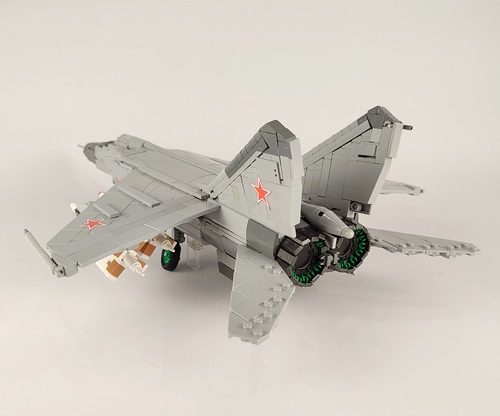
Foxbat

It’s 1970, and the Cold War is approaching its coldest. The U.S have taken images of an unknown Soviet fighter plane, and they’re terrified.

It’s massive, with huge wings, and looks highly manoeuvrable. The aircraft is the MiG-25, a supersonic interceptor and reconnaissance plane, armed with-air-to-air missiles, powerful radar, able to climb to the edge of space, and still to this day one of the fastest aircraft ever created.

This phenomenal Model Team recreation of the fighter that defined the Cold War is the work of previous bloggee [Maks] of Flickr, who has recreated the MiG-25P ‘Foxbat’ in stunning detail. Working landing gear, four air-to-air missiles, and accurate markings all feature, and you can pretend you’re U.S intelligence worriedly studying grainy images c1970 via the link in the text above.

Behind Enemy Lines

After decades of peace, Europe is once more at war, thanks to an under-endowed dictator intent on re-colonisation. However the last time war raged along Russia’s borders, it was defending against, rather than fighting for, a maniacal despot.

This wonderful diorama depicts a small part of that fight, when in 1942 German ace Wolf-Dietrich Wilcke was shot down by a Soviet Air Forces Hawker Hurricane, crash landing on an icy lake. 

His Messerschmitt Bf 109 slipped through the ice to the bottom of the water, but Wolf-Dietrich survived to continue his service in the Luftwaffe, before finally being killed in action in March of 1944, with a scarcely believable 162 victories to his name.

Constructed by Jonah Padberg, this beautiful creation captures the moment of Wolf-Dietrich’s crash, and you can visit the frozen lake on which he landed, before it claimed his Messerschmitt Bf 109 but not his life, via the link above.

Flight 714 to Sydney

The news that Putin’s… er, “chef” has been killed in a private plane “accident” is the top story of the moment, but private air travel seems fraught with peril even if you haven’t pissed off an under-endowed dictator, with a long list of celebrities lost to private air disasters over the years.

Of course it tends to be the rich and famous using private jets, a theme that French comic ‘The Adventures of Tintin’ explored way back in 1968 with ‘Flight 714 to Sydney’. Owned by a ‘millionaire who never laughs’, the fictional Carreidas 160 jet was hi-jacked by Tintin’s arch-nemesis Roberto Rastapopoulos in an effort to steal millions from the aircraft owner’s Swiss bank account. Also there was a volcanic eruption, telepathy, and aliens for some reason. 

Anyway, the plane ended up in the ocean, adding further weight to the cool-but-perilous argument, and Tintin flew commercial thereafter.

This lovely recreation of the aforementioned fictional jet – and the characters from the comic – comes from Stefan Johansson, who’s used some lovely techniques to capture the swoopy shape. An opening cabin door and detailed landing gear also feature, and there’s more to see at Stefan’s ‘Carreidas 160 – Flight 714 to Sydney’ album via the link above. It’s just probably best you don’t get on board…

LEGO Icons 10318 Concorde | Set Preview

LEGO’s latest Icons set is arriving with a boom. This is the brand new Icons 10318 Airbus Concorde.

Developed in the 1960s by France and Great Britain, the Aérospatiale/BAC Concorde was the world’s first supersonic airliner. Flying at twice the speed of sound, Concorde halved traditional jet airliner travel times, and could fly higher and faster than even fighter jets of the time.

Unfortunately this incredible speed meant immense noise, and not just the sonic boom but during take-off too, limiting supersonic flight to the skies over open water and causing almost every potential airport destination to block Concorde flights in the face of local opposition.

It also meant huge costs, more than double those of a conventional jet airliner, with Concorde (operated in effect by the British and French governments) losing money every single year.

The British Concordes were eventually sold for ‘next to nothing’ to the newly privatised British Airways, and yet – despite all the problems and the financial disaster of the project – Concorde was the way for wealthy passengers to fly transatlantic until its retirement in 2003.

Paying homage to probably the most iconic aircraft ever built, the new 10318 Concorde set recreates the supersonic airliner from 2,083 pieces, and includes a miniaturised interior, working retracting landing gear, and the aircraft’s famous ‘drooping nose’ that allowed the pilots to see the ground when taxiing.

Measuring over a metre long and aimed at ages 18+, 10318 is expected to cost $199.99 / £169.99 / €199.99 when it reaches stores next month, and you can book your supersonic flight from September 7th.

Flight of the Bumblebee

This marvellous contraption is a ‘Brickston Police Doubledecker Bumblebee’, and it might be the most delightfully absurd aircraft that this site has ever featured.

From the mind (and hands) of Markus Ronge, the Bumblebee forms part of an expansive brick-built story that continues from the ‘Full Steam‘ series that featured here extensively back in 2018-’19.

We’ll be following Markus’ ‘Netbrix Original Series’ as it unfolds this year, until then you can join the Brickston Police’s airborne squad via the link above. It’s Full Steam ahead!

Fly-Bi

This fictional First World War era biplane was discovered by one of our Elves on Flickr, and you can practically hear the rush of the propellor. Kirill Simerzin is the builder and you can take the skies a century ago via the link to his photostream above.

Reheated Russian

Poland and Russia are not exactly best mates right now (but then Russia only has three friends left and they’re all maniacal dictatorships).

However back in the 1960s Poland and Russia were rather closer, as – whilst Poland was never formally part of the Soviet Union – the influence of Russia’s Red Army taking control of Polish territory from Germany in the aftermath of the Second World War turned Poland into a communist satellite state.

It also led to the supply of (usually obsolete) Russian military hardware, including this; the MiG-17. Replaced by more modern supersonic aircraft in the Soviet Union, the MiG-17 was then produced under license in Poland, becoming the Lim-5 and Lim-6, and used all the way up to the 1990s.

This neat Lego replica of the rather funky-looking Cold War fighter is the work of [Maks], who – with the help of some strategic stickers – has created the Lim-6 ground-attack aircraft brilliantly.

There’s more to see at [Maks]’s ‘Lim-6bis’ album on Flickr, and you can fly back to 1960s Poland via the link in the text above.