Tag Archives: Aircraft

What’s in a Roundel?

This TLCB writer has learned something today; the Royal Australian Navy uses little red kangaroos in place of the red dot more usually found in the centre of the RAF roundel! Kangaroos!

Entering the rabbit hole he has now learned that South Africa’s insignia features an eagle, Trinidad and Tobago a hummingbird, Papua New Guinea the mythical phoenix, and Luxembourg an extravagant lion.

If we ever start a military campaign against The Brothers Brick perhaps we should outline an Elf for the centre of ours?

Following that somewhat tangental start to this post, the aircraft depicted here that features the kangaroo-in-a-circle markings is a Hawker Sea Fury, in this case flown by the Royal Australian Navy.

Based on the Hawker Tempest, the Sea Fury entered service at the end of the second world war and flew until the early ’60s, operating first a pure fighter and then as a fighter-bomber as its suitability for multi-role use became apparent.

This particular Sea Fury is a F.B.11 that operated with Squadron 724 from the H.M.A.S. Albatross, most notably serving in the Korean War, and it’s been recreated beautifully by John C. Lamarck, complete with folding wing-tips, retractable landing gear, an opening cockpit, and – of course – accurate Royal Australian Navy markings including kangaroo roundels.

There’s much more to see of John’s superb Hawker Sea Fury F.B.11 on Flickr – hop on over via the link above!

Catalina

This beautiful aircraft is a PBY-6A Catalina, as built by Henrik Jensen of Flickr. Introduced in 1936 over 3,300 Catalina were constructed, making it one of the most widely used flying boats during the second world war. The Catalina saw service in maritime patrol, night bombing, anti-submarine warfare, and search and rescue, with some still in use today as fire fighting water bombers.

The PBY-6A Catalina depicted here was operated by the Royal Dutch Air force, and has been recreated wonderfully by Henrik using a myriad of clever building techniques, with a few stickers enhancing the realism too. There’s more to see of Henrik’s Catalina at his photostream – click the link above to head there and take a look.

I Can’t Hear You, There’s a Helicopter

President Trump is going to have to return to his own helicopter from February. Whilst we’re sure this will still offer plenty of toupee-glue testing moments, incoming President Joe Biden’s numerous cosmic alterations seem not to include a wig, more’s the pity.

Anyhoo, whichever cosmetically enhanced face is in the White House, it will be flown about in this, the specially adapted Sikorsky SH-3 Sea King ‘Marine One’.

Often a feature on the White House lawn, doing its best to drown out whatever spur-of-the-moment nonsense is being spouted to the press, Marine One has been a Presidential fixture for decades, with almost twenty (Marine One and Twos) in operation the current Presidential fleet.

This superb mini-figure replica of the world’s most famous helicopter comes from BigPlanes of Flickr, who has recreated the real VH-3D Marine One beautifully, including custom decals and a fully-fitted interior, although there’s no angry orange mini-figure shouting from underneath it, which is surely a missed opportunity.

No matter, there’s more to see of BigPlanes’ creation at his ‘LEGO VH-3D Marine One’ album on Flickr, plus you can find his amazing previously blogged recreation of Air Force One by clicking here.

Swiss Stork

This is a Fieseler Fi-156 Storch, a short take-off and landing aircraft designed in Germany in the late 1930s. Oddly, despite Germany being a bit of a bad neighbour at the time, it was also built in the Soviet Union (before the German invasion) and France (during and after the German invasion).

One country not invaded was neutral Switzerland, which is where this Fi-156 Storch (or Stork in English) hails from, being used in the Alps for search and rescue.

Built by Flickr’s daviddstone, this brick-built recreation of the Swiss Stork captures the design brilliantly, including wing and landing-gear struts, skis for snow landings, and a lovely Swiss Cross tail-fin.

There’s more to see of daviddstone’s creation at his photostream – click the link above to fly over the Alps in the 1940s.

Phantom Rising

This glorious McDonnell Douglas F-4N Phantom II was found by one of our Elves on Flickr today, and it proves – at least in USS Coral Sea livery – that more was more for the U.S Navy when it came to applying stickers.

Of course ask any 7 year old (or TLCB Elf) if stickers make something faster and you’ll get an answer along the lines of ‘Duh… Yeah.’ or whatever it is 7 years olds say these days.

The Phantom II confirms this entirely scientific fact as it was phenomenally fast, setting multiple world records during the ’60s and ’70s. Of course this speed was in no doubt helped by the addition of a shark’s mouth, US Navy motifs, red racing stripes, and rising sun/rainbow/gay pride arrangement on the tail.

Flickr’s Jonah Padberg (aka Plane Bricks) has captured all of that stickerage brilliantly, applying them to his beautifully constructed F-4N Phantom II model that comes complete with opening cockpits, under-wing armaments, and folding landing gear.

There’s much more of Jonah’s impressive Phantom II to see at his photostream; click the link above to take a closer look, whilst we see if applying some stickers to the office Rover 200 can work the same magic…

Meet the Fokker

Are three things better than two? Engines? Yes. Beer. Yes. Stool legs? Yes. Wings? Er… no, probably not. However, whilst the triplane idea was abandoned by 1920, it was a widespread aeronautical design before then, being used by pretty much every plane-building nation of the time.

Most notably triplanes were the mainstay of the German Air Force in the First World War, with aircraft such us this extravagantly painted Fokker Dr.1. used extensively (and successfully) throughout the conflict.

This superb small-scale recreation of the Fokker Dr.1 – made famous by the ‘Red Baron’ Manfred von Richthofen – comes form Flickr’s Henrik Jensen, and there’s more to see at Henrik’s ‘Fokker Dr.1’ album via the link above.

SXSW

Three engines are better than two. They might even be better than four, just because of how cool they look. This is the Boeing 727-200, the brand’s 1960s narrow-body airliner and its only tri-jet. Over 1,800 727s were built between 1962 and 1984, with a handful still in use today by some airlines it’s probably best to avoid.

This marvellous Lego recreation of the 727-200 comes from a time when they were in regular service with mainstream airlines however, being recreated beautifully in Southwest’s 1980s livery.

Previous bloggee Big Planes is the builder, and like his past work there is a complete mini-figure interior, retractable landing gear, and functioning flaps too, with much more to see at his photostream. Head south by Southwest via the link above.

Simply Flying

This odd contraption is a gyrocopter, a sort-of-helicopter with an un-powered lift rotor, which instead spins in the wind as the rear propellor drives the vehicle forward. It looks terrifically dangerous as only the maddest (and usually cheapest) form of transport can, with paave‘s minimalistic looking Technic version being pretty much as robust and complex as the real thing.

Paave’s version includes complete flight controls with the main rotor pitch and yaw controlled via the joystick, the rudder via pedals, and a working two-cylinder piston engine linked to the propellor.

Head to Eurobricks to see more, and you can see the controls in action via the video below.

YouTube Video

Fly Like an Eagle*

This blueish greyish entity is a McDonnel Douglas F-15C Eagle, constructed rather neatly by Dornbi. Detailed landing gear, an array of exploding thingies under the wings, and custom decals are all included, and there’s more to see on Flickr via the link.

*Today’s title song.

Flight of Fancy

This is not a car, and nor is it a real aircraft, instead coming from the video game ‘Ace Combat’. It’s also a bit nonsensical, being Japanese but named after a Welsh dragon, however… it looks so cool!

Built by Corvin Stichert of Flickr, this beautifully detailed mini-figure version of the fictional ‘X-02 Wyvern’ fighter captures the variable geometry design brilliantly, and there’s more to see at Corvin’s ‘X-02 Wyvern’ album. Click here to fly over to the complete gallery.

Air Pirate

Is there anything cooler than a fighter jet with a skull and crossbones painted on it? The answer is no, and thus here’s Lennart Cort‘s Grumman F-14 Tomcat resplendent in VF-84 ‘Jolly Rogers’ livery. See more at the link!

Return of the Mav


This is an F/A-18 Super Hornet, and it is definitely not a car. But it is awesome, and it comes from Lennart Cort, who has recreated Maverick’s training aircraft from the upcoming Top Gun 2 movie in beautifully smooth fashion. There’s more of Lennart’s F/A-18 to see on Flickr – head into the skies over the Navada desert via the link above.

Black Ace

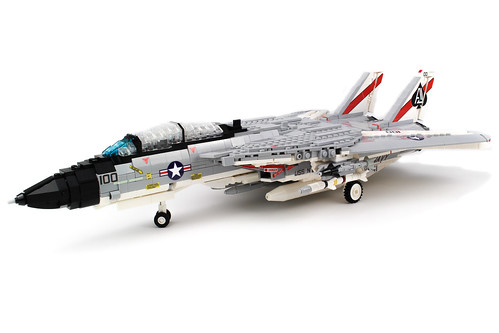
This is the Grumman F-14A Tomcat, as flown by the U.S Navy’s Strike Fighter Squadron 41, the ‘Black Aces’ until he mid-’00s before being superseded by the F-18 Super Hornet.

First flying the in the early ’70s, the F-14 is a twin engine variable-sweep wing fighter that saw deployment in Kosovo, Bosnia, Afghanistan and Iraq, and is – somewhat oddly – still in service with the Iranian Air Force today, despite the U.S destroying its retired aircraft to prevent spare parts ending up in Iran.

This spectacular replica of the F-14A resplendent in ‘Black Aces’ markings is the work of Jonah Padberg (aka Plane Bricks) of Flickr, who has recreated the supersonic fighter in breathtaking detail.

Featuring working flaps, ailerons, elevators, rudders and air brake, plus an opening canopy, functions landing gear, and an array of explody things slung underneath, Jonah’s F-14A is so realistic we wouldn’t be supposed if Iran try to buy it for spare parts. Which they can do, as Jonah is making his model available for purchase in kit form!

There’s more of Jonah’s incredible Grumman F-14A to see on Flickr, including detailed photos of the underside and all the explody things too. Click the link in the text above to visit Jonah’s photostream, where a few Iranian aviation maintenance people may also be snooping about…

Silver Bird

American Airlines have a great paint scheme. Both retro and futuristic, their shiny silver overlaid by a tri-colour stripe is surely one of the best liveries in the industry. This particular TLCB Writer was most excited to get on an AA aircraft for the first time, newly painted in the shiniest of silvers, before realising the interior was last refreshed in the American Civil War. It was a l.o.n.g flight…

Perhaps that’s a metaphor for much of American produce; shiny on the outside, shit underneath. Anyhoo, equally shiny, yet wonderful underneath too, is this spectacular Boeing 757-200 airliner from Flickr’s BigPlanes, complete with the iconic American Airlines livery and a fully-fitted mini-figure interior.

BigPlanes’ 757 also features beautifully working landing gear, moving flaps, and lighting, which – admittedly – worked fine on this writer’s real-world American Airlines flight, but the interior wasn’t a patch on this! There’s much more to see of BigPlanes incredible creation at his ‘American Airlines Boeing 757-200‘ album; click the link to head to the departure gate, before wishing you’d flown Virgin Atlantic instead.

Flying Wing

This is the Northrop XB-35, one of America’s amazing ‘flying wing’ experimental aircraft that would, eventually, lead to the modern B-2 Spirit ‘Stealth Bomber’.

But 1946 was a long time before the B-2, and the ‘flying wing’ idea was still in its infancy. The much smaller N-9M proved the concept enough (despite crashing quite a lot) for Northrop to build a version three times larger, the XB-35, initially powering it with four huge contra-rotating ‘pusher’ propellors driven by Wasp R-4360 radial engines.

The vibrations were awful though, so as the design entered the jet age it was upgraded with eight turbojets, becoming the YB-49 – although the aircraft was still far slower than conventionally winged bombers like the B-47.

It’s the original mid-’40s propellor-powered XB-35 we have here though, created in astonishing detail in 1:40 (mini-figure!) scale by Flickr’s BigPlanes. The detail is beautiful on the inside too, with a complete four-seat cockpit and accurate landing gear underneath.

BigPlanes’ incredible creation is due to go on show at the 2021 Virginia Brickfair event (COVID-19 depending), but you can see it via the spectacular imagery at his ‘XB-35 Flying Wing’ album on Flickr.

Click the link above to take to the skies c1946, and watch the horizon go all blurry and your tea jump out of your mug as four enormous contra-rotating props start shaking the world’s weirdest wing to bits.