Tag Archives: navy

Decking Vietnam


This is a Vought F-8E Crusader II, one of the first supersonic carrier-based fighters, and it flew from the decks of U.S aircraft carriers from the late-‘50s right up until the mid-‘70s. Which of course meant it served in the Vietnam War, where it earned the nickname ‘MiG Killer’ because it, well… killed MiGs, with an astonishing 19:3 kill ratio.

This exceptional brick-built replica of the F-8E is the work of Flickr’s Juliusz D., and includes working landing gear, the Crusader’s trick variable incidence and folding wings, an opening cockpit, a deployable air-brake, functioning flaps, a full compliment of missiles and bombs, and phenomenally accurate period-correct markings.

It’s one of the finest Lego fighters we’ve ever featured, and you can take flight from a carrier deck somewhere in the South China Sea in 1967 via the link above.

Seahawk

We’re back, although not with a car… This is a U.S. Navy Sikorsky MH-60S Seahawk, a multirole helicopter in service since the mid-’80s. Based on the U.S Army UH-60 Black Hawk, the Seahawk features folding rotor blades and tail, allowing it to store more easily on the ships from which it operates, and serves in Search and Rescue, Medevac, Anti-Submarine Warfare, Special Naval Warfare, and various other types of Naval airborne operations.

This splendid replica of the MH-60S Seahawk comes from Ralph Savelsberg, who has recreated the U.S Navy helicopter with fantastic attention to detail detail. Enhanced by accurate markings and photographed beautifully, there’s lots more of Ralph’s creation to see at his ‘Lego MH-60S Seahawk’ album on Flickr. Click the link above to land on a U.S. Navy amphibious assault ship and take a look.

Golden Warrior

The ‘Golden Warriors’ might sound like a Japanese kid’s cartoon or an army in ‘Game of Thrones’, but they are in fact a U.S Navy strike fighter squadron based out of Virginia.

Flying the F/A-18A since 1986, the VFA-87 ‘Golden Warriors’ were deployed in Operation Desert Storm, Bosnia, and the second Iraq War, before switching to the upgraded F/A-18E Super Hornet in 2015, in which they shot down the first manned aircraft since 1999 (a Syrian Su-22), in the skies over Syria.

It’s the upgraded F/A-18E Super Hornet we have here, courtesy of TLCB Master MOCer Ralph Savelsberg (aka Mad Physicist), whose phenomenal recreation of the U.S Navy fighter is pictured on a slice of the carrier deck from which the aircraft operates.

Folding wing-tips, detailed armaments, and retractable landing gear all feature, and you can find all of the superb imagery at Ralph’s ‘F/A-18E Super Hornet’ album.

Flight of the Phantom

It’s Halloween, the season of pumpkins, candy, spooky household ornaments, girls wearing literally nothing, and tenuous TLCB links.

TLCB Towers doesn’t feature any of the first things, so we’ll try to make up for it with the last one on the list, beginning with this; the McDonnell Douglas F-4J Phantom II.

Constructed by Flickr’s Juliusz D., this incredible recreation of the U.S military’s 1960s long-range supersonic fighter-bomber captures the aircraft in Vietnam War livery, as flown from the USS Constellation aircraft carrier in 1972.

With working flaps, folding wing tips, retractable landing gear, an opening cockpit, and a variety of scary weaponry, Juliusz’s Phantom is spookily accurate. Top quality decals and beautiful presentation make this a ghost that’s worth a closer look, and there’s lots more to see at Juliusz’s ‘McDonnell Douglas F-4J Phantom II’ album. Click the link to go ghost hunting.

Seasprite

This is a Kaman SH-2 Seasprite, a U.S Navy ship-based anti-submarine and search & rescue helicopter. Introduced in 1963, the Seasprite saw service in the Vietnam and Gulf Wars, and flew until 1993 with the U.S Navy, as well as being operated in small numbers by a several other nations.

This excellent (and rather wonderfully liveried) SH-2 Seasprite is the work of Robson M (aka BrickDesigners), who has captured both it and the rather exciting looking weaponry slung underneath beautifully.

Top quality building techniques and presentation abound, and there’s more to see of the SH-2, including its folding landing gear, opening doors, and cartoonesque missiles, at Robson’s photostream. Click the link above to get airborne.

Tomcat

Not a car, but rather brilliant nonetheless, this glorious Grumman F-14A Tomcat was found by one of our Elves on Flickr. It comes from previous bloggee [Maks], and – unusually for a brick-built fighter jet – it’s mini-figure scale. Tremendous detail abounds though, which [Maks] has enhanced via some excellent custom decals, and there’s much more of the build to see at his ‘F14A Tomcat’ album via the link.

Sea Stallion

Military things, like cars, are often named after exciting or deadly animals. Unless they’re from the Soviet Union of course, in which case an array of numbers and letters was sufficient.

Cue the Sikorsky RH-53D ‘Sea Stallion’, so called because ‘Sea Horse’ was already taken by another Sikorsky aircraft, but mostly because ‘Stallion’ sounds far more masculine.

The RH-35D was operated by the U.S Navy Marines from 1975 until 1997, primarily for mine clearing and heavy lifting, and it’s been recreated in incredible detail in Lego form by previous bloggee [Maks].

At 1:40 scale, [Maks]’s Sea Stallion measures 80cm across, and took almost a year to complete, with his spectacular attention to detail further enhanced by some beautifully authentic decals.

There’s a whole lot more of the Sikorsky RH-35D to see at [Maks]’s ‘RH-53D Sea Stallion’ Flickr album, including imagery showing those enormous rotor blades cleverly folded, and you can take a look via the link above. Just don’t call it a horse.

Ghost Pirate

Disney’s ‘Pirate’s of the Caribbean’ managed to successfully* combine both pirates and ghosts, which – to any 8 year old or TLCB Elf – made it the coolest thing ever.

Their piratical spectres were beaten by a few decades however, by the U.S. Navy, whose ‘VF-84 Jolly Rogers’ squadron operated Phantom II jets from the USS Roosevelt in the 1960s.

Featuring a variety of pointy weapons, superb building techniques, and a ‘skull and crossbones’ tail-fin motif (which – to any TLCB writer – makes it the coolest thing ever), previous bloggee [Maks] has captured America’s ’60s fighter in stunning detail, and there’s more to see of his airborne ghost pirate via the link above.

*Ok, maybe not by the third one. Which was (and still is) one of the worst sequels of all time.

Horse Truck

Surprisingly we don’t think we’ve ever blogged a horse truck here at TLCB (and we’re reluctant to go into the Archives to check properly as there are rumours of a feral band of TLCB Elves inhabiting them).

Today doesn’t change that though, despite the title, as this lovely Dodge M-37 truck is not a horse truck per say, rather it’s here as ground support for [Maks] previously blogged UH-34D Seahorse U.S Navy helicopter.

That means no attractive horsey girls called Arabella, but still an ace scene that would have been commonplace in the 1960s U.S Navy. There’s more to see of [Maks] Dodge M-37 truck and superb Sikorsky Seahorse on Flickr – click the link above to take a look.

What’s in a Roundel?

This TLCB writer has learned something today; the Royal Australian Navy uses little red kangaroos in place of the red dot more usually found in the centre of the RAF roundel! Kangaroos!

Entering the rabbit hole he has now learned that South Africa’s insignia features an eagle, Trinidad and Tobago a hummingbird, Papua New Guinea the mythical phoenix, and Luxembourg an extravagant lion.

If we ever start a military campaign against The Brothers Brick perhaps we should outline an Elf for the centre of ours?

Following that somewhat tangental start to this post, the aircraft depicted here that features the kangaroo-in-a-circle markings is a Hawker Sea Fury, in this case flown by the Royal Australian Navy.

Based on the Hawker Tempest, the Sea Fury entered service at the end of the second world war and flew until the early ’60s, operating first a pure fighter and then as a fighter-bomber as its suitability for multi-role use became apparent.

This particular Sea Fury is a F.B.11 that operated with Squadron 724 from the H.M.A.S. Albatross, most notably serving in the Korean War, and it’s been recreated beautifully by John C. Lamarck, complete with folding wing-tips, retractable landing gear, an opening cockpit, and – of course – accurate Royal Australian Navy markings including kangaroo roundels.

There’s much more to see of John’s superb Hawker Sea Fury F.B.11 on Flickr – hop on over via the link above!

Black Ace

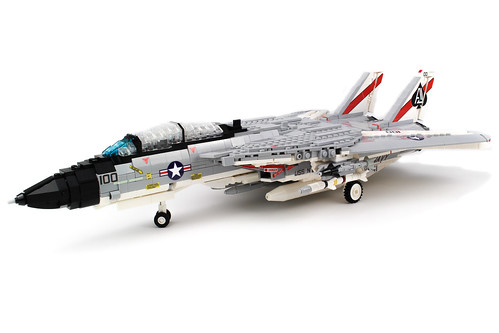
This is the Grumman F-14A Tomcat, as flown by the U.S Navy’s Strike Fighter Squadron 41, the ‘Black Aces’ until he mid-’00s before being superseded by the F-18 Super Hornet.

First flying the in the early ’70s, the F-14 is a twin engine variable-sweep wing fighter that saw deployment in Kosovo, Bosnia, Afghanistan and Iraq, and is – somewhat oddly – still in service with the Iranian Air Force today, despite the U.S destroying its retired aircraft to prevent spare parts ending up in Iran.

This spectacular replica of the F-14A resplendent in ‘Black Aces’ markings is the work of Jonah Padberg (aka Plane Bricks) of Flickr, who has recreated the supersonic fighter in breathtaking detail.

Featuring working flaps, ailerons, elevators, rudders and air brake, plus an opening canopy, functions landing gear, and an array of explody things slung underneath, Jonah’s F-14A is so realistic we wouldn’t be supposed if Iran try to buy it for spare parts. Which they can do, as Jonah is making his model available for purchase in kit form!

There’s more of Jonah’s incredible Grumman F-14A to see on Flickr, including detailed photos of the underside and all the explody things too. Click the link in the text above to visit Jonah’s photostream, where a few Iranian aviation maintenance people may also be snooping about…

Hippocampus Helicopter

The seahorse is a funny little animal. Delicate looking but with bony armour, they swim upright, have no scales, and the female gives birth to eggs which the male then carries before giving birth live young. That’s shared parenthood right there. It’s also not like a horse in any way, but most things in the sea seem to be named after things on land that they aren’t really like.

Cue the Sikorsky UH-34D Seahorse, which isn’t really like either the sea or land based versions of it’s namesake either. But it is quite a cool device, being one of the last piston-engined helicopters in use in the U.S Navy, operating from the mid-’50s to the 1970s. This one, built by [Maks] of Flickr, is in a rather fetching (and highly visible) orange due to its use in the arctic, and has been quite wonderfully recreated.

Finding the orange parts needed to construct this model must have been tricky as it’s a rather rare colour, and you can see the excellent fruits of [Maks]’s efforts at his photostream. Swim over to Flickr in an upright fashion via the link above.

More Corsair

This isn’t Henrik Jensen’s first Vought F4E Corsair. In fact he built one way back in 2014, which didn’t feature here as it didn’t quite meet our standards. Or we weren’t paying attention. One of those two anyway. Henrik’s second iteration updates his previous design with LEGO’s latest dark blue parts and folding wingtips, and adds a gloriously cool brick-built checkerboard engine cowling that frankly every plane should have. Custom decals complete the aesthetic accuracy and there’s more of Henrik’s superbly realistic F4E Corsair to see at his Flickr album by clicking these words.

Super Hornet

The Lego Car Blog Team do not like hornets. They’re like wasps, only they’re even bigger bastards. This though, we do like. It’s an F/A-18E ‘Super Hornet’ carrier-based fighter, and it’s been brilliantly built in brick from by previous bloggee Plane Bricks. There’s an opening cockpit, folding wing-tips, fully working landing gear, and an array of angry-looking weaponry, and there’s a whole lot more to see on Flickr. Click the link above to make the jump.

Black Panther

Lego A-6E Intruder VA-35 Black Panthers

Jungle cat, 1960’s political movement, comic-book hero (and slightly overrated movie), and U.S Navy attack squadron, the name ‘Black Panther’ has seen varied use over the years. It’s the latter usage we’re focussing on here, and the squadron that adopted the name from the 1930s until its disbandment in 1995.

The Black Panthers were a carrier-based air squadron that flew combat missions in the Second World War, Korean War, Vietnam War and the First Iraq War, with all of those bar the first using this aircraft, the Grumman A-6 Intruder. This spectacular recreation of the A-6 comes from Master MOCer and TLCB regular Ralph Savelsberg (aka Mad Physicist), who has constructed the Intruder in A6-E Black Panthers specification in glorious detail.

With folding wings, a sliding canopy, custom decals and a full armament there’s a whole lot more to see. Take a look at Ralph’s A6-E Intruder Flickr album by clicking here, where over twenty high quality image are available.