Tag Archives: steam

The Hornsby Steam Crawler…

…sounds like an English pub. Or a magical artefact at Hogwarts. Or a Victorian murderer. Or an unspeakable sex act. But is in fact this bizarre contraption from the 1909; a British steam-powered chain-track tractor that worked in the wilds of Canada where gas was scarce but coal was abundant, and the father of all Caterpillars.

Constructed by previous bloggee Nikolaus Lowe (aka Mr_Kleinstein), this marvellous brick-built remotely controlled recreation of the Hornsby Steam Crawler ingeniously replicates its two-speed gearbox and differential subtractor steering (which you can see in action here), with more to see at Nikolaus’ ‘Hornsby Steam Crawler’ album on Flickr. Click these words to murder someone with a magical artefact in an English pub, all whilst…

Fare Dodging

Fare dodging is the preserve of the terminally shifty. But not today, because Flickr’s mahjqa (a TLCB Master MOCer no less) is the creator of this excellent steam locomotive, and has released building instructions for free! A motor and battery box are hidden inside to bring this locomotive to life, with more to see at mahjqa’s photostream and via the video below. Plus you can dodge the fare to recreate it for yourself by clicking here.

YouTube Video

Steamy Show

Here at The Lego Car Blog we don’t get out much. Partly this is because we work secretively in the shadows, but mostly it’s because TLCB Elves are banned from many public spaces.

However if you lead more exciting lives than we do, you can get out to the subject of today’s post, the huge LegoWorld 2024 show in Utrecht in the Netherlands.

Over two decades old, LegoWorld is the largest LEGO show on earth, and this year Flickr’s Tamás de Groot is making his exhibitor debut, leading the collaboration behind this epic (and enormous) railway layout.

Beautifully landscaped with trees, embankments, fields and bridges, there are multiple lines, locomotives, and a range of rolling stock travelling though the display, and you can see the whole thing (plus much more besides) at the LegoWorld 2024 show for the remainder of this month.

If like us you’re unable to make it to LegoWorld 2024 in person, head to Tamás de Groot’s Flickr album of the same name to see his fantastic display, or click here to take a look at a round-up from 2023.

Steamy Erection

A long time ago it wasn’t diesel, electricity, or gasoline that powered humanity’s vehicles, but steam. Very heavy, with minimal range and requiring regular impractical refuelling, steam-powered vehicles were nevertheless immensely powerful – far more so than those powered by other fuels – and thus they were the engines of choice for heavy duty applications, even as all other vehicle types moved on.

This is one such steam vehicle, Nikolaus Löwe‘s fabulous Fowler traction engine, here outfitted with a working crane. Connected to the tractor-part via a wonderfully complicated-looking arrangement of ratchets and gears, Nikolaus’ creation harks back to an era of coal, soot, noise, and perhaps a little magic.

Get steamy at Nikolaus’ photostream via the link above, whilst we ponder if today’s electric fuel of choice – being very heavy, with minimal range and requiring regular impractical refuelling, but nevertheless immensely powerful – really marks a century’s worth of progress from when this was trundling down the roads.

Tiny Tracks

We’re often guilting of favouring enormous million-part creations here at TLCB. This is because we’re eight, and also because ‘subtlety’ isn’t really in the TLCB Elves’ vocabulary. To be fair to them though, very little is in their vocabulary. Anyway, today we are going small, because Thomas Gion has produced this lovely micro-scale railway vignette, complete with the tiniest trees, teeniest tracks, and littlest locomotive. All look wonderful despite their miniature size and there’s more to see (although not that much more) at Thomas’ photostream. Click the link above to go on a teeny tiny train ride.

Blue and Steamy

No, not your Mom’s old movies, but this rather lovely steam tractor by Flickr’s Nikolaus Löwe. Working ‘chain’ steering, a spinning flywheel, and other old-timey steamy things are all included, and there’s more to see at Nikolaus’ photostream. Click the link above for more steamy blue action.

Choo Choo!

If there’s a more ‘Choo Choo!’y Lego creation than this, we haven’t found it. Wonderfully built by Owen Meschter, this is a Class Y14 steam locomotive, as used by LNER at the turn of the century who classified them as J15s, and which saw service on British railways right up until 1958. But that’s enough boring train facts. You now have permission to run around your house or place of work shouting ‘Choo Choo!’. If anyone stops you tell them TLCB sent you.

A Steaming Log

It’s the late 1920s and steam powered road vehicles are pretty much over and done. There are a still a few being built though, primarily for applications where their monstrous torque was required; usually for pulling things along, pulling things over, or pulling things that powered other things.

Cue the Foden D-Type, a steam-powered logging tractor that enabled us to write a poo-based title, which is pretty much the main reason it’s appearing here. We’re not a classy blog.

The model is though, coming from previous bloggee Nikolaus Lowe, and it featuring a variety of technical functions including steering, a working ‘steam’ piston engine, and chain drive to the rear differential.

A extensive gallery of excellent imagery is available and there’s more to see of Nikolaus’s huge steamer on Flickr – click the link above to lay a log.

Dutch Rudder

Rolling coal‘ is for idiots. Aside from blasting a load of carcinogenic particulates into the air as some sort of moronic ‘anti-environment’ protest, plumes of black smoke actually signify wasted fuel, ergo less power. Which is why we don’t use steam engines any more.

That said, we do still like a good steam engine (which is possibly the saddest sentence in the English language), and so too does TLCB debutant Jebbo, who has built three unfathomably beautiful Dutch steam tugs from our favourite plastic bricks.

Each model is an exquisitely detailed replica of a real steam tug boat, of which two are apparently still running on coal.

Amazing attention to detail and ingenious building techniques are in abundance and there’s more to see of Jebbo’s ‘Furie’, ‘Hercules’, and ‘Noordzee’ steam tug boats at the Eurobricks discussion forum. Click the link above to roll coal the right way.

Steam Rollin’ Rollin’ Rollin’*

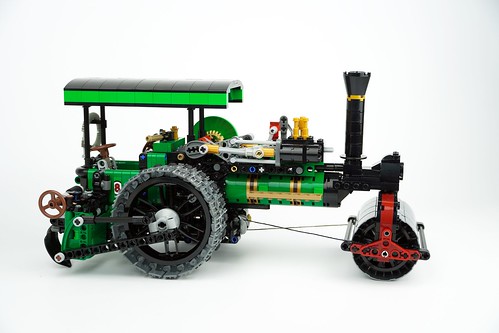
It’s been over a hundred years since steam rollers were built, and yet in TLCB’s home nation we still call road rollers ‘steam rollers’ over a century later. No we don’t know why either. Anyway, this one is a steam roller, being effectively a giant kettle with a big metal drum attached to the front, powered by burning lumps of fossilised wood.

It comes from previous bloggee Nikolaus Lowe, who has done a tremendous job building this beautiful and fully functional Model Team/Technic c1910 steam roller, complete with working rope steering, rear ripper, drivetrain pistons and valve gear, and even the weird centrifugal spinning thingy that steam-powered vehicles always seem to have, the purpose of which remains a mystery.

A wealth of superb imagery is available to view at Nikolaus’ ‘Steam Roller’ album on Flickr, where you can also find details on how to vote for this model to become an official LEGO set. Click the link above to go rollin’.

*Today’s loosely related title song!

Best in Show

After the violent events that occurred here in TLCB Office yesterday we’ve been nervously awaiting the next remotely controlled Lego creation that the Elves would find. Fortunately for all concerned (except the Elf that found it), this Daniel Best steam traction engine by Flickr’s Nikolaus Löwe managed to do no damage whatsoever.

Despite its BuWizz battery, Nikolaus’s creation is heroically slow, and therefore accurately represents the real contraption from the early 1900s which had a top speed of… 4mph.

However such glacial velocity allowed us to view the magnificently recreated pistons and rods that Nikolaus has faithfully recreated, which all do their things thanks to well concealed Power Functions motors. The Elf at the controls was less impressed, and after watching its find trundle across the floor squashing precisely no-one, ran off in disgust.

It’ll be back for its meal token reward soon enough, but if you like this build as much as we do there’s more to see on Flickr. Click the link above to head very slowly across America in 1905.

Mr. Kleinstein’s Steam Powered Amusements

Today at TLCB we’re trumpeting this glorious traction engine and trailer built by previous bloggee Nikolaus Löwe (aka Mr_Klienstien), who has opened up his own steam-powered amusement arcade!

Frogger, Time Crisis, and Sega Rally probably aren’t included, (and we’re not really sure what a steam powered amusement might consist of. Well, we had some ideas but they’re definitely not right), but you can see more of the beautiful traction engine that would power them along with the trailered living accommodation that accompanies it at Nikolaus’s ‘Showman’s Engine ‘ album on Flickr.

Click the link above to let one rip!

Steam Powered Velocipede

The current craze for e-bikes shows that mankind’s propensity to make literally everything lazier continues unabated. However we’re not new in our quest to eradicate all forms of exercise, as back in the late 1800s our forebears had the same idea, first creating the ‘steam powered velocipede‘ which we want based upon its name alone, and later strapping a steam engine to a penny farthing, to eliminate all that inconvenient pedalling. Remarkably they worked too.

Cue TLCB Master MOCer and all-round Technic-building genius Nico71, who has created his own ‘steam’ powered bicycle (or velocipede as we shall now call it), equipped with a single cylinder Lego Pneumatic Engine, that – when fed with ‘steam’ (compressed air) – powers the velocipede through a two speed gearbox.

Every element of Nico’s machine is LEGO, including an ingenious design that genuinely ‘throttles’ the amount of air entering the engine controlled via a handlebar-mounted lever, a flywheel for maintaining the engine’s smoothness, and a working rear brake.

It’s all preposterously clever and best of all Nico has made instructions available so that you can build you very own Steam Powered Velocipede at home, which we genuinely might do! Head to Brickshelf to see all the imagery, Nico’s excellent website for full details and building instructions, and you can watch this remarkable contraption in action via the video below.

YouTube Video


The Greatest Showman

Lego Traction Engine

Before the internal combustion engine took over as the dominant technology, early vehicles were powered by all sorts of stuff. Electric – weirdly – was widely used (so things are coming full circle and perhaps Tesla aren’t that revolutionary after all), as was steam, which featured in everything from small(ish) runabouts to enormous tractors, or ‘traction engines’.

Unlike electric, steam vehicles probably aren’t going to make a comeback, but we do still like to see a nice traction engine. Yeah, we’re a bit sad. So does Flickr’s Nikolaus Lowe though, and as such he’s built this splendid mini-figure scale ‘Showman’s Engine’, completely with a wonderfully be-hatted showman at the controls. Head to Nikolaus’s photostream via the link above for more details.

Esmeralda

Lego Steam Corvette

Nope, not that Spanish exchange girl from your youth that you always wish you’d kept in touch with, but this rather neat steam corvette sailing under Chilean colours.

Built for the Chilean Navy by a British shipyard in the 1850s this Esmeralda is one of several Chilean warships to carry the name, and was sunk in the Battle of Iquique in Chile’s defeat to Peru and Bolivia in 1879. We know so little about about South American conflicts that our narrative ends there, but the model of the lost ship itself is nevertheless beautiful. Flickr’s Luis Peña is the builder behind it and there’s more to see of his gorgeous recreation of the Esmeralda via the link above.