Tag Archives: Miniland

A Virtual Triumph

The Triumph 2000-series was, like so many British cars of the time, fantastic. Beautifully styled by Michelotti, powered by a range of smooth 6-cylinder engines, and with over 400,000 built in five countries, it was one of the finest mid-sized saloons of its era.

Which of course meant that British Leyland would go on screw it – and all of Triumph – up, as exemplified by the fact that its predecessor was a Standard and its successor a Rover. And if that makes no sense… you’re right, it doesn’t.

But let’s not get bogged down in the collapse of the British automotive industry, because back in the late-’60s and early-’70s it was still riding high, with the Triumph 2000-series a big part of that success.

This one is a 2500S estate, as superbly recreated in digital form by Lego Professional Peter Blackert (aka lego911). Alongside the excellent exterior the doors, tailgate and hood all open and there’s a detailed engine and interior too, with more to see of Peter’s virtual Triumph at his photostream. Take a look via the link whilst we fantasise about buying the real thing…

What’s Going on at Jaguar?

If you’re even slightly into cars, you can’t help but have noticed Jaguar’s divisive rebrand that dropped this week.

Shot in some kind of soft-play-on-Mars, Jaguar’s thirty-second Statement of Intent features exactly zero cars, but does feature a variety of extravagantly dressed androgynous beings representing ‘exuberance’, ‘vividness’, ‘mould-breaking’, and gender fluidity. And that’s got people mad.

Which is perhaps unsurprising, as Jaguar’s executives have thrown the brand’s seventy year history in the bin (including its logo and typography), and yet at the same time the ire seems rather disproportionate. Because despite being entitled ‘Copy Nothing’, the new campaign copies every minority-centred advertising checklist of the last few years. And it’s genius.

Jaguar, for all their heritage, engineering brilliance, and race winning history, have barely made money in decades. We may like Jaguar, but not enough of us are actually buying their products. Not by a long-shot. If we were, they wouldn’t have needed to conduct a shock-tactics rebrand. Nor stop selling cars altogether for a year or two before returning (as they will) with $130k-and-up EVs.

In the meantime, Jaguar have created more exposure through a single thirty-second visual abomination than they have in the last ten years. And if that annoys fans of growling big cats and V8 sports cars, well we weren’t buying enough of their cars anyway.

So before Jaguar return with something wildly different from what’s gone before, here’s what they used to build; a well proportioned if traditionally styled luxury sedan, that frankly, wasn’t quite good enough. Flickr’s Peter Blackert (aka Lego911) is the builder, and you can see more of his digital recreation of Jaguar’s mid-’90s XJ6 at his photostream.

Click the second link above to take a look, or the first if you haven’t yet seen how Jaguar’s marketing department have put a match to everything Jaguar used to be…

Yeah Baby!

Is there anything more British than a Jaguar E-Type bedecked in Union Flag? OK, maybe tea. Or politely queuing. Or pilfering far-off countries’ antiquities. Or football hooliganism. But other than those things a Jaguar E-Type bedecked in a Union Flag is bloody well right up there.

Famously driven by Austin Powers (“women want him, and men want to be him”), the “Shaguar” first appeared in the International Man of Mystery’s 1997 debut, and has been recreated superbly in brick form – including the patriotic paint job – by published Lego author Peter Blackert (aka Lego911).

Building instructions are available with more to see on Flickr. Take a look via the link above whilst we go and politely queue for a tea.

Golden Air

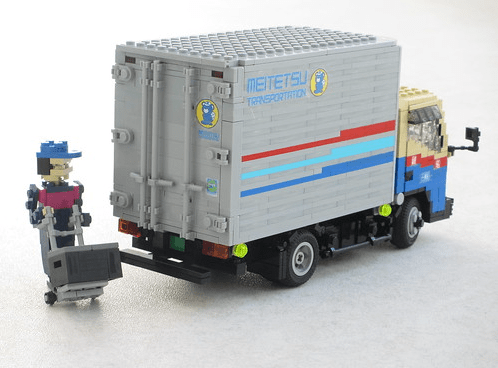
We haven’t written a post regarding golden air transport since we blogged about Donald Trump’s Air Force One showers*. Today though we’re back to golden air travel, courtesy of Ralph Savelsberg and this lovely Mitsubishi Fuso Canter box truck, wearing the livery of Japan’s ‘Meitetsu Golden Air Cargo’ company.

Ralph has captured both the truck and livery beautifully in Miniland scale, and there’s more of the Meitetsu Mitsubishi to see at his photostream. Click here for golden air delivery.

*Trump likes to be pissed on.

Cougar Town

The station wagon (or ‘estate’ to our European readers) is all but dead in the United States. The unstoppable rise of the SUV has meant literally every car now has the same shape, but back in the late 1970s enormous wagons were still part of the automotive furniture. Literally in some cases, clad as they were in ‘wood’. Or something that looked a bit like it.

This particular ‘wood’ clad wagon is a 1977 Mercury Cougar Villager, as built by TLCB regular Ralph Savelsberg in Miniland scale. The fourth generation of Ford’s mid-size sedan/wagon, the Cougar Villager was pitched in-between Ford and Lincoln, powered exclusively by V8 engines, and named after both a mountain lion and a peasant.

Such a confused brief probably accelerated the demise of such cars (and the entire Mercury brand), but nevertheless the Cougar – including its Villager offshoot – was a popular family hauler in the late ’70s. And infinitely more interesting than a modern SUV.

Jump back to when family cars could be more than a high-riding blob via the link in the text above, whilst we see if we can get hold of some ‘wood’ decals to enliven the SUVs in the office car park.

Railroad Inspection

This is a Volvo PV 831, built from the end of the 1930s, through the ’40s and ’50s, primarily as a taxi. However this PV 831 has swapped one form of public transport for another, as there won’t be any fare-paying passengers sitting in its back seat.

Instead this PV 831 has been adapted to run on the rail tracks, in order to perform its job as an inspection vehicle for Sweden’s railways. Built by Flickr’s SvenJ, a third-party motor and bluetooth receiver bring the model to life, and there’s more to see at his ‘Volvo PV 831 Railroad Inspection Car’ album. Click the link above to inspect some Swedish tracks in the 1940s.

The Big Purple One*

The recently launched Speed Champions 76094 Dodge Charger R/T set continues LEGO’s welcome foray into real-world classic cars. Taking the purple Challenger from that set and upsizing it is Flickr’s Joey Klusnick, who has replicated the iconic 1970’s muscle car in ‘Miniland’ scale, making his model perfect for the streets of a Legoland theme park. It’d sure be a quality street** with Joey’s Challenger parked on it. Click the link above to rummage through the box for a taste.***

*Non UK readers; you’ll have no idea what we’re on about.

**As above.

***That’s enough now (Ed.)

Ambition is a Dream with a V8 Engine

Blue suede shoes, white rhinestone jumpsuits, cheeseburgers, and pink Cadillacs. Just some of the things the great Elvis Presley was famous for besides his captivating musical performances.

Elvis’ first pink Cadillac was a ’54 Fleetwood that he purchased in 1955, and it lasted all of a few months before the brake lining crapped out and the car was incinerated by the ensuing fire. Undeterred, Elvis bought a ’55 Fleetwood in blue, and had it repainted in custom pink by a neighbour, before he gave it to his Mom as a gift.

Now Mrs. Presley didn’t have a driver’s license, which meant Elvis continued to drive the Fleetwood through ’55 and ’56 (which sounds like a rather cunning ‘present’ to us), during which time it was repainted again due to an accident whilst in the hands of his guitarist.

After completing his military service in 1960, Elvis lent the Caddy to his friend and road-manager, buying himself a new ’61 Cadillac Coupe deVille, before the Fleetwood was parked up in a carport.

Many white rhinestone jumpsuits and cheeseburgers followed, the latter of course contributing to Elvis’ untimely death on the toilet at his Graceland home.

The musical world mourned his loss, and Graceland became a museum to Elvis’ life. Fortunately the ’55 Cadillac Fleetwood that Elvis had purchased, painted, gifted, crashed, painted, and lent had somehow survived, and it was saved to go on permanent display in the Graceland museum.

This lovely homage to that car, and the home in which it rests, comes from Joey Klusnick, who has recreated it beautifully in Miniland scale. A complete album of images can be found at Joey’s photostream, and you can head to Graceland in a ’55 Pink Cadillac via the link in the text above.

Not a WRX

Subaru don’t just make the WRX. In fact they’ve made all sorts of weird things, from trains and planes, to wind turbines and generators.

From a vehicular perspective Subaru’s products vary widely too, some of which are rather further from the WRX than you might think.

This is one of them, the dinky Sambar micro-truck. A ‘kei’ car in Japan also badged as the Daihatsu Hijet and Toyota Pixis, the Sambar first launched in the ’60s, and today is on its tenth generation, powered by a 660cc engine and available in a variety of body-styles.

This is the pick-up variant, as built rather nicely by Joey Klusnick in Miniland style, replicating a Sambar owned by his local model shop. There’s more to see at Joey’s Flickr album, where his model is pictured alongside its real world counterpart.

Click the link above for a Subaru that’s not driven by an irritating bro with a blow-off valve.

The Long Way Home

This return journey will be familiar to anyone with an extended period of Land Rover ownership in their vehicular history.

Actually that’s not entirely fair; whilst classic Land Rovers (in this case a Series III) will break, they do only require electrical tape and a piece of string to fix. Clearly the owner of this one forgot to bring their string…

Ralph Savelsberg is the creator of this excellent MAN TGS AA recovery truck (along with the lovely Series III Land Rover it’s recovering), which includes a working under-lift, sliding platform, tilting cab with four opening doors, and some beautifully authentic decals.

It could only be more realistic if the Land Rover Series III on the back was replaced by a Range Rover Sport. And that’s definitely not a car that’s repairable with electrical tape and piece of string.

Fork This

We all need a little lift now and again, and that’s what we have here. Built in ‘Miniland’ scale, newcomer Joey Klusnick‘s Hyster forklift captures the real deal brilliantly, alongside which it’s pictured too. Fork your way over to Flickr for all the photos.

Soporific Sedans

Is there anything more automotively dreary than an American full-size sedan?

OK, American mid-size SUVs, which have almost completely replaced the sedan market, are the new pinnacle of blandness, but we’re not sure that even they can eclipse a grey Ford Crown Victoria.

This Lego version of the wheeled white space comes from Flickr’s Ralph Savelsberg, who somehow managed to complete it without falling asleep during construction.

Ralph’s Ford Crown Vic joins some other tediously drab sedans in the corner of his garage, and there’s more to see of it and them at his photostream via the link above, all of which are perfect for something that’s coming soon here at The Lego Car Blog…

I Predict a Riot…

There’ll be no tenuous Christmas links in this post! No, this writer is altogether more gloomy, as COVID sweeps back across Europe, several nations have imposed strict lockdowns once more and – as is the want of a small but very vocal minority – that will mean some noisy protests. Because the main aim of this global conspiracy is clearly to stop people drinking in groups larger than six.

Sigh.

The Dutch look prepared though, at least if Ralph Savelsberg‘s Mercedes-Benz Vario riot van is anything to go by. Wonderfully constructed, Ralph’s riot van features opening doors, some really trick building techniques, and pair of suitably protected riot police officers.

Join the protest against, er… masks, maybe – we’re not sure – via the link above!

*Today’s title song.

Every Wagon

The Suzuki Wagon R was roundly mocked when it arrived in TLCB’s home nation in the late 1990s. These days though it’s, well… still roundly mocked, but we think Japan’s kei cars deserve to be taken seriously outside of the country that created them.

After all, as the population rises and urban dwelling intensifies homes have become smaller. Appliances have become smaller. Even chocolate bars have become smaller. So why not cars?

Oh yeh, because size somehow signifies social importance, and f*** the planet. Sigh.

This is the Wagon R’s successor, the Suzuki Every Wagon, and whilst the name is undoubtedly silly, we’d happily take one of these over a BMW X7. We could probably take three of them for a BMW X7 and still have room left over to be honest…

This one comes from previous bloggee Ralph Savelsberg, and there’s more to see of his kei creation at his photostream. Click the link above and think small. It’s all you really need anyway.

Box Clever

Japan has two car markets; one for ‘normal’ cars like Corollas, Crowns and suchlike, and the other – the kei class – for vehicles such as these two.

Designed to ensure that car ownership in Japan’s tight streets and congested cities doesn’t completely break the road network, kei cars must measure less than 3.4m in length, 1.48m in width, and have an engine no bigger than 660cc (if powered by an internal combustion engine).

Denoted by their yellow number plates, kei cars benefit from lower taxation than regular cars, but they must comply with reduced speed limits too. Although that’s probably so they don’t fall over.

Over one in three cars sold in Japan are in the kei class, and the specs can be wild, with turbocharging, all-wheel-drive, and even convertible sports cars available.

Most kei cars however, look like these two; a box measuring exactly 3.4m long and 1.48m wide, precisely maximising the interior space within the permitted exterior dimensions.

The Daihatsu Move Canbus and the Honda N-Box Slash pictured here are both the work of Flickr’s Ralph Savelsberg, who has constructed them in his trademark Miniland style.

Each packs as much detail as possible into a tiny package, which is appropriate, and there’s more of each build to see at Ralph’s photostream. Click the link above to see what’s inside the box.