Tag Archives: Communist

Romanian Renault

Crappy communist cars such as this, this and this weren’t just made out of old Fiats. No, because there was an exception! Dacias were made out of old Renaults. 

Based on the Renault 12, Dacia produced the 1310 from 1979 until 1999, before Renault took over the company from the Romanian state and, well… just continued making it for another seven years. Small revisions to the design were made over that lengthy production run, although all were somewhat ungainly, with the 1980s example pictured here looking particularly tragic.

Still, when you’re part of a communist dictatorship choice is somewhat limited, and thus over two million Dacia 1310s were sold.

This superb replica of the 1310 is the work of previous (but newly named) bloggee blockostalgia, who has done a tremendous job of recreating the humble Romanian people’s car in brick form. Everything opens, there’s a detailed interior and engine bay, and presentation is top shelf. Literally.

There’s lots more of block’s delightful Dacia to see on Flickr via the link above, and if you’re wondering what became of the brand after Renault’s take-over… well they now make the best selling car in all of Europe.

Short & Ugly

Short, ugly, slow, and looks older than it is. No no, not this TLCB Writer (and he’s offended you thought so), but this neat render of the UAZ-469, a Soviet-era off-road vehicle that is still in production today. Flickr’s Thinh Thi is the creator of both these soft-topped military and civilian versions, which cunningly include four opening doors, and you can check them out via the link.

It’s the East German Rozzers!

The Trabant 601 may not have seemed a formidable police car, but seeing as most of the East German population would have had, at best, their own Trabant 601, and more likely a crappy motorcycle or a pushbike, it was probably a sufficient deterrent.

Perhaps less so by the early ’90s though, when – after the collapse of the Soviet Union and the reunification of Germany – East German criminals suddenly had access to the Mercedes-Benz E-Class.

This example comes from _Tiler, who’s been sitting on some official LEGO ‘Polizei’ stickers for a decade just for this moment. Join him keeping the streets of East Germany safe via the link above.

Monster MAZ

This astonishing vehicle is a MAZ 543, an enormous Soviet 8×8 truck developed in the 1960s as a strategic missile carrier. Powered by a near 40-litre tank engine, the 543 could weigh up to 41 tons loaded, featured eight-wheel-drive, four wheel steering, planetary hubs, and an on-board tyre inflation system.

The single-cab ‘M’ variant followed in 1976, with the amazing creation pictured here representing part of the ‘A222 Bereg’ coastal defence force, which consisted of around half-a-dozen artillery units, a couple of support vehicles, and a central command centre (which is this one), all based on MAZ 543 M platforms.

Samuel Nerpas’ incredible Technic recreation of the MAZ 543 M-based central command centre recreates the enormity of the real ‘A222 Bereg’ coastal defence force vehicles brilliantly, and is packed with working functionality.

Six Power Functions L-Motors drive all eight wheels, a Servo steers the first four, two M Motors power pneumatic compressors that operate the stabiliser legs and engine compartment blinds, whilst three more lift a rotating radar antenna and observation equipment through an opening roof hatch.

It’s a terrific example of Technic engineering, and you can take a closer look at this gargantuan creation via Samuel’s Flickr photostream and at the Eurobricks discussion forum, where a full build description and several videos of the model in action can be found.

Do As The Romans Do

Or, in this case, do as everyone else does. This a Roman SR 113/114 truck, built in Romania in the 1960s, using – as many Communist manufacturers did – designs licensed from Western companies.

Early Roman trucks were clones of Soviet ZIL designs, however by the late ’50s Roman looked west for their engineering sources. Launched in 1958 the SR 113/114 truck used a Ford-designed engine mounted ahead of a French cab, and was available in a tipper, crane, military specifications.

Mercedes-Benz and Perkins engines powered export versions, and the model was built for around a decade before being superseded by designs licensed from West Germany’s MAN.

This excellent recreation of the Roman SR113/114 is the work of newcomer Pufarine, who has captured the classic Romanian truck beautifully. Fitted with Power Functions remote control drive and steering, Pufarine’s model also features opening doors, a raising hood, and a dropping tailgate, and there’s more to see at both Flickr and Eurobricks.

Click the links above to do as the Romans did. Which, as it turns out, was whatever the Soviet Union, America, France, and West Germany were doing.

Communist Cream Creepiness

The Halloween tenuousness continues here at The Lego Car Blog, with this rather excellent communistical sedan. Rendered in cream by newcomer Kirill Petrov, the ‘Somekon-30.59’ is reminiscent of various GAZ, ZIL, and Volga models from behind the iron curtain, all of which were scary. Kirill’s photostream features a variety of fictional communist vehicles hailing from invented communist countries, and there’s more to see of his terrifying alternate reality on Flickr via the link above. At least the return of Soviet oppression is only fiction of course. Oh wait…

Zuk but Nysa

This is a ZSD Nysa 522, a Polish communistical van based on the FSC Zuk, only a little nicer (hence our terrifically amusing title!). The Zuk was itself based on an FSO, which was based on a GAZ, making the Nysa the last link in effectively one long chain of Iron Curtain automotive misery.

Said Iron Curtain meant the Nysa 522 remained in production – unbelievably – until 1994, by which time the newly democratic Polish government could elect to import vans that weren’t based on the design of a Russian passenger car from the 1940s.

This lovely Model Team recreation of the ZSD Nysa 522 comes from previous bloggee and weird-Eastern-European-communist-era-specialist Legostalgie, who has captured its characterful styling beautifully. There are opening doors, including a clever sliding one on the passenger side, a detailed engine, and a lifelike interior, and there’s much more to see at Legostalgie’s ‘Nysa 522’ album on Flickr, where a link to building instructions can also be found.

Click the link above to take a look, and the link above that to see all of the weird-Eastern-European-communist-era vehicles from Legostalgie that have appeared here at The Lego Car Blog to date. All are fantastic, but we think this one is even a little Nysa…

Commie Combi

This beautiful blue creation is a Lada 1200 Combi / VAZ-2102, one of the defining cars of the communist-era Soviet Union and – in it’s earlier years at least – not actually a bad one.

Produced from 1970 until 1988, the Lada 1200 / VAZ-2102 was based on the Fiat 124, itself still in production and rather good too.

For the licensed version the Soviet engineers raised the Fiat’s ride height, strengthened the chassis, and increased the thickness of the bodywork steel to ensure the car could cope with Russian roads and winters, and replaced the rear disc brakes with aluminium drums, because… er, we don’t know. They were worse.

Anyway, the car was a success, with a million built in the the first three years alone, and exported to many markets where the Fiat version wasn’t already on sale (Fiat didn’t permit Lada/VAZ to compete directly with its own product).

TLCB’s home nation got the Lada 1200 in 1974, when the Fiat 124 was replaced by the newer 131, becoming the first Lada on sale in the market, and likely a brave purchase by consumers during the Cold War.

A thousand Lada jokes would follow, which was a bit unfair as the 1200 was fine, but many were probably as much to do with anti-communist sentiment as they were with automotive quality.

This lovely Model Team recreation of the Lada 1200 Combi / VAZ-2102 comes from Flickr’s Legostalgie, whose wonderful Lego replicas of Communist cars have appeared here numerous times so far. His latest captures the Lada brilliantly, with superbly accurate bodywork, opening doors, hood and tailgate, a life-like interior and engine, and even a trunk on the roof-rack.

There’s lots more to see Legostalgie’s ‘Lada 1200 Combi / VAZ-2102’ album on Flickr, and you can head to the Communist-era Soviet Union (or the United Kingdom) c1974 via the link in the text above.

Beige Brick Barkas

This pot of Communist cream is a Barkas B1000, an East German forward-control van produced from 1961 until 1988, and powered by a tiny one-litre, three-cylinder, two-stroke engine.

Available as a pick-up, an 8-seat minibus, and – as pictured here – a panel van, the B1000 could carry a one-ton payload (probably very slowly), and proved so reliable and adept at doing so it was built virtually unchanged for nearly thirty years.

This charming Model Team recreation of the B1000 comes from previous bloggee and TLCB favourite Legostalgie, who has captured the East German workhorse beautifully in beige bricks.

Opening doors and a superbly detailed interior are included, and you can head to the other side of the Iron Curtain sometime in the 1970s via the link to Flickr above.

What’s Brown and Smelly?

It’s time for another delve into the automotive curiosity cupboard that is the Eastern Bloc, a Communist alliance renowned for the oppression of millions, waiting lists that stretched into decades, and cars that were almost comically bad. This is one of them, the Wartburg 353.

As with many Communist creations though, the Wartburg was not a bad car when it launched in the late 1960s. A weird one perhaps, but not bad objectively speaking.

The 353 started production from a pinched BMW factory in 1966, and was powered by a 1 litre, 3-cylinder, 2-stroke engine that had its roots in a 1938 DKW. This made it as torquey as the larger engines in the west, and meant it had only seven major moving parts, but also made the car incredibly unrefined and polluting, leaving a cloud of burnt oil behind it whenever it went.

A unique freewheel system meant the 353 required no clutch to change gear, and the car was also front-wheel-drive, still fairly novel at the time, although the set-up imbued it with terrifying understeer characterises in the wet.

Despite the niggles, the Wartburg 353’s low price, reliability, and the fact it wasn’t a Trabant, led to success, and meant that – due to the ‘planned economy’ of East Germany – the waiting list stretched out to fifteen years for private citizens.

The 353 was also exported to several countries as the Wartburg ‘Knight’, presumably to bring in foreign currency (which must have been frustrating for those on the waiting list), as well as being used by the police and East German government.

Of course as time passed the 353 became increasingly outdated, and little was done to keep pace with Western products that were out of reach for those trapped behind the Iron Curtain. The government even repeatedly refused to upgrade the polluting 2-stroke engine, despite Wartburg’s engineers having developed working alternatives.

By the late-’80s the writing was on the wall, both for East Germany and Wartburg. The eventual addition of a modern 1.3 litre engine from the Volkswagen Polo in 1984 came too late, and the reunification of Germany finally killed the 353 – alongside many other long-obsolete East German offerings – in 1988.

This splendid Model Team recreation of the Wartburg 353 ‘Tourist’ is the work of previous bloggee Legostalgie, who has captured the East German family car beautifully in period-correct brown.

Opening doors, hood and tailgate, plus a detailed engine and interior all feature, and there’s lots more of the model to see at Legostalgie’s ‘Wartburg 353 Tourist’ Flickr album. Click the link above to join a fifteen year queue in East Germany sometime in the 1970s.

Cotton Communism

From one iconic classic to another, although this one perhaps for very different reasons…

The Trabant 601 was a reasonable little car when it first launched in the 1960s, despite the shortage of metal in post-war Europe forcing its construction from cotton, and its two-stroke 600cc engine.

The cotton body meant that it didn’t rust, which – combined with a near monopoly in East Germany and a production run until the collapse of the Soviet Union some thirty years later – led to well over two million Trabants being on the roads at one point.

That number quickly fell once East Germans could buy Volkswagens and Opels instead though, as even by the ’80s the 601 was hopelessly outdated, such is the folly of Communism.

Cue this excellent Model Team version of the Trabant 601, built by Flickr’s Legostalgie who has recreated the classic cotton car superbly in brick form. A detailed interior, engine bay, and opening doors, hood and trunk are included, and there’s more to see at Legostalgie’s ‘Trabant 601’ album by clicking here.

Back in the Dnepr

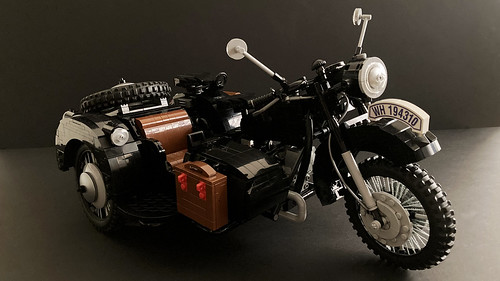
This wonderful creation is a KMZ-Dnepr K650, a Soviet Ukrainian motorcycle based on the 1930’s BMW R71. Whilst this version is 650cc, early bikes were fitted with a 98cc Wanderer engine design taken from Germany as part of reparations for World War 2, before KMZ’s own much larger 650cc was used for the rest of the design’s long production run.

Of course the BMW bit of the KMZ-Dnepr pre-dates war reparations, as the Soviet Union officially licensed the design from Germany before the two countries later went to war. In fact Germany and Russia held talks about becoming allies, with only Hitler’s ideological greed preventing Stalin from agreeing. Had they found common ground then this TLCB Writer would probably be typing this in German.

Fortunately Hitler and Stalin didn’t team up, and Germany invaded the Soviet Union just a year after the deal to license the BMW R71 was signed. This led – rather oddly – to the bike fighting on both sides of the conflict; the BMW version for the Axis Powers and the Soviet IMZ-Ural copy for Russia.

Production of the KMZ-Dnepr version shown here commenced in Ukraine in 1946, and continued right up to the fall of the Soviet Union, with both civilian and military versions produced. This beautifully presented replica of the KMZ-Dnepr K650 comes from KMbricklab, making their TLCB debut, and depicts the German-Russian-Ukrainian bike in both civilian and (awesome) military two-wheel-drive sidecar variants.

Gorgeous detailing and clever building techniques are evident in abundance and there’s lots more of KMbricklab’s superb build to see at their ‘KMZ-Dnepr K650’ album on Flickr. Click the link above to make the jump to Soviet-era Ukraine.

*Today’s lightly butchered title song.

Just Like a 911. Sort of.

The Porsche 911 is not the only rear-engined rear-wheel-drive European car. In fact there were loads, including Volkswagens, Tatras, Skodas, the Smart ForTwo, and – of course – Fiats.

Following the phenomenally successful 500, Fiat followed up with another rear-engined, rear-driven design, the near five-million selling 126.

Much of the 126’s technology was based on the 1950’s 500, which – considering it was produced in Polski-Fiat 126p form until the year 2000 – is both an astonishing achievement and rather frightening.

It’s the Polski-Fiat version we’re featuring here today, a car that mobilised Poland, although only if you were prepared to wait years or had communistical connections. Recreated in a fetching ‘hearing-aid beige’ / ‘baby-sick yellow’, Legostalgie‘s Model Team replica of the 126p captures the real car wonderfully, with a near perfect exterior, detailed interior, plus opening doors, front trunk and engine cover, with a realistic two-cylinder engine underneath.

Legostalgie has presented his model beautifully, and there are more top-notch images available to view at his ‘Polski Fiat 126p’ album on Flickr – click on the link above for all the drawbacks of a 1970’s Porsche 911, but none of the thrills…