It’s not just Dennis the Menace and old-timey scallies in the park who were armed with catapults. Because this is an Arado Ar 196, a Second World War German reconnaissance floatplane, powered by a 1,000bhp BMW radial engine, and stationed on every German capital ship during the war – from which it was launched by catapult.
This splendid recreation of the Ar 196 – and the ship-mounted catapult from which they were propelled – is the work of Flickr’s Veynom, who has captured the floatplane brilliantly in brick form. Catapult yourself over to Veynom’s photostream to take a closer look via the link in the text above.
The world is full of people with strange outlooks. These include those who think melon is an acceptable starter, enthusiasm for the Tesla Cybertruck, and people who put Christmas lights up in October. But right up there with the climate-change denying flat-earthers in the weird stakes are fans of ‘Girls und Panzer’, a Japanese anime in which high school girls compete against one another in World War 2 tanks.
Cue this golden Italian CV-33 tank commanded by a Japanese school girl named after a fish. It’s the work of Flickr’s lavishlump, here making their TLCB debut, and both tank and school girl are brilliantly built, particularly given the limitations of LEGO’s gold piece portfolio.
There’s more to see of lavishlump’s ‘Anchovy & CV-33 Tankette’ at their album of the same name, and you can head to a playing field in Japan for the weirdest school sports day via the link above.
We run a tight ship here at The Lego Car Blog. Models need to be of the highest quality of course, but so does their presentation. We have a whole page explaining the need for clean uncluttered backgrounds, so, um… here’s a model with a messy cluttered background.
It looks fantastic though doesn’t it? Just look at that reflection. Martin Spunkt‘s Kübelwagen shows how outdoor photography should be done, and there’s more to see of the model that’s earned him his TLCB debut via the link above.
This is a Messerschmitt Bf 109F, the backbone of the Lufftwaffe’s fighter force throughout the entire of the Second World War.
First flying in 1937, the Bf-109 was one of the most advanced fighters in the world, with an all-metal monocoque, fully enclosed canopy, retractable landing gear, and a liquid-cooled inverted-V12 providing 700bhp.
Over 30,000 units were produced for use in the Luftwaffe and the air forces of Nazi Germany’s allies, making it the most numerous fighter aircraft in history, with final units eventually retiring from the Spanish Air Force in 1965.
This incredible brick-built example of the Messerschmitt Bf 109F is the work of previous bloggee JuliusZ D., who has recreated the aircraft in stunning 1:33 detail.
Beautifully constructed in North Africa colours, there’s lots more gorgeous imagery to view at Juliusz’s ‘Messerschmitt Bf 109F-4/trop’ album on Flickr, where the model is also pictured alongside his fantastic Supermarine Spitfire that appeared here a few weeks ago.
And fortunately for TLCB’s home nation (and the rest of the world), good as the Messerschmitt Bf 109 was, it was that Spitfire that won in the end.
This TLCB Writer can think of little more terrifying in the Second World War than being part of an Atlantic Convoy, traversing the frigid waters all the while knowing that death lurked beneath at any moment. Little more that is, other than being on the aforementioned submerged death itself.
Nazi Germany built around 1,100 U-Boats during World War 2, of which almost 800 – or 2/3 of the fleet – were sunk.
This superb diorama of one of those 1,100 ships, depicted here breaking the waves of a choppy Atlantic, is the work of Ralph Savelsberg, who has captured not just the U-Boat but also the ocean in which it operates in spectacular realism.
Built as part of a display for the Brickfair Virginia show, there’s more to see of Ralph’s beautifully presented model at his ‘U-Boot Diorama’ album, and you can head out onto the waters of World War 2 via the link above.
After decades of peace, Europe is once more at war, thanks to an under-endowed dictator intent on re-colonisation. However the last time war raged along Russia’s borders, it was defending against, rather than fighting for, a maniacal despot.
This wonderful diorama depicts a small part of that fight, when in 1942 German ace Wolf-Dietrich Wilcke was shot down by a Soviet Air Forces Hawker Hurricane, crash landing on an icy lake.
His Messerschmitt Bf 109 slipped through the ice to the bottom of the water, but Wolf-Dietrich survived to continue his service in the Luftwaffe, before finally being killed in action in March of 1944, with a scarcely believable 162 victories to his name.
Constructed by Jonah Padberg, this beautiful creation captures the moment of Wolf-Dietrich’s crash, and you can visit the frozen lake on which he landed, before it claimed his Messerschmitt Bf 109 but not his life, via the link above.
This beautiful aircraft is a CANT Z.506 Airone floatplane, one of the fastest, most-advanced, and highest flying aircraft of the 1930s. Powered by three Alfa Romeo radial engines, the Z.506 was first developed as a luxury airliner, wherein it set numerous aeronautical world records.
Such success inevitably led to the development of military versions, with the design used by the Italian Airforce for maritime patrol, bombing and torpedo operations, first in the Spanish Civil War (leading to the Franco dictatorship) and then by Italy’s own dictator Mussolini in the Second World War, where it played a significant role in Italy’s invasion of Greece, and bombing French North Africa. Yay fascisim.
Anyway, 1930s and ’40s Dictator willy-waving wasn’t really the CANT Z.506’s fault, and the aircraft continued to fly long after Mussolini was deposed and Italy switched sides, operating in search and rescue until 1959, which is far more noble.
This one is isn’t a search and rescue aircraft though, instead being an early example from the Spanish Civil War, thusly equipped with four machine guns and a 1200kg bomb payload. Flickr’s Eínon is the builder behind it, and there’s more to see of their brilliant Lego version of the CANT Z.506 Airone at their photostream. Click the link above to join the 1930s fight for fascism…
Does anyone else remember that fiendishly addictive early computer game in which the player was tasked with manoeuvring around a seeming infinite plain populated by the outlines of various 3D shapes, hunting and destroying enemy tanks? Just us? OK.
Anyway, perfect cubes and prisms aside, the concept of hunting tanks was based on reality, with specific machines (themselves looking rather like tanks) designed for their destroy enemy counterparts.
This is one such device, the Sturmgeschütz III tank-hunting assault gun, as deployed by Germany during the Second World War (and Syria until 1973).
Handily known as the STuG III, it saw service on almost every front, from Russia to Europe to Africa, and proved very successful at destroying Allied armour.
This excellent fully remote controlled Lego version of the STuG III comes from TLCB favourite Sariel, who – despite the model measuring just 32cm in length and weighing under 1kg – has packed in drive and steering, fully suspended tracks, and an oscillating and slewing gun barrel, all powered by a LEGO battery and controlled via bluetooth courtesy of a third-party SBrick.
There’s more to see of Sariel’s STuG III at his Flickr album of the same name, plus you can watch the model in action via the video below. Go tank hunting across a plain of cubes via the links!
As is currently playing out in Ukraine, thanks to the murderous dick-bag Vladimir Putin, war can have a catastrophic effect on food production. But food production must continue, even when an invading enemy is standing amongst your crops.
Recent bloggee SirLuftwaffles travels back eighty years to the last time a murderous dick-bag brought war to Western Europe, with this wonderful scene depicting an Opel Blitz 3-ton truck parked in occupied France during the Second World War.
SirLuftwaffles has made free building instructions for the truck available and there’s more to see at his photostream. Click the link to take a look.
15,000 pieces, 4½ years, and 1.8 metres. A few of the astonishing statistics associated with Ciamosław Ciamek‘s breathtaking 1:38 scale Second World War U-Boat.
Constructed in six sections, each with a removable sides to reveal the spectacular detail within, Ciamosław’s incredible mini-figure scale replica of a German ‘Typ VII C U-Boot’ accurately recreates the control room, front and rear messes, bow, engine rooms, and stern, all of which were designed digitally before being built from thousands of LEGO pieces.
A crew of dozens of mini-figures are shown throughout the interior of the boat, many operating the equipment, engines, and weaponry, whilst others are off-shift in the mess.
It’s a jaw-dropping creation, with hundreds of images across two albums required to capture the model’s scale and complexity, and you can check out the first of these on Flickr via the link in the text above. Click it, sit back, and take in the most amazing World War 2 creation you’re likely to see in 2022…
It might sound like European cat food, but the Kettenkrad was altogether weirder than that. Half motorcycle, half tank, the Sd.Kfz 2 Kettenkrad was designed by NSU, powered by Opel, weighed 1.5 tons, and could climb slopes of over 24°, even in sand.
A unique drive system delivered power to both tracks simultaneously on hard ground, or – when the driver selected – operated via a subtractor to skid-steer on soft ground, and it was used throughout the Second World War to lay cables, transport troops, tow aircraft, oh – and to invade Russia.
This amazing motorised Model Team recreation of the Sd.Kfz 2 Kettenkrad comes from previous bloggee Samolot, and not only does it feature the most terrifying LEGO figure we’ve ever seen, it also includes a fully working remote controlled version of the real bike/tank’s ingenious steering system.
Exactly how it works is beyond the collective minds housed here at TLCB Towers, so the best way to see if you can figure it out is via the video below. There are also more images of both Samolot’s model and the real 1940s contraption at Bricksafe, and you can read the full build description and join the discussion via the Eurobricks forum here.
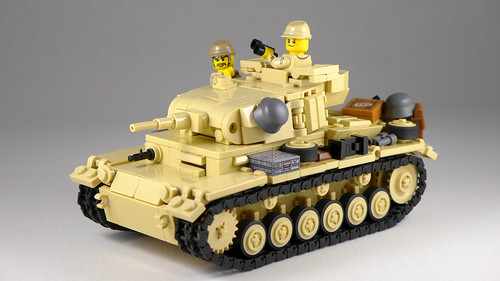
Designed by Daimler-Benz, this the Panzer III Sd.Kfz 141, the German military’s primary medium battle tank built to take on the formidable Soviet T-34 during the Second World War. It was powered by a 300bhp Maybach V12 giving it a top speed of just over 20mph, which wasn’t fast (but then it did weigh around twenty-two tons), and it was armed with either a 37mm, 50mm, or 75mm gun, depending on specification.
Around 5,700 Panzer IIIs were built between 1939 and 1943, seeing service in Poland, the Soviet Union, France, North Africa, the Netherlands, and Italy – amongst other theatres of war. This superb Lego version of the Sd.Kfz 141 comes from previous bloggee Rebla, who has recreated the design brilliantly, including a rotating turret, elevating cannon, and a crew of custom mini-figures.
Rebla has presented his model beautifully too, and there’s more to see at his photostream – click the link above to make the jump to all the imagery.
Are three things better than two? Engines? Yes. Beer. Yes. Stool legs? Yes. Wings? Er… no, probably not. However, whilst the triplane idea was abandoned by 1920, it was a widespread aeronautical design before then, being used by pretty much every plane-building nation of the time.
Most notably triplanes were the mainstay of the German Air Force in the First World War, with aircraft such us this extravagantly painted Fokker Dr.1. used extensively (and successfully) throughout the conflict.
This superb small-scale recreation of the Fokker Dr.1 – made famous by the ‘Red Baron’ Manfred von Richthofen – comes form Flickr’s Henrik Jensen, and there’s more to see at Henrik’s ‘Fokker Dr.1’ album via the link above.
The Second World War, for all the death and destruction it wrought, did provide the catalyst for some amazing technological advances. Sticking some floats underneath a Mitsubishi A6M Zero fighter probably isn’t in the top three though, but the result is still rather cool. The Nakajima A6M2-N ‘Rufe’, developed from the infamous Zero, turned the land-based fighter/bomber into an amphibious floatplane. Just over 300 were produced between 1942 and the end of the war, with last being operated by the French following its capture in Indo-China. This ingeniously constructed small scale version comes from John C. Lamarck of Flickr, who has captured the Rufe’s unique asthenic brilliantly in miniature. See more at John’s photostream via the link.
This is an SPA TL.37, a light artillery tractor built by a subsidiary of Fiat during the Second World War for Royal Italian Army. Powered by a huge 4-litre 4-cylinder engine, with four wheel drive and four wheel steering, able to climb a 40-degree slope, and capable of 40km/h whilst pulling 75 or 100mm artillery pieces, it looks like a seriously fun vehicle for gadding about in the desert. Unfortunately for the Axis Powers their gadding about in the desert did not go well, but that’s not exactly the fault of SPA TL.37. There’s more to see of this one courtesy of Rebla of Flickr – click here to take a look.