Tag Archives: Honda

Height of Honda

Some say Honda’s peak was its six-year dominance of the Formula 1 World Championship from 1986. Others the Ferrari-beating NSX that followed. Still others the fantastic S2000, a car with the highest specific output-per-litre of any naturally-aspirated engine for a decade. But we say it’s this, the mid-’00s ‘CL7’ euro-spec Honda Accord.

Launched in 2003 with Honda’s famous VTEC engines, imperious build quality, superb exterior design, and later the option of the brand’s first ever (and instantly world-beating) diesel engine, the seventh-generation accord was a huge success, with its big sales in TLCB’s home market no doubt helped by the best car commercial ever made.

Honda have never since recaptured that mid-’00s success (and neither have increasingly unimaginative car ads), so we’re heading back to the height of Honda courtesy of Mihail Rakovskiy and his incredible Lego Honda Accord Type-R.

Replicating the sharp exterior, interior, engine bay, and even chassis and drivetrain of the seventh-generation Accord beautifully in brick form, Mihail’s model features an opening hood, trunk and four opening doors, and is presented as perfectly as it’s been constructed.

There’s much more to see at Mihail’s ‘Honda Accord Euro-R (CL7)’ album and you can head back to when Honda were on top of the world via the link in the text above.

Tiny Turbo

This is a Honda’s B-Series engine, as used in numerous Civics, Preludes and Accords in the late-’80s to late-’90s, and the genesis of VTEC. Available from 1.6 to 2.0 litres in capacity, the B-Series could rev to over 8,000rpm, and became one of Honda’s defining accomplishments.

An engineering masterpiece, Honda’s B-Series has featured in quite a few Lego Hondas over the years. Except of course, it hasn’t. Not really. But today we really do have a Lego Honda B-Series, because this amazing creation is a fully working replica of the B16.

Complete with brick-built pistons, crank, manifold, wastegate and ancillaries, this remarkable build captures every aspect of the real Honda engine inside and out, and – purely because it’s cool – in the version we’ve pictured above builder Delton Adams has added a motorised turbocharger for added ‘phish – whuudududu!’ noise imaginings.

As wonderful as it is unusual, there’s a whole lot more of Delton’s incredible Honda B16 to see – both in original and turbo-modded forms – at his Flickr album of the same name. Reliably rev your way to 8,400rpm* via the link in the text above.

*Unless you’ve added turbocharger for ‘phish – whuudududu!’ noises of course.

Mysterious Liking

There are some things that this TLCB Writer probably shouldn’t admit to liking. Made in Chelsea. His own farts. Nickelback. Star Wars Episode I. And, most embarrassingly of all, the Opel Frontera.

Launched in 1991, the Opel Frontera (or Vauxhall Frontera in our home market) was based on the amazingly-named Isuzu Mysterious Utility Wizard, and is perhaps the most successful worst car ever, being rebadged around the world as the aforementioned Opel/Vauxhall Frontera, the Holden Frontera, Chevrolet Rodeo, Isuzu Rodeo, Honda Passport, and finally the Landwind X6/X9.

Each was a different flavour of awfulness, with appalling build quality, terrible ride and handling, leaking doors, an interior of the dreariest plastic imaginable, and yet… this TLCB Writer rather likes them. This is one of those occasions were it’s a good thing our identities are secret.

Cue a strange enthusiasm therefore, when one of our Elves found this brick-built example on Flickr, as created brilliantly by Fedor Kolbasin.

Featuring all-wheel-drive, working steering and suspension, four opening doors, plus one of the most realistic interiors we’ve ever seen fitted to a Technic model, Fedor’s Opel Frontera blends working functions with a beautifully executed exterior to create one of the nicest ’90s 4x4s we’ve published yet. (Even if you’re not as much of a Frontera fan as the writer of this inexplicably is. Ed.)

There’s lots more of the model to see at Fedor’s ”99 Opel Frontera / Isuzu Rodeo’ album, and you can head to peak ’90s SUV-ness via the link above. You might even leave with a mysterious liking for the real thing. (Probably not though. Ed.)
Here Comes the Sun*

Winter is coming here at The Lego Car Blog Towers. But whilst us North Northern Hemispherers are steeling ourselves for it getting dark by mid-afternoon and defrosting the car both before and after work, our readers in the Southern Hemisphere are getting ready to enjoy sunny summer days.

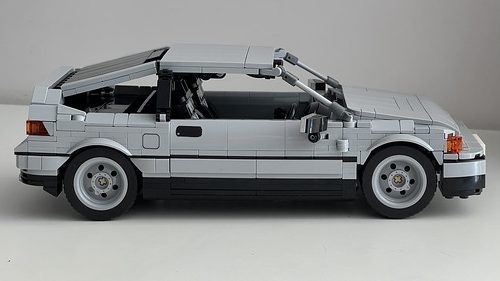
Cue the perfect car for the sunshine, and one – in the US at least – named after it; the lovely Honda CRX / Del Sol.

Produced when Honda were at their glorious peak, the CRX / Del Sol brought affordable, economical, reliable fun to the masses, and in targa form open-top motoring too.

This fabulous Technic recreation of the Del Sol captures the real car brilliantly, and comes from previous bloggee (and TLCB Master MOCer) Nico71.

Featuring a removable transverse 4-cylinder engine driven by the front wheels, working steering via ‘HOG’ and the wheel, rear suspension, opening doors, hood and trunk, and a stow-able targa top, Nico’s model is as luminous inside as out, and you can see more of his fantastic Technic Del Sol at his excellent website (where building instructions can also be found), and via the video below.

YouTube Video

*Today’s title song.

In Accordance

In accordance with the current rule that says all cars must be dreary crossovers, we don’t get the Honda Accord in TLCB’s home nation any more, instead having the choice of four equally bland SUVs. Sigh.

Back in the 2000s we did though, and this writer rather liked it, what with it being considerably more interesting than the U.S version. What the U.S did get that we didn’t however, was the V6 engine. And the Coupe. And this one is the unicorn combination of both.

Constructed by previous bloggee Mihail Rakovskiy, this fantastic Technic replica of the 8th generation Accord Coupe recreates the builder’s own 2008 example, and includes a V6 engine, manual gearbox, front-wheel-drive, working steering, all-wheel independent suspension, opening doors, hood and trunk, and adjustable seats.

It’s also, as you can see here, a rather neat looking model, accurately recreating the mid-’00s Accord Coupe’s handsome-if-anonymous exterior. Kinda like an automotive news reader.

There’s lots more of the model to see Mihail’s ‘Lego Honda Accord Coupe’ album on Flickr, and you can take a closer look at all the images via the link above. And if you’re European and wondering why the U.S gets the fun Hondas, the V6 engine and Coupe body-style have since been dropped there too. Still, at least there are half-a-dozen tedious automatic SUVs to choose from…

Hondari

Inspired or sacrilege? Mike “Stanceworks” Burroughs’ Honda-powered Ferrari 308 is definitely not for the purist, but we’re firmly in the former camp, and think it’s spectacular.

Cue Stephan Jonsson’s fantastic 8-wide Speed Champions homage to Mike’s real-world build, complete with 3D-printed wheels and one of the most impressive brick-built liveries we’ve ever seen (see LEGO, you don’t need a hundred stickers).

There’s lots more of Stephan’s Ferrari ‘244 GTK’ to see on Flickr, and you can check out the real car that inspired it here.

There’ll be Honda Coupe

What we value, particularly our vehicles, depends very much upon time and place. The sixth generation Honda Civic, built from ’95 to 2000 (and its Rover 200/400 counterpart), is worth scrap money here in TLCB’s home nation. That is despite the fact they go on for ever, and shouldn’t really need scrapping yet at all.

In the Unites States however, the ‘EM’ Civic is both revered (and hated) as a staple of the tuner scene, and is rather sought-after. No doubt reverence for the mid-’90s Civic will rise in the UK too, as the numbers on the road dwindle to almost nothing, but for now many end their days doing this. There are thousands left on the roads in America though, with many tastefully modified (and many more rather less so) thanks to an abundance of tuning parts.

This neat Speed Champions recreation of the sixth-generation Honda Civic Si Coupe comes from Ilya M of Flickr, who has taken the former route to modification to rather smart effect. There’s an opening hood (with a detailed engine underneath), room for two mini-figures, and free building instructions available (100 TLCB Points to Ilya). Take a look via the link above to see more.

My Other Car’s a Ferrari

Once seen as a knock-off Ferrari, yet now revered more than the Maranello products it sought to take on, Honda’s NSX is often regarded as the pinnacle of driver’s cars.

It’s fitting then, that this stunning Technic recreation of the first generation Honda NSX is built only from the parts found within an official Ferrari product, the LEGO Technic 42143 Ferrari Daytona SP3.

Built by Eurobricks’ Romanista, who is making not just their TLCB debut but also posting their first ever creation online, this amazing alternate includes all-wheel double-wishbone suspension with positive caster, working steering with Ackermann geometry, a V6 engine linked to a functional gearbox, pop-up headlights, and opening doors, front trunk and engine cover.

Full details and further imagery of Romanista’s spectacular 42143 alternative can be found at the Eurobricks discussion forum via the link above, and if you’d like to check out TLCB’s huge archive of brilliant B-Models that have appeared here over the years – many of which have building instructions available – you can start your search by clicking here.

Monaco ’88

‘2001: A Space Odyssey’, the Toyota Corolla, and the Monaco Grand Prix. All simultaneously the greatest examples of their respective genres, and also the most boring.

But Formula 1 in Monaco wasn’t always a procession. Before the cars were the size of school buses, which these days makes overtaking impossible, Monaco could put on quite a show.

Back in 1988, even with the complete dominance of the McLaren-Honda MP4/4, the ’88 Monaco Grand Prix delivered. Twenty-six cars started – two of which were even called ‘Megatron’ (seriously, look it up!) – just ten finished, and Ayrton Senna was the class of the field.

Out-qualifying his team-mate Alain Prost by a staggering 1.4 seconds, Senna led the race by almost a minute… until he didn’t. A momentary lapse of concentration eleven laps from the finish and he hit the wall, whereupon he exited his broken McLaren and walked home.

Prost took the win (his forth and final Monaco GP victory), followed by Gerhard Berger’s Ferrari some twenty seconds back. Which means there’s perhaps some artistic license with the cars’ proximity in alex_bricks‘ stunning 1988 Monaco Grand Prix vignette, but in every other respect this is a spectacularly realistic homage to the Monte Carlo street race.

Recreating the circuit as it was in the late-’80s required Alex to watch old race footage (which is surely some of the most fun research required to build a Lego model), matching his brick-built version of the Mediterranean Principality to the televised imagery from the time.

The result is a replica of the streets of Monaco as they were in 1988 so perfect we can practically hear the noise from the Formula 1 cars bouncing off the walls of the buildings, with Alex displaying his incredible build at the Brickfair show earlier in the year.

Fortunately he’s uploaded a few images to Flickr too, so you can join TLCB Team immersing themselves in Monaco in 1988 via his photostream. Click the link above to head the greatest race on the Formula 1 calendar, long before it was boring.

Type-BWAAAA

The Lego Car Blog Elves are running around the office making VTEC noises. Which isn’t annoying at all. Still, said racket is at least accurate, because – around TLCB Towers at least – the nighttime streets echo to the sounds of the youths of today driving their ageing Civic Type-Rs fitted with silly exhausts on full throttle. Everywhere. BWAAAAAA!

Still, the clientele isn’t really Honda’s fault, and the late-’90s first generation Civic Type-R (based on the sixth generation Civic) is rapidly heading to genuine classic status. Which will soon make it too expensive for the aforementioned youths to be irritating with.

This one (and the source of the Elven office ‘BWAAAAA!’ing) is the work of previous bloggee Daniel Helms, who has absolutely nailed the first generation ‘EK9’ Civic Type-R in Model Team form.

Opening doors reveal a life-like interior, which accurately recreates the real Civic’s ’90s plasticky dashboard via some excellent bespoke decals, there’s a realistic replica of the 185bhp, 8,200rpm 1.6 litre naturally aspirated ‘B16B’ engine under the opening hood, plus the model features an opening tailgate, working suspension, and custom ‘Type-R’ stickers and Honda badging.

There’s loads more of Daniel’s terrific Type-R to see at Eurobricks, Flickr, and Bricksafe, and you can head there on full throttle at 8,200rpm via the links above. BWAAAAA….

More Power to the People

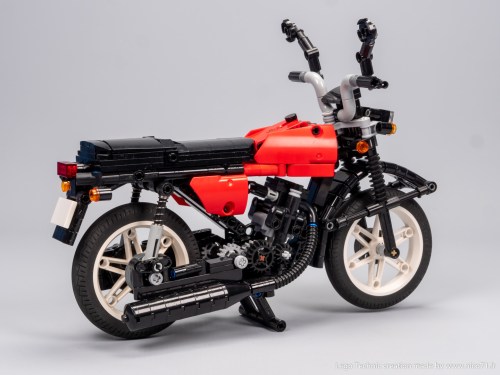
First appearing here over a decade ago (in fact it was one of our earliest posts!), the Honda CG 125 continues to be one the great mobilisers of the people. Whilst many assume the most influential vehicles are the Toyota Corolla, the Volkswagen Beetle, or the Ford Model-T, this humble Japanese moped has moved people than probably every other private transport method combined.

First produced in 1976, the Honda CG 125 is still being made today, and units built forty years ago are still carrying entire families, shops, and livestock the world over.

This beautiful Technic recreation of the world’s greatest people mover comes from Master MOCer Nico71, who has updated his decade-old design with newer parts, excellent presentation, and building instructions so you can create it for yourself.

There’s much more to see at Nico’s Brickshelf gallery; join the millions of people who ride a Honda CG 125 every day via the link in the text above!

Beat It

‘Sports’ cars today have about a thousand horsepower and weigh sixteen tons. Except when they’re EVs, and then it’s double that. Which is why we love the Honda Beat.

Built to Japan’s kei-car regulations in the early ’90s, the Beat had only 660cc, 63bhp, and weighed in at just 760kgs. Which means your Mom could double the kerb-weight just by getting in. Not that she’d fit.

This neat Speed Champions Beat was found by one of our Elves on Flickr, coming from Ilya Muratov who has captured the ’90s kei icon wonderfully. Jump in via the link to Ilya’s Flickr album above. If you fit.

*Today’s title song. Of course.

Senna & Cigarettes

Formula 1 was different in 1991. Cigarettes, a variety of engine configurations, and only one Unites States Grand Prix. Oh, and a titanic battle between McLaren’s Ayrton Senna and Williams’ Nigel Mansell, that culminated in a third Driver’s World Championship for Senna and the only Constructor’s World Championship ever won by a V12 powered car.

This is that car, the awesome McLaren-Honda MP4/6, as designed, liveried, rendered and presented beautifully by Robson M aka BrickDesigners, and there’s more to see of Robson’s stunning recreation on Flickr. Click the link above to race in ’91.

Insert Safety Car Here

Mercedes-AMG’s seven-year dominance of the Formula 1 World Championship finally ended in 2021. Well, sort of… they still won the Constructor’s Championship, making it eight-in-a-row, but Lewis Hamilton did not win an eighth Driver’s Championship, and as such may now never move ahead of the record he shares with Schumacher.

Of course we also say ‘sort of’ thanks the controversial way in which Hamilton lost the Driver’s Championship on the final laps of the final race to Max Verstappen.

Thanks to crash-a-holic Lattifi (who – if he wasn’t paying to drive the car – surely wouldn’t be in Formula 1), and an improbable safety car decision that eventually cost race director Michael Masi his job, Verstappen was able to pass Hamilton on the final lap, giving us the first new World Champion in four seasons, and ending years of ‘#blessed’ instagram posts from the bejewelled multiple-champion.

Cue much arm waving and shouting from Mercedes-AMG (unusual, seeing as Christian Horner of Red Bull had done it all season for various imagined grievances), an investigation, but the race result standing. Which, by the way, we’re all for.

Yes the rules hadn’t been followed, but we’re of the opinion that even if there’s just one corner of the race remaining, it is a race, and therefore it should be, well… raced. Plus it made for amazing TV.

Anyway, Verstappen took the Championship, Hamilton felt what it’s like to lose (although he’s more than familiar with that this season), and fans got a finale to talk about for years to come.

This is the car that took Verstappen to his first Formula 1 Driver’s World Championship, the Honda-powered Red Bull RB16B, as created in spectacular detail by previous bloggee Noah_L of Flickr, and joining his already-impressive roster of brick-built modern Formula 1 cars.

The incredible realism is enhanced by some frankly jaw-dropping decals, created for Noah by a fellow builder, and there’s more to see of his astonishing (and beautifully presented) creation at his ‘Red Bull RB16B’ album on Flickr, where a link to building instructions can also be found.

Click the link above to deploy the safety car…

*It’s the Azerbaijan Grand Prix today. If you’re a Hamilton / Mercedes-AMG fan, this link from the 2018 race may raise a snicker.

Accessibly Interesting

Having just posted a hugely valuable exotic car built from another hugely valuable exotic car, you might be surprised to learn that at The Lego Car Blog, we rather prefer the ordinary. So much so we’re running a building competition in search of boring vehicles.

You see, it’s easy to make a squillion-dollar supercar that precisely eight people will buy, not drive, and park in a garage hoping it will one day be worth two-squillion dollars, but it’s much harder to make something hum-drum fun.

It’s even harder these days, when the only thing that sells are angry-looking crossover-SUVs with too much power and too little handling finesse, but back in the 1980s, a number of affordable, interesting, fun cars could be had from car manufacturers who today wouldn’t know fun if it ran them over.

Honda were one such company, who – at the peak of their engineering brilliance – created a small 2+2 front-wheel-drive coupe built from standard economy-car parts and powered by a dinky (but clever) 1.5 or 1.6 litre engine. And that was the ‘sports’ model, base versions had a 1.3!

The result was fabulous, and a car that was infinitely more fun to drive than a BMW X7M or whatever the hell they’re trying to pass off as as a ‘sports’ vehicle this week.

Flickr’s Mihail Rakovskiy has captured the humble CRX beautifully in Creator style, recreating its ’80s aesthetic brilliantly and including opening doors, tailgate and hood, a superb interior, and a realistic brick-built version of the little Honda 4-pot that powered it.

It’s a fantastic homage to a Honda’s proof that power and price are no match for cleverly engineered affordable fun, and there’s much more to see at Mihail’s ‘Honda CRX’ album via the link above.