Category Archives: Model Team

Automotive Cool

’60s Italy was, in the mind of this TLCB Writer, the peak of automotive cool. The Vespa, the Fiat 500, Ferrari, Lamborghini, Lancia, and – of course – Alfa Romeo.

This glorious 1965 Alfa Romeo Giulia Sprint GTA takes us back to Italy’s golden era, having been wonderfully recreated in brick form by 5eno of Flickr.

A realistic interior is accessed through opening doors, a brilliantly detailed engine resides under the opening hood, and there are more images of the model to see at 5eno’s Alfa Romeo Giulia Sprint album.

Head back to ’60s Italy via the link in the text above, when every vehicle was infinite cool.

Brown Rat

You’re never more than 6ft from a rat. Or something. We’re OK with that here at TLCB Towers, because we’re certainly never more than 6ft away from a TLCB Elf, which is probably worse.

Cue Sergio Batista and his brown rat rod, which makes us all very close to a rat today. There’s more to see at Sergio’s photostream, where you can get even closer should you wish. To his rat, not a TLCB Elf. You wouldn’t want that…

Bulkwagen

This is a DAF FAS 2600 ‘Bulkwagen’ in Hendrix livery, and it comes from DAF-building specialist Arian Janssens. Arian’s classic DAF 2600 joins his extensive line-up of Dutch trucks, with some simply exquisite detailing throughout to accurately capture the (somewhat odd) design of the 1960s original.

Replica decals, vintage Technic wheels, working steering, and excellent presentation make this worth a closer look, and you can do just that via the link to Arian’s photostream above.

Anything but Mundane

The Festival of Mundanity Competition is beginning to receive some wonderfully dull entries. This flying Porsche 911 Turbo is not one of them. Suggested by a reader and built by BobDeQuatre, this futuristic Porsche is based on the official LEGO 10295 Porsche 911 set, only with a few choice modifications.

These apparently include “two anti-grav generators, and a powerful VV hydrogen repulsor motor, integrated into the old bodywork without disrupting the lines. The interior features very old accessories like the strange levers between the two seats, but also top notch controls”.

Which makes for a vehicle that we really hope becomes a reality one day. Until then you can join us in dreaming at Bob’s ‘Porsche 911 Turbo VV’ Flickr album or at the Eurobricks forum here.

Yellow Niva

The Soviet Union was full of terrible cars. This is not one of them.

The Lada Niva / VAZ-2121 is unibody 4×4, capable of going as far as a Land Rover (only more comfortably, as it had proper springs) and able to be easily worked on with limited tools. And it’s brilliant.

Unusually, the Niva was an in-house design – rather than using left-over bits of old Fiats – and so successful is it that is still being built today. Not for long though, as the Niva’s days are numbered, after which it’ll be replaced by a re-badged Dacia Duster courtesy of Lada’s parent company Renault.

Now we quite like the Duster, but it’s not a Niva, and it certainly can’t go as far as a Land Rover off road. Which means we suspect the original Niva will become quite a sought-after vehicle once production stops, not something you might expect of a Communist-era Lada.

This rather lovely Lego version comes from previous bloggee Legostalgie, who has evolved his previously featured design and has now made building instructions available. If you like the Niva as much as we do you can check out all the images of Legostalgie’s update, and find a link to building instructions, by clicking here.

Blue and Steamy

No, not your Mom’s old movies, but this rather lovely steam tractor by Flickr’s Nikolaus Löwe. Working ‘chain’ steering, a spinning flywheel, and other old-timey steamy things are all included, and there’s more to see at Nikolaus’ photostream. Click the link above for more steamy blue action.

Get Bent

Ah the bendy bus. Commonly used at airports when those raised tubey tunnel things are too far away, and – until recently – found clogging up the streets of TLCB’s home capital.

However whilst the bendy bus works a treat on the wide open concrete of an airport (unless you’re the unfortunate sole stuck standing on the articulation point as it meanders back to Terminal 4), they absolutely do not work on the streets of a two-thousand year old city.

Many American cities though, are rather like airports, what with their wide open concrete, multitude of fast food outlets, and overly-zealous armed security. This makes the bendy bus a much more appropriate method of public transportation there than in London*.

Fortunately this bendy bus, a New Flyer Xcelsior XD60, is transporting commuters in the right place, as evidenced by the excellent ‘Newark Penn Station’ destination boards. And the American flag on the side.

Constructed by JLui15’s Studio, this brilliant brick-built bendy-bus not only looks spectacularly accurate inside and out, there’s a full remote control drivetrain hidden within it too.

Custom replica decals enhance the realism, as does the working articulation in the middle, and there’s loads more to see of JLui15’s incredible creation at their ‘Motorized New Flyer XD60 Articulated Bus’ album on Flickr. Click the link above to ride to Newark Station, New Jersey.

*On the flip side of course, the average American bus passenger would probably get wedged in the winding stairs of a Routemaster double-decker, so the inappropriateness goes both ways.

Mack and Cheese

This beautiful creation is a Mack R Series, one of America’s most ubiquitous heavy duty trucks, introduced in the 1960s and built for almost forty years, they were even made under license in Iran.

R Series trucks came in a huge variety of cab and drive configurations, with this lovely Lego version depicting a simple 6×4 single cab hauling a container trailer.

It’s the work of previous bloggee Vladimir Drozd, who has captured the Mack’s subtle curves brilliantly using a wealth of ‘cheese slopes’, curved bricks and wedges.

Underneath the superbly replicated bodywork Vladimir has fitted a Power Functions remote control drivetrain, with motorised drive and steering, working suspension, and a mechanised fifth-wheel trailer hitch, whilst the trailer itself also includes suspension and working support legs.

Photographed and presented beautifully, there’s more to see of Vladimir’s wonderful Mack R Series on Flickr – click the link in the text above to take a look.

El Camino

Car-based pick-ups have been a strangely transient body style over the years. Currently popular in South America, previously popular but now dead in Australia, and returning once more after a long hiatus to the U.S.

This new crop of car-based pick-ups being marketed in the U.S includes the new Ford Maverick and the decidedly strange-looking Hyundai Santa Cruz, and it could mean there’s room for the famous of them all to make a comeback; the mighty Chevrolet El Camino SS.

Based on the Chevrolet Chevelle, the El Camino swapped the traditional sedan/station-wagon bodywork for a two-door cab with a pick-up bed, and it could be bought with Chevrolet’s most powerful engine of the time, a 13-second 1/4 mile 450bhp V8.

Despite this prodigious power, suspension and steering were still, well… it had them we suppose, and disc brakes were an optional extra. Handling was clearly not an El Camino strong-suite then, but if it could stop and go round corners quickly all your stuff would fly out of the bed, so perhaps Chevrolet were cleverer than we’re giving them credit for. Or it could be that American consumers only cared about big power and racing stripes…

This wonderful recreation of the definitive muscle-car-pick-up comes from Jakub Marcisz, who has replicated the 1970 El Camino SS brilliantly in brick-form. Jakub’s model includes (somewhat superfluous) working steering, the requisite big piston engine connected to the rear wheels, opening doors, hood and tailgate, and – most importantly of all – racing stripes.

There’s lots more to see at Jakub’s ‘Chevrolet El Camino SS’ album, and you can make the jump to ’70s racing-striped muscle-car-based-pick-up wonderfulness via the link above.

Fork This

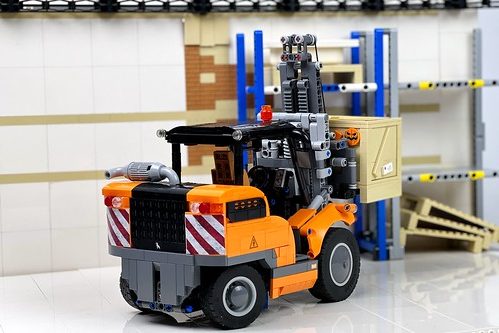
This a motorised forklift truck, it comes from previous bloggee Vladimir Drozd, and it is quite good at squashing Elves.

With a number of our smelly little workers distracted by something shiny, the Elven discoverer of this creation snuck up and dropped a box on them. Because it could.

Doubtless a victim of past smushings, it enjoyed being the perpetrator immensely, and is now happily eating an orange Smartie whilst we patch up the victims.

A pair of Power Functions motors raise and tilt the forklift boom (enabling a brick built box to tip smartly onto those underneath), whilst a further two motors drive and steer the truck itself, and there’s more to see at both Flickr, Eurobricks, and via the video below.

YouTube Video


Hash Brown

We’re on two wheels today, thanks to Jonathan Elliott and this lovely BMW R80 ‘Cafe Racer’ motorcycle. There’s a brick-built boxer engine, single-shock suspension, and shaft drive constructed from the five-hundred carefully chosen pieces, a good few of which are brown. And brown bikes look ace. Ride to the cafe via the link above.

Commie Combi

This beautiful blue creation is a Lada 1200 Combi / VAZ-2102, one of the defining cars of the communist-era Soviet Union and – in it’s earlier years at least – not actually a bad one.

Produced from 1970 until 1988, the Lada 1200 / VAZ-2102 was based on the Fiat 124, itself still in production and rather good too.

For the licensed version the Soviet engineers raised the Fiat’s ride height, strengthened the chassis, and increased the thickness of the bodywork steel to ensure the car could cope with Russian roads and winters, and replaced the rear disc brakes with aluminium drums, because… er, we don’t know. They were worse.

Anyway, the car was a success, with a million built in the the first three years alone, and exported to many markets where the Fiat version wasn’t already on sale (Fiat didn’t permit Lada/VAZ to compete directly with its own product).

TLCB’s home nation got the Lada 1200 in 1974, when the Fiat 124 was replaced by the newer 131, becoming the first Lada on sale in the market, and likely a brave purchase by consumers during the Cold War.

A thousand Lada jokes would follow, which was a bit unfair as the 1200 was fine, but many were probably as much to do with anti-communist sentiment as they were with automotive quality.

This lovely Model Team recreation of the Lada 1200 Combi / VAZ-2102 comes from Flickr’s Legostalgie, whose wonderful Lego replicas of Communist cars have appeared here numerous times so far. His latest captures the Lada brilliantly, with superbly accurate bodywork, opening doors, hood and tailgate, a life-like interior and engine, and even a trunk on the roof-rack.

There’s lots more to see Legostalgie’s ‘Lada 1200 Combi / VAZ-2102’ album on Flickr, and you can head to the Communist-era Soviet Union (or the United Kingdom) c1974 via the link in the text above.

Don’t Mention the War

This bizarre looking vehicle is a Porsche 356 Carrera GTL Abarth, a lightweight racing car from 1960 resulting from a rare collaboration between Germany and Italy.

Previous partnerships between the two European powers were – thankfully for mankind – disastrous failures, but the Porsche 356 Carrera GTL Abarth was… OK, not great either.

It overheated, the steering couldn’t turn enough, and there were a few ‘differences of opinion’ between Porsche and Abarth when it came to acceptable build quality.

However unlike their 1940s effort, the two nations persevered and re-engineered the 356 Carrera GTL to the point where it became a rather excellent racing car, successfully competing across Europe and taking three consecutive class wins at Le Mans.

This neat Model Team recreation of the German-Italian racer comes from Tim Inman, who has managed to replicate the 356 Carrera GTL’s decidedly odd bodywork in brick form.

Opening doors and a lifting engine cover reveal a detailed interior and rear-mounted engine respectively, and there’s more to see of Tim’s Porsche 356 Carrera GTL Abarth at his photostream.

Click the link above to join the Axis Powers’ 1960 campaign, which was a lot better than their 1940 effort…

Sharknado

Sharks are definitely not cut out for life on land. No-one told the makers of Sharknado though, who managed to extract such cinematic brilliance from the premise that a further five films have followed. If they keep going surely eventually one’s going to win an Oscar.

Anyway, enough on the tragic state of film-making – here’s another fictional land-based shark – but unlike the aforementioned cinematic disgraces, this one is most excellent.

Previous bloggee Martin Vala is the builder behind this ‘Shark’ Dakar concept, and fictional though it may be it looks so real we had to look it up to check it didn’t actually exist. Like a Sharknado Oscar though, it definitely doesn’t, which makes it all the more impressive that the design originated from the inside of Martin’s head.

There’s much more of the build to see at Martin’s ‘Shark T1+’ album on Flickr, and you can swim over via the link in the text above.

Mighty Mini

This is the Mini JCW Dakar Buggy, and it has about as much in common with a Mini you can actually buy as a fish does with the international space station. But it is throughly awesome!

Powered by an I6 turbo-diesel, the RWD-only John Cooper Works buggy won the Dakar Rally in 2020 and 2021, and has been recreated in stunning detail by Flickr’s Martin Vala.

Removable bodywork, an internal space-frame, a complete brick-built drivetrain, and some superb photography and presentation make Martin’s build an excellent way to kick-off 2022.

Head to Martin’s ‘Mini JCW Buggy’ album via the link above for over forty stunning images.