Tag Archives: Lotus

Back to the Studio

Unlikely as it may sound today, in the 2010s the biggest television programme in the world came from an old airfield hangar just outside of Guildford, in which three middle-aged men talked about cars.

The newly rebooted BBC ‘Top Gear’ grew from its producer having to pay audience members from his own pocket to stick around to the end of filming, to the most-watched television event on the planet. Over twenty seasons, dozens of cross-country adventures, and countless celebrity laps in reasonably-priced cars are now embedded in the memory of an entire generation, and Flickr’s NV Carmocs takes us right back to the height of mid-2010’s television with his fabulous homage to the place where it was all made.

With mini-figure versions of Top Gear’s three most famous hosts, a studio audience, and some of the most iconic vehicles and sets from the show, NV Carmocs has captured a hundred Top Gear memories in one spectacular diorama.

The studio set includes ‘The Cool Wall’, a V8 coffee table, the ‘Power Board’, and the plinth for perhaps Top Gear’s most famous ever vehicle, the near-destroyed late-’80s Toyota Hilux, also faithfully recreated in brick form.

There’s a huge amount more to see of NV Carmocs’ incredible mini-figure BBC Top Gear Studio diorama at their Flickr photostream, where over a dozen high quality images are available to view, plus even more of the starring Top Gear vehicles themselves.

Click the link above to go back to studio, and to take yourself back to when Sunday night TV couldn’t get any better…

The Last True Lotus

This TLCB Writer, living in Lotus’ home-market, can’t remember the last time he saw an Elise. Or an Exige. Or an Evora.

He can however, remember the last time he saw Lotus’ new five-meter-long, 2.6-ton ‘hyper SUV’. Because it was yesterday. In fact, because of the previously alluded to SUV arms race that takes place around TLCB Towers, they’re seen with alarming regularity. This is of course good news for the future of Lotus, and – simultaneously – bad news for the future of Lotus. Because if a Lotus is a Lotus in name only, then arguably the company is already dead.

Happily though, there’s one last hurrah before all Lotuses become near-three-ton Chinese-built electric behemoths; the fantastic Emira.

Launched in 2022, the Emira is Lotus’ final combustion-engined car, powered by either an AMG-sourced turbocharged 4-cylinder, or a Toyota-sourced supercharged V6, and available with a manual gearbox.

It’s the latter we have here today, in the form of newcomer Combustible ice‘s superb Technic recreation of the British sports car. The transverse mid-mounted V6 is present, as is a six-speed gearbox, all-wheel suspension, working steering, and opening doors, front trunk and engine cover, along with a stunning replication of the Emira’s pretty bodywork.

It’s one of the standout Technic Supercars of 2024 and there’s lots more to see, including technical renders and images of the chassis, at the Eurobricks discussion forum. Click the link above for a look at the last real Lotus…

Wetter Than an Otter’s Pocket

We all know that James Bond can seduce any woman in less time than it takes to read this sentence. Yup, if you’re a girl (What? We have female readers! Probably…), you’d already be, well.. you know.

Cue László Torma, and this magnificent Speed Champions Lotus Esprit S1, the star the 1977 Bond film ‘The Spy Who Loved Me’. Of course in the aforementioned movie, Bond’s Lotus was fitted with a few optional extras courtesy of Q-Branch / the Pinewood special effects department, which meant that his Esprit could get rather more aquatic than most.

A car submarine chase of utter ridiculousness was the obligatory result, in which Bond seemed to spend as much time no-doubt-successfully seducing his female passenger as he did trying to evade the generic goons sent in pursuit.

Eventually 007’s Lotus sprung an inevitable leak (because even non-aquatic Esprits would do that), but by then he’d already defeated his adversaries and secured certain relations with his glamorous fellow submariner.

With building instructions available and the ability to become (well, be rebuilt as) a submarine, we’re looking forward to the effect László’s Lotus Esprit will have on the females here in TLCB Office. You can give it ago yourself via the link above, plus you watch the real car submarine in the iconic movie scene here.

Hot Hatch Genesis

Despite what Volkswagen would have you believe, the Golf GTI was not the world’s first hot hatchback. Nope, that honour goes to a little factory in Scotland that was originally part of the Rootes Group.

Rootes owned a variety of successful British brands, including Hillman, Humber, Singer and Sunbeam, before they were acquired by Chrysler in 1967, who then proceeded to ruin them.

In just a few short years the whole thing was loss-making, and the French government – fearing the demise of the French brands that Chrysler also owned – encouraged Peugeot-Citroen to purchase the remnants, which they did. For a dollar.

The result was the return of the Talbot name, which was applied to various Rootes products including their Sunbeam small hatchback. It was a design Chrysler kept hold of too, being quite a good one, successfully selling a very similar looking model as the Dodge Omni / Plymouth Horizon in the US.

In Europe, Peugeot-Citroen wanted to raise the profile of the reborn Talbot name, and so they decided to go motor racing, with Group B rallying their chosen route. Fortunately for them, Chrysler had already developed a sporty version of the Horizon / Sunbeam, having turned to Lotus for the development, but didn’t have time to launch it before the sale to Peugeot-Citroen.

Thus when it finally arrived, the 150bhp Sunbeam Lotus wore a Talbot badge, becoming the world’s first hot hatchback, and duly winning the World Rally Championship in 1981.

Such immediate success meant that Talbot become a household name, which must’ve pleased Peugeot-Citroen. Or so you would have thought. By the mid-’80s they’d killed it, with the marque lingering on a van for few a years before disappearing completely.

Still, SIM CAMAT of Flickr does remember the Talbot Sunbeam Lotus, and has paid homage via his wonderful Model Team recreation of the world’s first hot hatchback.

Beautifully accurate, SIM’s Sunbeam features opening doors and hood, a highly detailed interior complete with folding seats, and a stunning removable replica of the 2.2 litre slant-four Lotus engine that powered the car to the ’81 World Rally Championship.

There’s lots more of the model to see at SIM CAMAT’s photostream, and you can head back to the often-forgotten genesis of the hot hatchback via the link in the text above.

There’ll be Elf to Pay

It’s not often that The Lego Car Blog Elves are enthusiastic about a Lego model, beyond it resulting in a meal token. Today however, they’re beyond excited, as – in their minds – their ancestors sponsored the 1985 Lotus 97/T that gave Ayrton Senna his debut win.

What with it being the ’80s, John Player Special cigarettes did too – and it’s debatable which is worse for your health – but nevertheless that JPS gold-on-black livery sure does look cool.

This spectacular replica of the race-winning Lotus is the work of recent bloggee Robson M, whose other cigarette-sponsored Formula 1 car, also driven by Ayron Senna, appeared here earlier in the month.

A stunning recreation of the Elf/JPS livery, perfect presentation, and some rather clever building techniques make Robson’s Lotus 97/T well worth a closer look, and you can jump to 1985 via the link above, along with a bunch of excited TLCB Elves.

Lotus 18 | Picture Special

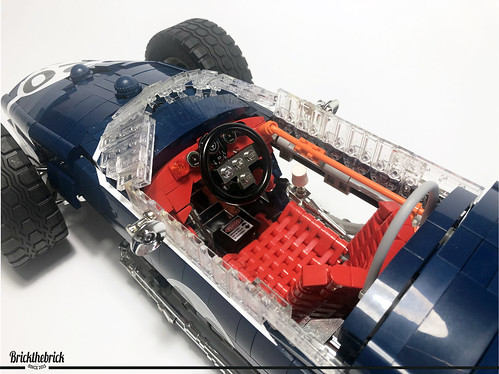
This beautiful creation is a Lotus 18, and it’s one of the most wonderful racing cars ever made.

Succeeding Colin Chapman’s Lotus 16 (what happened to 17?), the 18 was designed to compete in both Formula 1 and Formula 2, and was powered by a little Coventry Climax 4-cylinder engine, first in 2500cc and then 1500cc sizes when Formula 1 reduced the engine limit.

The 18 gave Lotus’ their first Formula 1 win, plus two-time World Champion Jim Clark his first Grand Prix drive, before he and Innes Ireland took Lotus to the Constructors Runner-up spot in the 1960 World Championship.

However it wasn’t just Team Lotus who raced the 18, with Rob Walker Racing leasing a car to be driven by a new hotshot driver by the name of Stirling Moss.

Moss won the 1960 Monaco Grand Prix for Rob Walker Racing, the first time a privateer team had ever one a Formula 1 race, with only two teams managing it since.

Moss went on to take another win later in the season, although the Lotus 18’s campaign was marred by Moss’s injury at Spa-Francorchamps which put him out for most of the championship, and fellow Lotus 18 driver Alan Stacey’s death at the same track, after the 26 year old driver hit a bird.

Moss returned to racing though, continuing to campaign the Lotus 18 successfully for Rob Walker Racing in 1961, winning another two races and taking third in the World Championship behind the two Ferrari drivers.

The Lotus 18 was quite an important car then. It gave not only Lotus, but several future racing greats their early wins, their first Formula 1 drives, and – sadly in Alan Stacy’s case – their last drive too.

This unfathomably good recreation of the Lotus 18 comes from Andre Pinto, whose stunning replica of Sir Stirling Moss’s 1960 race-winner is one of the finest historic racing cars that this site has ever featured.

Beautiful detailing and attention to detail is evident everywhere you look, and there’s lots more to see at both the Eurobricks discussion forum and at Andre’s ‘Lotus 18 Stirling Moss‘ album on Flickr.

Click the link above to take a look at one of the most important Formula 1 cars ever made.

Wet Nellie

The second most famous Bond Car of all time is actually the best. Discuss. This is ‘Wet Nellie’, the Lotus Esprit S1 from 1977’s ‘The Spy Who Loved Me’, that ‘transformed’ – by the push of a button – into a submarine. And nothing in the world is cooler than that.

Suggested by a reader, this is Paul Nicholson‘s fantastic recreation of the aquatic sports car, and not only does it look absolutely spot-on, it transforms too, with the wheels tucking in to reveal submarining fins, and the rear fins and propellers also folding out from within. Of course it wouldn’t be a classic Bond Car without some evasive weaponry too, and Paul’s Esprit duly replicates the front missile launcher, mine layer, and the rear missiles (that really fire) used by Roger Moore to escape Karl Stromberg’s henchmen.

It all adds up to something that would make a superb official LEGO set, and whilst LEGO don’t have a Lotus license, they do have a 007 one, with Paul’s model constructed in a matching scale to the 10262 Aston Martin DB5 ‘Goldfinger’ set. Plus how cool would it be to add Lotus to LEGO’s ever growing list of vehicle manufacturer partners?

There’s much more to see of Paul’s incredible creation at his Flickr photostream, where you can ask him to add it to LEGO Ideas where it would surely get 10,000 votes so we can all buy it one day. For what it’s worth TLCB would be at the front of the queue. Get wet via the link above.

Super Seventies

LEGO’s new 8-wide Speed Champions sets are generating a lot of interest in the online Lego community. Firstly because they’re rather good, and secondly because of those windscreen pieces. Suitable for all manner of cars, we’ve seen them pop up (and look perfect for) several real-world replicas as yet unlicensed by LEGO, including a Lamborghini Countach and Maserati Boomerang.

Today we have two more classic supercars that look made for the new part, Jonathan Elliott‘s superb DeTomaso Pantera (above) and RGB900‘s angular Lotus Esprit (below). Each captures their real world counterpart brilliantly and there’s more to see of both builds via the links in the text above.

Forty-Nine

We have a contender for Creation of the Year today. This utterly bewitching Lotus 49 is the work of Flickr’s Pixeljunkie who has not only recreated one of the greatest racing cars ever designed in spellbinding beauty, the model’s presentation is absolute perfection.

Pixel’s gorgeous model includes spectacular suspension, engine and gearbox detail and a superbly replicated ’67 Team Lotus livery complete with authentic logos and badging. It’s an incredible piece of work and you can see the images shown here in more detail via the link above, plus you read more about how the real car became one of racing all-time greats by clicking here.

Floatus

Lego Lotus Esprit Submarine James Bond

James Bond might be a dark and moody character these days (as he was in the books too), but there was a time when spying was a little more… extravagant.

The height of 007 ridiculousness was the late ’70s, when Bond went into space, spent more time on one-liners than actually secret agenting, and – in 1977’s ‘The Spy Who Loved Me’ – drove a sports car underwater.

It was a ludicrous scene, but one that cemented both Bond and Lotus into vehicular film royalty. Bond’s Lotus Esprit S1, modified by Q-branch, featured some rather ingenious optional extras, and – as Q always somehow seemed to manage – they were exactly what was required for the mission. What luck eh?

This brilliant recreation of the iconic movie car/submarine was suggested to us by a reader and comes from Luis Pena of Flickr. Luis’ ‘Wet Nellie’ as it was called (stop sniggering at the back!) includes all the cunning features of Q’s finest creation and there’s more to see on Flickr. Dive in via the link above.

Groundhog

Lego Lotus 79

As detailed in yesterday’s post, Ferrari are back on top after a few years in middle of the F1 pack, but there was a time when they barely won anything. And not because they had a bad car either.

Ferrari (and everyone else’s) woe was due to the utter dominance of one car, the pioneering Lotus 79, the first car to make full use of ground effect aerodynamics.

The first Formula 1 car designed using computer design aids, Lotus took downforce to an entirely new level, with the 79 producing 30% more of it than even their own car from the previous year. The suction generated by the 79 at speed was so strong that early cars suffered chassis fatigue and had to be strengthened to allow them to cope with race distances.

Lego Lotus 79 RoscoPC

The strengthening worked, and the cars went even faster in testing. Upon the 79’s debut at the 1978 Belgium Grand Prix Mario Andretti took pole by over a second, and won the race ahead of the next Lotus in second place by ten seconds, with Ferrari in third almost half a minute behind. In fact, so fast were the new Lotuses that Ferrari could only win if the 79s retired.

Lotus finished the season with 50% more points than the next nearest team, securing the 79’s position amongst Formula 1’s most dominant ever designs.

This spectacular homage to one of Formula 1’s greats is the work of previous bloggee and TLCB Master MOCer Luca Rusconi aka RoscoPC. Built eleven years ago, Luca has recently uploaded his model to Flickr, and despite its age Luca’s 79 is still one of the finest Lego F1 replicas you’ll see. Accurate decals, a working V8 engine, steering and suspension are all included, and there’s lots more to see at Luca’s Lotus 79 Flickr album by clicking here.

Lego Lotus 79

Lotus 49B | Picture Special

Lego Lotus 49B

Modern Formula 1 is almost all about aerodynamics. The art of directing airflow around a car seems quite mundane today, but when Colin Chapman first added ‘wings’ to his Lotus 49B in 1968 in order to generate downforce it was a revolution.

As is often the way with innovation, the other teams first tried to ban the Lotus, and then copied it, including its innovative use of the Cosworth DFV engine as a structural component in the chassis, and much of Chapman’s design is still in standard use in F1 today.

Lego Lotus 49B

Chapman’s Lotus 49 won both the Constructor’s and Driver’s World Championships twice, and also lays claim to being the first ever Formula 1 car to feature a racing livery, again – normal now, but a revolution in the 1960s.

This exquisite recreation of one of the greatest (perhaps the greatest) Formula 1 car ever designed comes from previous bloggee Lucas Rusconi (aka RoscoPC) who continues to upload his extensive catalogue of beautiful historic racing cars to Flickr.

Luca’s 1968 Lotus 49B features working suspension, steering, and a beautiful replica Cosworth DFV V8 engine, and you can see more of the build as well as his other incredible creations by clicking the link to his photostream above.

Lego Lotus 49B

Lotus 43 – BRM H16 | Picture Special

Lego Lotus 43 BRM H16

Race car building legend Luca Rusconi (aka RoscoPC) has been building his stunning historic racing cars for the best part of a decade. He’s recently uploaded another one of his glorious creations to Flickr (where we hope many more will follow), and thus we’re able to publish it here. It’s also one of the weirder racing cars in Luca’s garage, although it might not look remarkable at first glance.

Any classic racing fan will know of the incredible performances of the Lotus F1 team. Led by Colin Chapman, and powered by the legendary Cosworth DFV engine, the partnership delivered four Driver and five Constructor World Championship titles. However, before the DFV was ready Chapman needed an engine to put into his new 43 Formula 1 car for the 1966 season. He turned to previous Championship Winners BRM, and their unique P75 H16 engine.

Lego Lotus 43 BRM H16

Yup, H16. Basically two Flat-8 engines stacked on top of one another, yet only 3 litres in capacity. Unfortunately the unusual design was unusual for a reason – reliability. Or lack of it.

Heavy, extremely complicated, and constantly breaking, the BRM engine in Chapman’s Lotus 43 caused it to retire from every race bar one during the 1966 season. However, that one finish was a race win at the United States Grand Prix at Watkins Glen, showing that when it worked, the Lotus 43 was quick. Really Quick.

The following year in ’67 the new Cosworth DFV 3 litre V8 engine was ready, Ford added their sponsorship to it (in a stroke of marketing genius), and the year after that the DFV starting a Championship Winning streak that went unbroken for seven years.

Lego BRM H16 Engine

BRM’s mental P75 H16 engine was quickly forgotten, although the team continued to produce Formula 1 cars until the late 1970s, and Lotus forged on with a Cosworth partnership that was to become one of the most successful ever seen in the sport.

However, we think the Lotus 43 BRM H16 deserves a little recognition. It was a race winner after all, and for a brief moment two of Britain’s greatest F1 teams combined to produce something, well…  a little bit crap.

RoscoPC’s homage to that disastrous partnership pictured here was first built in 2010 and is now available to view in wonderful detail on Flickr. It features working steering, suspension, beautiful detailing, and – of course – a recreation of one of the maddest engines ever seen in Formula 1.

You can see all of the images of Luca’s incredible Lotus 43 build at his photostream via the link above, and if you’re curious to know what an H16 Formula 1 engine sounds like, click here…

Lego Lotus 43 BRM H16

The Killer Years – Historic F1 Picture Special

Lego Lotus Ford 72D JPS

Every so often we receive a suggestion here at TLCB that makes the whole office stop what it’s doing (which today seemed to mostly be Google-imaging attractive Rio Olympics athletes) to gaze in wonder at the creation/s found. This was definitely one of those moments.

Lego Ferrari 640 Formula 1

These incredible Model Team classic Formula 1 replicas have all been built by newcomer Idihnab Szalab from Hungary, and he’s uploaded all four to MOCpages in one go. Each is an exquisitely detailed creation that perfectly captures one of the Formula 1’s most famous and iconic cars in Lego form.

Lego Williams-Honda FW11

From top to bottom Idihnab has built; the dominant 1972-75 Lotus-Ford 72D in John Player Special livery, Ferrari’s 1989 640, the double World Championship-winning 1986-87 Williams-Honda FW11, and lastly the beautiful Lotus-Ford 72C from 1970-71 in magnificent Gold Leaf livery.

Lego Lotus Ford 72C Gold Leaf

We can’t recommend paying Idihnab’s MOCpage a visit enough – click here to view all four incredible creations and to step back in time to Formula 1’s greatest era.

Red Letter Day

Lego Cars

It’s been an uneventful few days here at TLCB Towers, as not a single Elf has returned with anything of note. Out of patience, we summoned Mr. Airhorn and chased any remaining Elves out of the office. When they’re hungry enough (which won’t take long) we’ll have some more models to blog…

In the meantime we can keep the cars coming thanks to some of your suggestions.

From left to right; Previous bloggee Alexander Paschoaletto‘s tidy Model Team Koenigsegg CCX, previous bloggee Rage Hobbit‘s remote control Technic Lotus Elise S, and newcomer Ben Smith‘s lovely Model Team Dodge Viper GTS.

You can see more of each of today’s submitted creations via the hyperlinks in the text above, and if you’d like to suggest a creation too you can do so via the Feedback page found in the main menu.