Tag Archives: Mitsubishi

The Renfe in Spain*

Neither of today’s posts are cars, because… shut up, that’s why. We like trains. This is one is a Spanish Renfe S-251, designed and built by Mitsubishi Heavy Industries, and it comes from Flickr’s Ferro-Friki who has captured the 1980s electric locomotive superbly in brick form. There’s more of the model to see at Ferro’s ‘LEGO Renfe S-251’ album and you can buy your ticket at the link above.

*Today’s title song. We’re nothing if not diverse.

Tokyo Drift

When the ‘Fast & Furious’ franchise headed for Japan for its third instalment, abandoning its main characters in the process, drifting was the new street racing. And the obvious car for drifting is an all-wheel-drive saloon famed for its grip…

Still, a lot more of the plot made a lot less sense than the inexplicable choice of a Mitsubishi Evo IX, so we’re willing to look the other way. Particular as it’s led to a creation as brilliant as this.

Recreating Sean’s modified Mitsubishi Evo IX from the movie, previous bloggee ArtemyZotov has constructed a superb homage to the Japanese super-saloon, with working steering and suspension, a highly detailed transverse 4-cylinder engine, opening doors, hood and trunk, and movie-accurate decals.

Building instructions are available and you can try to get sideways in Tokyo in a deeply inappropriate car at the Eurobricks forum via the link above.

Peak Mitsubishi

It’s hard to believe today, but back in the 1990s Mitsubishi where one of the most advanced, dynamic and sought-after brands on the planet.

Dakar-winning 4x4s, World Rally Championship-winning sedans, and iconic street-racer favourites all came from Mitsubishi Motors, as did this – the wonderful 3000GT.

Available with a twin turbo-charged 24 valve V6, all-wheel drive, all-wheel steering, and even active aerodynamics, the 3000GT was a technical tour-de-force, becoming both a mainstay of ’90s racing games as well as proving to be quicker than much more exotic and expensive rivals on real roads.

Cue this fantastic recreation of Mitsubishi’s high water mark from Mihail Rakovskiy of Flickr. Opening doors, hood and tailgate, a highly detailed engine and interior, a brick-built drivetrain, and even accurate badging all feature, and you can check out more of Mihail’s stunning replica of the Mitsubishi 3000GT at his album of the same name via the link above.

And what of Mitsubishi Motors in 2025? Well their badge is now stuck, rather unconvincingly, on a Renault compact crossover… We’ll stick to the ’90s.

Not a Bad Way to Spend $10,000

The infamous words of Dominic Toretto, after lifting the hood of Brian O’Conner’s modified Mitsubishi Eclipse, and listing several things you wouldn’t be able to see by lifting the hood.

A ludicrous street race and the Mitsubishi’s demise at the hands of a Japanese motorcycle gang would follow, as would ten mostly terrible movies, and a whole load more modified cars.

But back to Brian’s first ride in the franchise, and previous bloggee ArtemyZotov, who has remembered the short-lived Eclipse from ‘The Fast and the Furious’ by recreating it in Technic form, complete with custom rims, opening doors, hood and trunk, working steering, and the option of remote control drive.

There’s more to see at both Eurobricks and Bricksafe, and building instructions are available so you can recreate your own ‘Fast & Furious’ street race at home. Click on the links above to race for pinks, and here to see the Eclipse’s rather more famous replacement.

My First Pick-Up

In TLCB’s home nation, first cars tend to be rubbish. The Inbetweeners’ Fiat Cinquecento may have been a running joke throughout the series, but it was also perfectly accurate for most of us. Imagine our surprise then, when newcomer and Italian builder brittle.lime.joint / CaptainSerMig recreated his first car in Lego form and it wasn’t a crappy little Fiat.

No, his first wheels were all driven, coming attached to a third-generation Mitsubishi L200 double-cab pick-up. Which is about a thousand times cooler than whatever we were driving in our late teens.

Brittle’s brick-built replica of his first car includes working steering, accurate independent front and leaf-spring rear suspension, plus opening doors, hood and tailgate, and there’s more of his model to see at both Eurobricks and Flickr. Join us in wishing our first wheels were as cool as his via the links above.

Golden Air

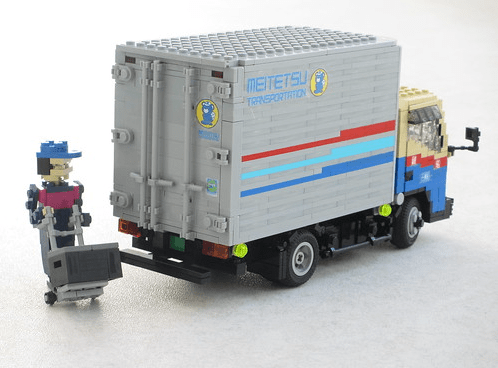
We haven’t written a post regarding golden air transport since we blogged about Donald Trump’s Air Force One showers*. Today though we’re back to golden air travel, courtesy of Ralph Savelsberg and this lovely Mitsubishi Fuso Canter box truck, wearing the livery of Japan’s ‘Meitetsu Golden Air Cargo’ company.

Ralph has captured both the truck and livery beautifully in Miniland scale, and there’s more of the Meitetsu Mitsubishi to see at his photostream. Click here for golden air delivery.

*Trump likes to be pissed on.

Cool Box

Like the Ford F-150 in America, the Honda Super Cub in East Asia, and the Toyota Corolla almost everywhere, the Mitsubishi Fuso Canter is background street furniture for a huge proportion of the world.

Built in half-a-dozen countries, across eight generations and six decades, and re-badged as a Hyundai, Nissan, plus a host of other brands, the Canter is one of the most widespread and ubiquitous vehicles on the planet.

This one is a fifth generation fridge truck version, as used in their thousands to deliver food produce in the world’s restaurant back-streets. It comes from Max Ra of Flickr, who has recreated the Canter brilliantly, picking out the details of what is essentially a white box to create an instantly-recognisable brick-built replica.

There’s more of the model to see at Max’s ‘Mitsubishi Canter 5th Generation Refrigerated Truck’ album, and you can take a look at all the images via the link in the text above.

Christmabishi

The seamlessly Christmas-linked titles keep coming here at The Lego Car Blog. You don’t get that kind of professionalism at The Brothers Brick. Anyway, here’s another definitely-Christmassy post, in the form of a mid-00’s Mitsubishi Evo IX, as created by Daniel Helms (aka danielsmocs).

There’s working rubber-band suspension, opening doors, hood and trunk, a detailed and removable engine, lifelike drivetrain and interior, and custom decals and wheels, with more to see at both Eurobricks and Flickr.

Have a Merry Chrismabishi via the links above!

What’s in a Name?

This is the Mitsubishi Pajero. Except in Spanish-speaking countries, where it’s definitely not.

Nor is it in TLCB’s home nation, where ‘Pajero’ isn’t an exceptionally rude word, but where ‘Shogun’ just sounds cooler.

Anyway, whatever it’s called, this Lego recreation of the ’90s Pajero/Shogun/Montero by regular bloggee SP_LINEUP is rather excellent, and there’s more of it to see at his photostream.

Click the link above to take a look. Unless you’re Spanish.

SuperGreat

Unlike today’s other off-road truck post, this one certainly doesn’t have a bland name. The Mitsubishi Fuso SuperGreat FX 6×6 is an off-road military tow truck, depicted here in Technic Japanese Self Defence Force form.

All six wheels are driven by a Medium Motor, the steering is powered by a combination of a  Medium and a Micro Motor, whilst the crane rotation, elevation, extension, and outriggers are all controlled manually.

Leaf-spring suspension features too and there’s more to see courtesy of LXF (Brickshelf) / syclone (Eurobricks) via the links.

Mitsubishi Memories

Mitsubishi Motors make precisely nothing that we would ever want to buy, drive, or ride in.

That Mitsubishi’s recent emissions fraud in Japan meant their share price dropped low enough for the Renault-Nissan Alliance to buy them (and then confirm they were pulling the brand out of Europe altogether) only makes us pleased, because there’s less chance of us having to look at the back of one of these.

Which makes it all the sadder that Mitsubishi Motors used to make some rather excellent cars, such as the mid ’90s Galant, the weird FTO, and this, the Lancer Evolution.

With all four wheels driven by a two-litre turbocharged four-cylinder, the Lancer Evo and its Subaru Impreza WRX rival were way ahead of the European and American competition in the ’90s, as demonstrated by Japan’s utter dominance of the World Rally Championship at the time.

Both Subaru and Mitsubishi developed their cars every year or so too, with the latter handily applying roman numerals to the nameplate so it was easy to see who had the latest version.

This particular Lancer is a ‘V’, which appeared for just one year exactly halfway through the Evo’s development. Previous bloggee Fuku Saku has captured the Evo V brilliantly, using some properly clever techniques to recreate the late ’90s performance car icon.

There’s loads more of Fuku’s build to see at his ‘Mitsubishi Lancer Evo V’ album on Flickr; click the link above to make the jump, and remember a time when Mitsubishi made more than just air-conditioning units. And this.

Red Rice

We’re not sure where the term ‘ricer’ came from in America, but today it’s defined as ‘Race Inspired Cosmetic Enhancements’, which means it seems to have transcended any xenophobic origins and can be used to describe any car modified in a ‘ricey’ way.

What we do know is that three favourites recipients of the term, at least according to the internet, are the Toyota Supra (specifically the Mk4 variant), the Mitsubishi Lancer Evo, and the Honda Civic, each of which has been recreated brilliantly in lightly-riced form by TLCB regular SP_LINEUP.

Each includes opening doors and hood, plus a detailed interior and engine bay, and some can be bought from SP in kit form too. Click the link above to visit SP’s photostream to see more of each build and the rest of his extensive back-catalogue.

Little Floater

The Second World War, for all the death and destruction it wrought, did provide the catalyst for some amazing technological advances. Sticking some floats underneath a Mitsubishi A6M Zero fighter probably isn’t in the top three though, but the result is still rather cool. The Nakajima A6M2-N ‘Rufe’, developed from the infamous Zero, turned the land-based fighter/bomber into an amphibious floatplane. Just over 300 were produced between 1942 and the end of the war, with last being operated by the French following its capture in Indo-China. This ingeniously constructed small scale version comes from John C. Lamarck of Flickr, who has captured the Rufe’s unique asthenic brilliantly in miniature. See more at John’s photostream via the link.

What’s in a Name?

Lego Mitsubishi Shogun Pajero

This is the Mitsubishi Pajero. Or not, depending on where you live. Mitsubishi’s toughest 4×4 was originally named after the pampas cat (Leopardus Pajeros), but the word means something entirely different in many Spanish-speaking countries…

TLCB Towers are not situated in a Spanish-speaking country, but nevertheless the big 4×4 is called something different here too. The Shogun, as it’s known in our market, was one of the founders of the modern SUV craze, but has long since been left behind by more car-like rivals. In fact we can’t remember the last time we saw a new-ish Shogun on the road.

We do still occasionally see early ones though, as they keep going forever. This lovely 6-wide mini-figure scale model of a late ’80s Shogun comes from previous bloggee Pixel Fox, adding to his already impressive line-up of Lego 4x4s. Take a look via the link above.

Perfect Pajero

Lego Technic Mitsubishi Pajero

This little red box is a 1980s 3-door Mitsubishi Pajero, and we want one. Launched long before the SUV/crossover craze arrived, the humble Pajero came from a time when Japanese off-roaders ruled, and they really could go off-road. This made them horrible to drive on-road of course, but back in the ’80s if you bought a Pajero there was probably a good chance that you did actually want to take it away from the black stuff.

Lego Technic Mitsubishi Pajero

This brilliant Technic recreation of one of the finest ’80s 4x4s comes from Kevin Moo of Eurobricks, and not only does it look absolutely spot-on it’s packing some neat functionality too, with remote control drive and steering, LED head and tail lights, working suspension, and an opening hood, doors and tailgate. There’s lots more to see of Kevin’s remote controlled Mitsubishi Pajero model at the Eurobricks discussion forum – Click the link above to make a jump to 1982.

Lego Technic Mitsubishi Pajero