Tag Archives: Technic

Universally Speaking*

This 1950s East German oddity is not a tractor. It is, apparently, a RS09 ‘universal carrier’, and we’ve deliberately chosen an image that hides just how weird it is. Powered by a two cylinder diesel engine that made about one bhp, the RS09 was produced from the mid-’50s until the mid-’70s, and could be attached to any number of Communistical mechanised items.

Built by Jundis, this smart Technic recreation of the RS09 features a straightforward digging bucket in place of some of the weirder attachments, and also includes a working two-cylinder piston engine with power-take-offs, a mechanically raising/lowering drawbar linkage, and an oscillating front axle with steering.

There’s more to see of this Radschlepper 09 Universal Carrier on Eurobricks, where you can see further imagery including a photo of the decidedly strange real thing, and where Jundis assures us some of the weirder attachments are soon to follow. Click here to check it out.

*Today’s title song

Mr. Kleinstein’s Steam Powered Amusements

Today at TLCB we’re trumpeting this glorious traction engine and trailer built by previous bloggee Nikolaus Löwe (aka Mr_Klienstien), who has opened up his own steam-powered amusement arcade!

Frogger, Time Crisis, and Sega Rally probably aren’t included, (and we’re not really sure what a steam powered amusement might consist of. Well, we had some ideas but they’re definitely not right), but you can see more of the beautiful traction engine that would power them along with the trailered living accommodation that accompanies it at Nikolaus’s ‘Showman’s Engine ‘ album on Flickr.

Click the link above to let one rip!

Super Stripe

This stunning Technic Supercar comes from previous bloggee Nico Lego (aka Levihathan), and it might just be our favourite of the year. Which may or may not be because of that wicked-cool stripe. There’s more than just the stripe to like though, as Nico’s creation is packed with old-school Supercar functionality, including working steering, suspension, a mid-mounted transverse V6 engine hooked up to a 5+R gearbox, and an opening engine cover, front ‘trunk’, and cockpit canopy. Plus it has a wicked-cool stripe.

There’s more to see of Nico’s stripe and the Technic Supercar attached to it at his Flickr album, where over thirty high quality images are available to view, detailing the exterior, chassis, working functions, and stripe. Click the link above to make the jump to our favourite stripe Technic Supercar of the year so far.

Skippy

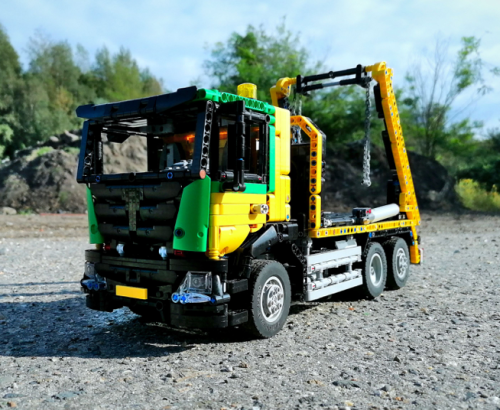
No, not that usefully nosey kangaroo (which was effectively a two-legged knock-off of Lassie), but this marvellous Scania P220, known to The LEGO Company as a ‘container truck’. Which of course it isn’t, because it’s a ‘skip lorry’.

Said skip lorry comes from Oliver 79 of Euroricks, who has recreated a Scania P220 truck with a skip hoist mounted on the rear. A pair of manually controlled linear actuators raise the mechanism just like the real thing, there’s a working 6-cylinder engine underneath the detailed tilting cab, functioning steering and suspension, plus working stabiliser legs too.

It’s a superb blend of Technic functionality and Model Team detail, finished with a perfectly recreated yellow skip. Well nearly; it is missing an old lady’s bathroom as all skip lorry models seem to be. Despite this omission it’s a stellar build and one that’s definitely worth a closer look. Skip over to Eurobricks via the link above to do just that.

Secondary Silo

LEGO’s 42112 Technic Concrete Mixer Truck set has split opinion here at TLCB. It looks rather good, continuing the trend of almost Model Team levels of detail alongside working Technic functionality, but to help it accomplish this (and presumably to save cost), the rotating drum is a single purpose-made part, which surely isn’t the point of LEGO at all.

However proving us wrong is Eurobricks’ blaz62, who has redeployed this seemingly single-use piece to a new purpose with his silo transport 42112 B-Model. Featuring working steering, fifth wheel, trailer support legs, and a silo loading/unloading mechanism, blaz’s alternate is packed with Technic functionality centred around the 42112 drum part.

There’s more to see of blaz’s 42112 B-Model, including full specification details, a video demonstrating the model’s features, and a link to building instructions, at the Eurobricks forum. Click the link above to take a look, whilst TLCB Team ponders other uses for that drum piece, with suggestions so far limited to a submarine or a bomb…

Constructive Air

Large, potentially dangerous, and full of air. No, not the 2020 U.S Presidential Candidates, but this excellent Technic backhoe loader from Shimon Bogomolov. Unlike the aforementioned angry old men, Shimon’s impressive creation uses the air within it for constructive purposes, with a working pneumatic front bucket and rear excavating arm. Air pressure can be generated manually or via a motorised compressor, plus there are working pneumatic stabiliser legs, steering, all-wheel-drive, and a 4-cylinder piston engine too. A complete gallery of images is available to view at Shimon’s ‘Pneumatic Backhoe’ album on Flickr, plus you can join the discussion at the Eurobricks forum by clicking here.

My Other Car’s a Corvette

TLCB’s Coronavirus Lock-down B-Model Competition is complete, although a lock-down could be on the horizon again as COVID-19 cases surge around the world and deaths pass one million. Oof.

Dozens of brilliant B-Models were produced for the contest, and whilst the competition may be over, alternate building keeps going, as demonstrated here by TLCB Master MOCer Nico71.

Constructed only from the pieces found within the 42093 Technic Chevrolet Corvette set, Nico has created this cool-looking sand buggy, complete with working suspension, a transverse three-cylinder engine, and functioning steering.

Nico has also made instructions for his alternate available so that you can convert your own 42093 Corvette into a sand buggy at home, and you can see all the images and find a link to building instructions on Brickshelf by clicking here.

Wangan Midnight

If there’s an unmodified R32 Skyline GT-R in existence, we’re yet to see it. And so to today’s creation, which has also cast OEM originality aside in order to create something rather more special. Which does mean it features a few non-LEGO parts, but seeing is the real car upon which it’s based features a few non-Nissan ones, we think it’s alright.

Built by Gray Gear of Eurobricks, this Nissan Skyline GT-R R32 recreates the car from the Wangan Midnight cartoon, including custom wheels, a replica straight six engine refitted with a single-shot turbo, and a few bodywork parts not officially produced by LEGO, seeing as they don’t come in black.

The model also features a working six-speed gearbox, all-wheel-drive, all-wheel independent suspension, functioning steering, plus opening doors, hood and trunk. There’s more to see for all of that at the Eurobricks forum via the link above, whilst we fall deeper into the Wangan Midnight YouTube rabbit hole.

The Boss

The muscle car market has gone mad in recent years. Upwards of 700bhp is now available from stock, and whilst many modern muscles cars have now added revolutionary new technologies such as ‘steering’ and ‘suspension’, we suspect actually using all that power is a difficult thing to do. Resulting in happenings like this. And this. And this. And this.

Things were little different back in the late ’60s, when the first power race between muscle car makers began. This was one of Ford’s efforts from the time; the Mustang Boss 429. The ‘429’ moniker stood for the V8 engine’s cubic inch capacity, which translates to seven litres. Seven. Most European cars at the time made do with just over one.

Of course the Boss’s steering, braking and suspension were – in true muscle car tradition – woefully inadequate, meaning that morons-with-daddy’s-money in 1969 could plow their new car into a street light in much the same way as they do today, only without the event being captured on YouTube.

Today though, we’re joining the muscle car crashing fraternity too, thanks to Hogwartus, and this superb SBrick-powered remote control Technic Boss 429.

Driven by two L Motors, with a Medium Motor turning the steering and another controlling the four-speed sequential gearbox, Hogwartus’s creation is a riot to drive. That is until we spun it into a kitchen cabinet. We’ll blame the Mustang-accurate torsion bar rear suspension for that faux-par. The front suspension is independent though, and the model also includes opening and locking doors, hood and trunk, a replica 7-litre V8 engine (that turns via the drive motors), sliding seats, and LED headlights.

There’s more to see of Hogwartus’s stunning Technic ’69 Mustang Boss 429 at the Eurobricks forum by clicking here, plus via the truly excellent video below, which must be one of the few Mustang videos on YouTube that don’t end like this.

YouTube Video

Skip This

Trucks such as this one always seem to have fancy names when LEGO produce them. Not at this blog though, where they are simply known as a ‘skip lorry’, seeing as they’re a lorry with an, er… skip. Said skip is usually full of an old bathroom, ripped out of an old lady’s bungalow when the new owners moved in, and all the junk from the neighbourhood lobbed into it by every house within walking distance whilst it was on the road.

Previous bloggee Damjan97PL/damianPLE’s fully RC Technic skip lorry is so realistic we’re surprised it doesn’t come with an old lady’s bathroom in the skip on the back to be honest, but besides that rather glaring omission he’s nailed it.

An SBrick provides bluetooth control for the motorised drive, four-wheel steering, raising/lowering rear axle (with automatic steering detachment when raised), and the skip loading arm, whilst there’s also a working six-cylinder engine underneath the tilting cabin, manually operated stabiliser legs and functioning suspension too.

There’s more of Damain’s remote control skip lorry to see at both the Eurobricks forum and at his Bricksafe gallery – click the links to chuck your rubbish on top of an old lady’s bathroom.

Sideways in the Soviet Union

Matthew Terentev’s Volga/GAZ-2402 station wagon has appeared here before, being a somewhat unusual choice for a Technic ‘Supercar’, with working steering, engine, and suspension. He’s now gone a step further though, replacing the miserable inline 4-cylinder engine with a V8 (which the real 2402 was actually available with), and he’s added a whole host of other exciting modifications including lowered suspension, aero, and – most importantly – racing decals and stripes, which are worth at least an extra 200bhp on their own.

We’re not sure how suited a Volga/GAZ station wagon is to drifting (about as much as your Mom is to the 110m hurdles we suspect), but because we’re rather sad here at TLCB we love unlikely cars turned into racers. Plus the Elves would’ve have rioted had we not blogged a drift car with racing stripes.

There’s more to see of Matthew’s drifty GAZ-2402 station wagon (and the unmodified permit-only family car on which it’s based) at his photostream. Go sideways in the Soviet Union via the link above!

LEGO Engineering Fundamentals – Interactive eBook | Review

It’s been a Technic-filled day at TLCB, but are you looking at some of the models featured here and wondering how they work? From steering and suspension, to ratchets, walkers, gearboxes – LEGO Technic can be used to create any mechanism you can think of. And probably a lot you can’t.

And that’s where Jorge Moreno Barrios’ eBook ‘LEGO Engineering Fundamentals’ shines, as the first 3D interactive guide to creating incredible mechanisms (and the basics too) from LEGO Bricks.

We were given access to an early copy of Jorge’s eBook, which is available to purchase through Apple Books, to assess how it works. And how it works is rather brilliant.

‘LEGO Engineering Fundamentals’ is divided into five chapters, each of which features 3D interactive renders of the subject;

1. LEGO brick alignment (effectively the measurements needed to build)
2. A complete 3D catalogue of LEGO Technic parts, sorted by use (e.g. ‘steering’, ‘gears’ etc.) with part numbers
3. Simple machines, consisting of levers, pulleys, wedges and screws
4. Basic mechanisms, including gears, ratchets, cams, chains, and junctions and linkages
5. Basic structures

Each render can be rotated on any axis, allowing the reader to see it from any angle, with the moving components rotating/sliding/lifting on a loop as if they were built from real bricks. Rotating the subject also reveals Jorge’s explanation of the render in question, with key words highlighted to ease understanding. If that sounds complicated it isn’t, and it works wonderfully. Naturally we can’t share the interactive element here, but hopefully the static images we’ve included will provide some insight.

In the examples above the inputs and outputs turn on the screen, with all the components of each mechanism following suit. Many of these are very simple pulleys and levers, taking readers through the basics of both Technic building and machines in general, but some – despite the ‘basic’ in the chapter titles – delve into advanced physics, recreating the beautifully intricate designs by noted engineers and kinetic sculptures. Again, each of these is completely interactive, and is ‘alive’ on the screen running through its mechanised loop to demonstrate how the design works in practice, with some looking really rather incredible indeed.

It’s mechanisms such as these we think readers will find most useful, as ‘LEGO Engineering Fundamentals’ provides a toolbox of options for ‘I want my creation to do [this], but I don’t known how’.

So is the eBook perfect? – It is Version 1 after all.

Not yet, as there are a few of refinements we’d like to see for v2, chief among which is a contents page. The ‘How this book works’ animation also didn’t work on our copy, and there a few official LEGO sets rendered within the book that are – we think – used as examples of either parts or mechanisms in action, but without any explanation. A brief ‘Set No. [xxxx] uses pneumatic cylinders and a basic lever. You can find details of these on pages [x]’ would definitely help to explain their context. The same is true for a few mechanisms that don’t have descriptive text – often because it isn’t needed, but we would prefer at least a title for every render as a minimum.

Verdict
Despite a few obvious improvements, the basics behind ‘LEGO Engineering Fundamentals’ are superb, and the first time you rotate a moving mechanism on screen to see the explanation appear you do go ‘Ooooh!’. Well we did anyway.

It’s also the first book we’ve received here at TLCB that has actively made us want to try creating new things, things we would never have thought of on our own, nor had the engineering capability to do. For that reason alone we can’t recommend ‘LEGO Engineering Fundamentals’ highly enough.

For now, this is a four star book. With a few tweaks for v2, it’ll be an easy five.

★★★★

Buy LEGO Engineering Fundamentals eBook via Apple Books here

Big Red

The halls of TLCB Towers were a bustling place today. Several Elves have recently returned with finds, TLCB staff were pretending to be busy to avoid sweeping up the cage room, and the Le Mans 2020 livestream was ticking over in the corner. All of which meant we were thoroughly distracted from the Elf proudly riding atop this rather brilliant remote control Caterpillar D10 bulldozer until it was too late.

‘Too late’ in this case means we now have a bit more than sweeping up to do, as several Elves have been smeared across the corridor (and over the front of the bulldozer) thanks to builder keymaker‘s inclusion of four Power Functions motors and a third-party BuWizz bluetooth battery, controlling the drive, steering, and ripper and blade mechanisms.

Individual suspension on the tracks’ jockey wheels plus track tensioners meant the blade stayed at Elf-smearing height even if one of them went under the tracks, whilst a working V8 engine, detailed cabin and engine bay, and opening doors and tool compartment add to the realism, if not the Elf-smushing capabilities.

We now have some considerable floor cleaning to do, as a number of our smelly little workers were caught off guard and fell victim the the D10’s blade, then tracks, then ripper, which doesn’t sound fun at all. Whilst we get on with that you can see more of keyworker’s most excellent creation at both the Eurobricks forum via the link above, or on Bricksafe, where over forty high quality images are available to view.

Lastly, if you’re wondering how mechanisms such as those found on keyworker’s ‘dozer work then come back to The Lego Car Blog later today where we’ll be sharing an awesome new tool that does just that!

Lime Horse

Painting a Ferrari in Lamborghini green will probably get you a ‘Cease and Desist‘ letter from Ferrari’s over-zealous legal department, but seeing as this one is constructed from left over bits of Lamborghini, it makes sense. Flickr’s James Tillson is the builder behind this lime green Ferrari Dino 246, and he has form, winning TLCB’s Lock-Down B-Model Competition with his previous Lamborghini-to-Ferrari conversion. His Ferrari Dino features the usual Technic Supercar functions and there’s more of the build to see at his photostream – click here to take a look before Ferrari write him an angry letter.

Striped Skyline

It’s an entirely Technic day today here at The Lego Car Blog, starting with this; LoMaC‘s neat Nissan Skyline R34, complete with a working six cylinder engine, steering, and opening doors, hood and trunk. Oh, and some Shelby-esque racing stripes, which means it gets the Elves’ seal of approval. Building instructions are available and there’s more to see on Flickr via the link.