Tag Archives: Classic Car

El Campino

Aaaand at the other end of the Chevrolet cool scale we have this; a dilapidated El Camino camper, cobbled together from assorted junk, inhabited by someone you’d expect to see throwing dice in an alley, and parked in a swamp. It’s TLCB of cars.

Which means we feel right at home posting ‘Florida Man’s El Camino & Cab-Over Camper’ by previous bloggee IBrickedItUp, and you can join us huntin’ ‘gators in the swamp via the link above.

Low Level Coolness

TLCB Staff are absolutely, tragically, deeply uncool. We work for free in a building with less structural integrity than the Lego creations we feature, our workforce is formed of mythical creatures that could well be figments of our imagination, and for all he knows this Writer is typing these words from a secure psychiatric facility onto a Casio PT-80.

But if we were cool, and we really aren’t, this is what we’d drive.

Tony Bovkoon‘s magnificent ’64 Chevrolet Impala Lowrider might just be the coolest vehicle we’ve ever seen, and not only does it look spectacular, it really, er… lowrides, with four L Motors driving linear actuators that control the suspension movements, allowing the Impala to twist and bounce just like the real thing.

A further two L Motors and a Servo deliver remote control drive and steering when for when the Impala isn’t lowriding, but that’s like wearing a baseball cap the right way round. Or some other cool-based reference. Like we said, we really aren’t cool.

But Tony’s ’64 Chevrolet Impala is, and you can check it out on Flickr, plus you can watch it in action here. Take a look via the link above if you’re cooler than we are.

Cream Dream

Things this TLCB Writer would like; More sleep, better hair, Jennifer Lawrence’s phone no., and a modified Toyota FJ60-Series Land Cruiser.

Whilst the first three aren’t going to happen any time soon we do have the latter here today, courtesy of regular bloggee 1saac W, whose superb brick-built FJ60 – suitably modified for overland adventures – is an absolute dream car.

Big tyres, a bull-bar, a roof cage, and a snorkel make the already awesome FJ60 even cooler, and you can check out 1saac’s brilliant build on Flickr via the link above.

Black Russian

Luxury cars behind the Iron Curtain were not a common sight, thanks to the automotive drudgery created by Communism. Which was probably a relief to most citizens, as the sight of one could mean things were about to get very unpleasant indeed. Fortunately there are no KGB agents (or bodies)* in Legostalgie‘s wonderful recently upgraded Volga GAZ-24, and there’s more to see of his splendid creation on Flickr.

*We can’t see in the trunk though…

Build-a-Buggy

The Volkswagen Beetle-based Meyers Manx beach buggy is one of this TLCB Writer’s very favourite vehicles. Designed by Californian boat-builder and surfer Bruce F. Meyers in 1964 for desert racing, around 6,000 Beetles were converted, with the design becoming a symbol of ’60s Cali Surf Culture. This lovely Model Team version of Meyers’ brilliant design comes from Flickr’s Johnni D, who has made instructions available so you can build one for yourself. Head to the California in the mid ’60s via the link above. Dude.

’80s Joyride

Volkswagen weren’t the only car manufacturer to attach the letters ‘G’, ‘T’ and ‘I’ to a family hatchback on the 1980s…

The Peugeot 205 GTI was an absolute sensation when it arrived in 1986. Powered by a 1.6 litre engine making 104bhp, and later a 1.9 litre making over 120bhp, the GTI was fast, fun, and wildly popular.

So much so that, like Volkswagen’s offering, quite a few people wanted to have a go even if they didn’t own one. Hot hatchback thefts rocketed, shortly followed by insurance premiums, and sales plummeted.

But Peugeot can’t really be blamed for joy-riding scumbags, and the 205 GTI is now a bona-fide classic, a high water mark for the brand that they are still to beat some four decades later.

This wonderful Technic recreation of Peugeot’s finest hour comes from TLCB Master MOCer Nico71, who has captured the 205 GTI magnificently.

Featuring working steering, functional suspension, a detailed engine under an opening hood, a life-like interior behind opening doors, and an opening tailgate too, Nico’s 205 GTI is about as visually realistic as it’s possible for a Technic model to be.

Plus best of all – like the aforementioned scumbags that nearly killed the hot hatchback genre altogether – you can have a go without having to do the work yourself!

Yup, Nico has made building instructions available too, with his design buildable in ’80s-appropriate red, black or white, and you can take a closer look – as well as a find a link to those instructions – at Nico’s Peugeot 205 GTI gallery on Brickshelf.

Click the link above to start our ’80s joyride!

Green Wart

The Soviet Union united multiple nations, languages, cultures and peoples into one giant bloc of automotive misery.

The Union’s ‘planned economy’ meant that those that could get their hands on a private car, after waiting over a decade for the privilege, could choose between a polluting two-stroke econobox, or another polluting two-stroke econobox. This was the ‘other’ one for East Germans between ’66 and ’88, the Wartburg 353.

The Wartburg 353 wasn’t a bad car when it was launched in 1966, although the engine coming from a 1930s design wasn’t a high point, and was even exported to the West (TLCB’s home nation included).

It was a bad one by the 1980s though, as the Communistical restrictions on the populous meant it didn’t need to keep pace with the Western cars that were unavailable behind the Iron Curtain. If you needed a car in East Germany it was this or the Trabant…

Previous bloggee Legostalgie has recreated the Wartburg 353 sedan beautifully in green bricks, following his brown estate version that featured here last year. The doors, hood and trunk open, there’s a wonderfully life-like interior, and there’s more to see at Legostalgie’s ‘Wartburg 353’ album on Flickr, where a link to building instructions can also be found.

Jump back to Soviet East Germany via the link above, plus you can check out two of Legostalgie’s previous communist cars via the bonus links.

The Graduate

The second most visually arresting thing in 1967’s ‘The Graduate’, the Alfa Romeo Duetto Spider is surely one of the most beautiful cars ever made.

Costing the same as a Jaguar E-Type, early Spiders were fantastically expensive for a 1.6 litre 108 bhp 4-cylinder, but none of that mattered when they looked this good.

Marco Q thinks so too, having constructed this glorious early Duetto Spider, with opening doors, hood and trunk, working steering, and a brick-built recreation of the stunning mid-’60s Pininfarina styling.

There’s much more of Marco’s beautifully presented Alfa Romeo Duetto to see at his photostream, where further top quality images are available, and you can click the link above to graduate.

Recovering the Satellites*

This wonderful 1971 LAPD Plymouth Satellite police car was discovered by one of our Elves on Flickr. It comes from regular bloggee Jonathan Elliott, whose Speed Champions scale models are beautifully diversified from the usual Ferraris and Lamborghinis that dominate the genre. Details and presentation are top-drawer and there’s more to see of this, and Jonathan’s other brilliant Speed Champions style builds, at his photostream here.

*Today’s title song.

Unlikely Animal

America likes naming cars after animals. Usually scary ones. Viper, Raptor, Cougar, Stingray, Cobra, Barracuda, Falcon…  there’s a long list of predators in car form. And then there’s this; the Impala, named after a medium-sized African antelope.

We’re not sure what a medium-sized African antelope has in common with a large American sedan, and the name is all the more surprising considering the antelope is the prey of top predators and America really doesn’t like naming anything with a hint of weakness. Nevertheless, the Impala was a smash hit.

Part of that success was no doubt down to the Impala’s engines, which themselves had very exciting names such as ‘Blue Flame’, ‘Turbo Fire’ and ‘Turbo Thrust’, although none of which were actually turbo-charged.

Top of the tree was the ‘SS’, which used a 409cu (6.7 litre) ‘Turbo Thrust’ V8 in third-generation form as pictured here, and could produce over 400bhp. This is one medium-sized antelope that was more than a match for the predators.

This beautiful brick-built example of the ’64 ‘SS’ comes from Jakub Marcisz of Flickr, who has recreated the aforementioned ‘Turbo Thrust’ V8, and the third-generation Chevrolet Impala that it powered, in spellbinding detail.

The fantastic exterior is matched by an equally well-detailed interior accessible by opening doors, plus there’s an opening hood and trunk lid, and working steering too, with much more of Jakub’s stunning creation to see at his ‘Chevrolet Impala SS 1964’ album, where twenty top-quality images are available.

The Impala’s success would continue across six decades, but – as with all animals – it eventually succumbed to age. The Impala was finally taken out in 2020, not by one of the various predatorily-named cars it competed against, but by the SUV, with Chevrolet ceasing production in order to focus on crossovers.

And if there’s a car name less cool than a medium-sized African antelope, it’s surely the Traverse.

906

Porsche have made dozens of sports cars beginning with a ‘9’, although most are forgotten due to the dominance if the one that ends in an ’11’. Including this one, which we’d forgotten about too, and we’re a car blog.

The 906 (or ‘Carrera 6’) was a mid-’60s homologation racing car, with 50 examples built for road use to allow the design to compete in Group 4 Sports Cars.

Powered by a 2.0 litre flat-6, the 906 certainly wasn’t powerful, but weighing just half-a-ton meant it outperformed even the V12-engined Ferraris of the day.

This neat 8-wide Speed Champions version comes from Laszlo Torma utilising LEGO’s brilliantly versatile cockpit piece, and he’s made building instructions available too. Check it (and them) out via the link!

Boring. Except When it’s Not.

Boring. Dull. White Goods. All things levelled at the Toyota Corolla (including by us), and all true. Except when they’re not.

Whilst there have been millions of tedious white boxes produced with the ‘Corolla’ name, there have also been some that really aren’t tedious at all. The AE86, Championship-winning rally cars, and even the current twelfth generation Corolla, which is both more interesting technologically and to look at than a Golf, a Focus or an Astra.

So the Corolla is boring, except when it isn’t, and this one ‘isn’t’; the lovely 1970-’78 ‘E20’ Coupe.

The second generation of Corolla, the ‘E20’ was available in sedan, coupe, station wagon and van variants (plus as a Daihatsu), with engines between 1.2 and 1.6 litres, and became the second best-selling car globally.

Built by Dicky Laban, this neat Technic recreation of the ‘E20’ Corolla coupe is interesting too, being equipped with LEGO’s Powered-Up system for remote control drive and steering cleverly packaged inside.

There’s more of Dicky’s creation to see at the Eurobricks forum and at his ‘Toyota Corolla E20 Coupe’ Flickr album, and you can make the jump via the links.

It’s Not Easy Being Green

Racing stripes and V8s are staple favourites here at The Lego Car Blog. Except within the current Festival of Mundanity competition of course. But this car isn’t mundane at all.

The Chevelle was Chevrolet’s mid-sized car in the ’60s and ’70s, built on GM’s ‘A-Body’ platform, and available with no less than eight V8 engines. And a pair of 6-cylinders, but we’re not interested in those.

Top of the tree was the SS, which had over 350bhp. And no steering, suspension or brakes, as was the fashion of American muscle cars of the time. Still, the racing stripes more than made up for that.

This excellent brick-built homage to the 1970s all-power-no-steering approach comes from previous bloggee Rolands Kirpis, and features opening doors, hood and trunk, a realistic V8 engine, and beautiful be-striped dark green bodywork. Which – considering how exceptionally rare dark green LEGO pieces are – must’ve been a proper faff. Apparently one part was $20 alone!

Further images are available and you can take a look via Rolands’ ‘Chevrolet Chevelle SS 1970’ album here, where a link to instructions will also appear soon. Maybe don’t try build it in green though…

Bored in ’64

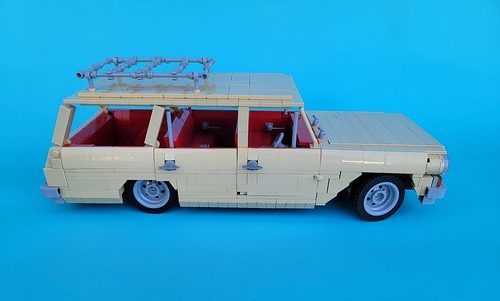
These days a cream station wagon would be a rather interesting vehicular sight, surrounded by a sea of grey SUVs. Back in ’60s America however, and they were the byword for boring.

Even the name of this one was uninspired. American car companies are usually quite good at exciting names, but – whilst this would eventually be called the ‘Nova’ – to begin with it was simply known as the ‘Chevy II’, which is almost Sovietly insipid.

Flickr’s Tim Inman is the builder behind this marvellous Model Team recreation of the Chevrolet Chevy II station wagon – which he’s created for the ongoing Festival of Mundanity competition – complete with a beautifully built interior and exterior, opening doors, raising hood, and a life-like engine. Which appropriately is not the optional V8. That would be too interesting.

It’s a fabulous build – although we’re not sure how many mundane points it will earn seeing as today a Chevrolet Chevy II station wagon would be a rather cool sight – and there are lots more images available to see at Tim’s photostream via the link above.

If you’d like to enter your own boring build there are still several weeks of the contest left to go, and some awesome prizes on offer for the winners, with Tim entering into both the Vehicle and Object categories. His object entry might just be the most default and uninspired item in the history of mankind too. Excellent!

Mini Explosion

When Austin/Morris launched the Mini in 1959, other car manufacturers couldn’t believe the ingenious packaging of Alex Issigonis’ masterpiece.

They also couldn’t believe how Austin/Morris were building it for a profit, and thus Ford bought one to take apart to see how they had done it.

What they found was definitely ingenious packaging, but also that the Austin/Morris profit was literally unbelievable, in that they, well… weren’t making any.

The British car industry was a weird place.

Austin/Morris corrected this rather crucial issue with a price rise (not that their incompetence would disappear of course, causing the companies to do so themselves eventually), and the Mini became one of the best selling small cars of all time, along with becoming a design icon.

If you fancy taking a classic Mini apart yourself as Ford did you can now give it a go, thanks to Pixeljunkie‘s ‘exploded’ Mini Cooper, instructions for which are available so you can explode your own!

There’s more to see at Pixel’s photostream, take a look via the link above, whilst we rue not titling this post something along these lines…