Category Archives: Lego

Virtually Toyotas

It’s a digitally Japanese day here at The Lego Car Blog, as we have four virtual Toyota products to share with you. We don’t often blog digital creations here, but these are a) throughly excellent, and b) we’re as certain as we can be that they can be built for real, what with designer Peter Blackert (aka Lego911) releasing building instructions alongside the imagery, and having literally written the book on how to build Miniland scale vehicles.

Rule-breaking explained, on to Peter’s first pixel-based Toyota, which is the third-generation Celica, depicted here in face-lifted pop-up headlight form. Powered by a huge array of engines (although solely by the 2.4 litre in the US) the A60-generation Celica helped the Toyota brand gain a reputation for attainable sportiness, and you can see more of Peter’s version via the link.

Peter’s second model appearing here captures one of Toyota’s earlier attempts at a sports coupe, the decidedly un-sporty 1971 Crown Coupe. It looked lovely though, and the Crown station wagon is one of the most comfortable cars that this TLCB Writer has ever had the pleasure of journeying in. Jump back to 1971 via the link.

On to the early-’00s, and the single most dreary vehicle Toyota has ever created, the 2002 Toyota Camry. As we’ve highlighted here before however, dreary sells, with the Camry becoming the best-selling car in America in 2002. And 2003. And 2004. And 2005… You get the picture. There’s more to see of this one at Peter’s photostream via the link.

And finally… the Toyota that isn’t a Toyota, but heralded the arrival of the Lexus brand, the phenomenal Lexus LS400. Created to beat the best car in the world at the time (the Mercedes-Benz S-Class), the LS400 did just that, and is still lauded as perhaps the most thoroughly-engineered car ever produced. Peter’s Miniland-scale version captures the pivotal arrival of Lexus beautifully, and there’s more of the model to see at his photostream.

Further images of each design, details of the real cars, and links to building instructions can be found at Peter Blackert’s Flickr account via the links for each car in the text above, plus you can check out our interview with Peter and his published works by clicking the bonus link here.

Off-Ferraroad

Taking a Ferrari off-road doesn’t end well. That said, a Ferrari is also perfectly capable of catching fire on smooth asphalt, but off-road is certainly outside of the prancing horse’s design brief.

Except that it’s 2023, which of course means that today you can buy a Ferrari off-roader, because all anyone wants is an SUV. We’d rather take this though, Slick_Brick’s ‘Off-Road Ferrari’ buggy, which is a million times cooler than the Purosangue abomination disgracing the Ferrari name.

Cunning use of the ubiquitous Speed Champions canopy, exposed brick-built suspension, and an equipment rack above the rear-mounted engine add to the off-roady look, and there’s more of the ‘Off-Road Ferrari’ to see at Slick’s photostream by clicking here. We’d probably add a fire extinguisher to that rack though…

SHIPtember Roundup


It’s the last day of September, which means the annual building bandwagon ‘SHIPtember’ – wherein builders create colossal spaceships measuring one hundred studs or more – is concluding too. Which is good news if you like cars, or you’re Sci-Fi Incompetent.

TLCB Team are of course both of the above, so expect lots of “this is a Really Massive Spaceship”, and little else, in the rest of this post…

Anyway, on to the first creation, and it’s a Really Massive Spaceship. Constructed by Oscar Cederwall, it cleverly utilises a LEGO Crane Support Element down the centre, and there’s more to see via the link above.

The second creation in our SHIPtember 2023 roundup is a Very Large Spaceship Indeed, and sports a veritable rainbow of colours. Nathan Proudlove is its maker and there’s more to see here.


The third SHIPtember model appearing here comes from -Soccerkid6, whose 106-stud racer ‘Falchion 55’ is a Truly Sizeable Spaceship. Ingenious parts usage abounds throughout the design and there’s more of No. 55 to see via the link.


On to the fourth creation in our SHIPtember roundup, this Decidedly Enormous Spaceship by Andreas Lenander, with three superbly constructed engines, beautifully neat asymmetry, and – at least to the eyes of this car blog – wearing Honda racing colours. Click here to see more.

And so, much to the relief of the proper Lego sites that can actually do sci-fi, here’s the final model in our SHIPtember Special, LegOH!s brilliant ‘Octan Mining Ship’. A Spaceship of Gigantic Proportions, LegOH’s entry packs in a variety of spacey details, none of which we can explain, but that you can see more of via the link above.

There you have it; TLCB’s immensely incompetent roundup of some Really Massive Spaceships for 2023. Don’t be fooled by our crap write-up though, each is a phenomenal build and well worth checking out, even if – like us – you don’t understand sci-fi whatsoever.

All can be found on Flickr (plus a lot more besides), and you can make the jump to hyperspace via the links above. Take a look whilst we get back to writing about things that have wheels and engines.

Poop Poop!


We’re pretty sure not every vintage car went ‘Poop poop!’*, but we can’t help but feel all Toad-of-Toad-Hall when we see one.

This lovely Speed Champions scale example comes from previous bloggee K P of Flickr, using only simple pieces and neat presentation to wonderful effect.

Poop poop your way to K P’s photostream for this and other old-timey creations via the link above.

*Some of course, went ‘Aaoogha!’

Hot Hatch Genesis

Despite what Volkswagen would have you believe, the Golf GTI was not the world’s first hot hatchback. Nope, that honour goes to a little factory in Scotland that was originally part of the Rootes Group.

Rootes owned a variety of successful British brands, including Hillman, Humber, Singer and Sunbeam, before they were acquired by Chrysler in 1967, who then proceeded to ruin them.

In just a few short years the whole thing was loss-making, and the French government – fearing the demise of the French brands that Chrysler also owned – encouraged Peugeot-Citroen to purchase the remnants, which they did. For a dollar.

The result was the return of the Talbot name, which was applied to various Rootes products including their Sunbeam small hatchback. It was a design Chrysler kept hold of too, being quite a good one, successfully selling a very similar looking model as the Dodge Omni / Plymouth Horizon in the US.

In Europe, Peugeot-Citroen wanted to raise the profile of the reborn Talbot name, and so they decided to go motor racing, with Group B rallying their chosen route. Fortunately for them, Chrysler had already developed a sporty version of the Horizon / Sunbeam, having turned to Lotus for the development, but didn’t have time to launch it before the sale to Peugeot-Citroen.

Thus when it finally arrived, the 150bhp Sunbeam Lotus wore a Talbot badge, becoming the world’s first hot hatchback, and duly winning the World Rally Championship in 1981.

Such immediate success meant that Talbot become a household name, which must’ve pleased Peugeot-Citroen. Or so you would have thought. By the mid-’80s they’d killed it, with the marque lingering on a van for few a years before disappearing completely.

Still, SIM CAMAT of Flickr does remember the Talbot Sunbeam Lotus, and has paid homage via his wonderful Model Team recreation of the world’s first hot hatchback.

Beautifully accurate, SIM’s Sunbeam features opening doors and hood, a highly detailed interior complete with folding seats, and a stunning removable replica of the 2.2 litre slant-four Lotus engine that powered the car to the ’81 World Rally Championship.

There’s lots more of the model to see at SIM CAMAT’s photostream, and you can head back to the often-forgotten genesis of the hot hatchback via the link in the text above.

Golden Air

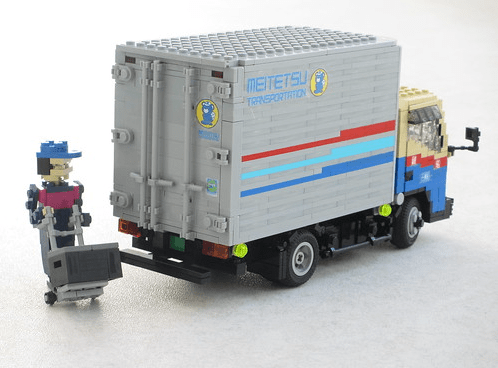
We haven’t written a post regarding golden air transport since we blogged about Donald Trump’s Air Force One showers*. Today though we’re back to golden air travel, courtesy of Ralph Savelsberg and this lovely Mitsubishi Fuso Canter box truck, wearing the livery of Japan’s ‘Meitetsu Golden Air Cargo’ company.

Ralph has captured both the truck and livery beautifully in Miniland scale, and there’s more of the Meitetsu Mitsubishi to see at his photostream. Click here for golden air delivery.

*Trump likes to be pissed on.

Rally-Bred

This is the unmistakable shape of the Lancia Stratos, designed by Bertone and powered by a Ferrari Dino V6, it was the first car purpose-built for rallying, winning the World Rally Championship three times consecutively between 1974 and 1976.

This lovely diorama by Flickr’s alex_bricks, who appeared here recently with his stunning 1988 Monaco Grand Prix scene, depicts a works Alitalia-liveried Stratos scything through a muddy forest.

Forced-perspective foliage and an array of mini-figures – including a driver and co-driver and some hardy spectators – add to the ambiance, and you can join them trackside c1975 via the link in the text above.

Behind Enemy Lines

After decades of peace, Europe is once more at war, thanks to an under-endowed dictator intent on re-colonisation. However the last time war raged along Russia’s borders, it was defending against, rather than fighting for, a maniacal despot.

This wonderful diorama depicts a small part of that fight, when in 1942 German ace Wolf-Dietrich Wilcke was shot down by a Soviet Air Forces Hawker Hurricane, crash landing on an icy lake. 

His Messerschmitt Bf 109 slipped through the ice to the bottom of the water, but Wolf-Dietrich survived to continue his service in the Luftwaffe, before finally being killed in action in March of 1944, with a scarcely believable 162 victories to his name.

Constructed by Jonah Padberg, this beautiful creation captures the moment of Wolf-Dietrich’s crash, and you can visit the frozen lake on which he landed, before it claimed his Messerschmitt Bf 109 but not his life, via the link above.

Cam Sensation

Don’t worry, we’re not exposing your Mom’s side hustle. Rather this excellent brick-built Petebilt 389 dump truck, the full-size version of which is owned by the uncle of its creator StudWorks of Flickr.

StudWorks’ aforementioned uncle is apparently “dash cam sensation” ‘Joey Whispers 1776’ who we… er, hadn’t heard of, but a quick look at his videos shows he doesn’t whisper at all. He does swear though. A lot.

Stud’s homage to his uncle’s truck includes a working dumping mechanism with lift-gate, posable lift-axle, and some splendid detailing, with more to see at his ‘JoeyWhispers1776 Peterbilt 389 Dump Truck’ album on Flickr.

Click the first link in the text above to find all of the imagery of StudWork’s Peterbilt, or the second to watch ol’ uncle Joey swearing at traffic.

The Lego Train Blog

Whilst this crumbling ruin in the corner of the internet is (mostly) a Lego Car Blog, we do like a Good Train. Which is probably the nerdiest sentence written outside of The Brothers Brick. Still, this is a very Good Train indeed, and it comes from previous bloggee Nikolaus Lowe.

A replica of a 1908 German steam locomotive ‘PtL 2/2 Glaskasten’, Nikolaus’ creation includes gorgeous detailing, some wonderful brick-built valve gear, remote control drive, and custom LED lighting front and rear.

Built for a competition there’s more of Nikolaus’ lovely locomotive to see on Flickr, and you can jump back to Germany in 1908 via the link in the text above.

Super Sunday

If you’re six (or a TLCB Elf), this post is for you. Yes today we have two of the greatest supercars ever made in LEGO form, and best of all they’re tiny, showing you don’t need to have a million pieces to build a blogworthy replica of your favourite supercar.

The first (above) is Jonathan Elliott‘s beautifully presented Lamborghini Diablo GTR, constructed to almost ridiculous accuracy in Speed Champions scale. Parts facing in every direction hint at the complexities within, and there’s more of the model to see at Jonathan’s photostream.

Today’s second small-scale supercar (below) is one from a later decade, the phenomenal Lexus LFA. Also constructed in Speed Champions scale, Flickr’s Tommy ñ has captured the iconic carbon-fibre supercar superbly in brick form, and you can check it out at his photostream via the link above.

Scania & Stepframe

From a truck-based flight of whimsy to a hauler altogether more real-world. Ralph Savelsberg’s Scania T730 with stepframe trailer is an exact miniaturisation of one of the trucks in use by Hodge’s of Scotland, pictured here with a Volvo excavator in tow. A replica livery adds to the realism and there’s more of the models to see at Ralph’s album by clicking here.

MANions

Today’s post is a Minion-coloured MAN with a mobile banana lab. Because shut up, that’s why.

The highest grossing animated movie franchise of all time, the Minions certainly have the resources, if not the intellect, for a giant mobile banana research centre. But seeing as mankind has genuinely conducted studies to determine that ‘Electric Fans have a Beneficial Effect in Extreme Heat’, ‘All Mammals above 3kg in Weight Empty their Bladders in Between 8 and 34 Seconds’, and – our favourite – ‘People Would be Able to Run Across a Pond if it was on the Moon and They were Wearing Flippers’, who are we to argue with the Minions’ choice of research?

Flickr’s Stefan is the unseen supervillain in command of this arrangement, and there’s more of his MANion to see at his photostream. Click the link above take a look, or here to learn that, shockingly, ‘People Adjust their Clothing Choices Depending Upon the Temperature‘. Thanks Scientists.

Agent Orange

It’s been a while since we let TLCB Elves watch Transformers cartoons, but today a number are happily crowded round an ancient TV thanks to one of their number and this; Angus MacLane‘s OR-ANJ G1 Transformer.

A normal-looking orange coupe (apart from the roof-mounted rocket launcher, which – let’s face it – we’ve all wanted as an optional extra at times), Angus’ creation can niftily transform from car to rocket-wielding robot via a few swivels, and there’s more to see at his photostream, where a range of other brick-built robotic contraptions can also be found.

Ascent to Orbit

Uh oh, more sci-fi incompetence from TLCB Writers. But it is ‘SHIPtember’, the annual month-based bandwagon wherein builders create science fiction builds one-hundred studs or more in length, so at least the creations are impressive even if our descriptions are not.

This one is the ‘USS Alliance’, a ‘United States Space Navy (USSN) Potomac-Class guided missile frigate’, according to the immensely talented Ryan Olsen, and measures 106 studs in length.

Constructed from over 4,000 pieces, Ryan has presented his creation just as beautifully as he’s built it, with the model pictured here ascending into orbit alongside another one of his other brick built behemoths.

There’s more of the build to see at Ryan’s ‘USS Alliance’ album, and you can make the jump to orbit alongside 106 studs of ‘SHIPtember’ brilliance via the link above.