Category Archives: Model Team

My Other Car’s a Camaro

Are you a fan of the LEGO Icons 1034 Chevrolet Camaro Z28, but don’t have a handlebar mustache and spend your nights chucking dice in an alley? Then why not rebuild your Camaro set into something altogether different?

Cue Nathanael Kruipers‘ stunning Pontiac Firebird, constructed entirely from the pieces found within the 10304 Camaro set, yet rebuilding the set to create a car driven by… OK, exactly the same stereotype.

Still, the Camaro and Firebird were the same cars underneath, so perhaps that’s not surprising, and it makes creating the Firebird from the Camaro rather appropriate.

Building instructions are available and there’s much more of Nathanael’s brilliant 10304 alternate to see at his photostream. Click the link above to join him in the alley.

Light Truck

This is a Kenworth W900 truck, and the more eagle-eyed reader may have noticed it’s been subtly modified with a little chrome and a few extra lights. Which means that if you’re six, a TLCB Elf, or from Texas, we’re sure you’re going to love it.

Truth be told we love it too, particularly as its creator Jonah Padberg (aka Plane Bricks) has included an opening hood under which lies a brilliantly detailed engine, a realistic interior, and working steering and suspension too.

There are more excellent images to view at Jonah’s photostream and you can light your way there via the link above.

Type-BWAAAA

The Lego Car Blog Elves are running around the office making VTEC noises. Which isn’t annoying at all. Still, said racket is at least accurate, because – around TLCB Towers at least – the nighttime streets echo to the sounds of the youths of today driving their ageing Civic Type-Rs fitted with silly exhausts on full throttle. Everywhere. BWAAAAAA!

Still, the clientele isn’t really Honda’s fault, and the late-’90s first generation Civic Type-R (based on the sixth generation Civic) is rapidly heading to genuine classic status. Which will soon make it too expensive for the aforementioned youths to be irritating with.

This one (and the source of the Elven office ‘BWAAAAA!’ing) is the work of previous bloggee Daniel Helms, who has absolutely nailed the first generation ‘EK9’ Civic Type-R in Model Team form.

Opening doors reveal a life-like interior, which accurately recreates the real Civic’s ’90s plasticky dashboard via some excellent bespoke decals, there’s a realistic replica of the 185bhp, 8,200rpm 1.6 litre naturally aspirated ‘B16B’ engine under the opening hood, plus the model features an opening tailgate, working suspension, and custom ‘Type-R’ stickers and Honda badging.

There’s loads more of Daniel’s terrific Type-R to see at Eurobricks, Flickr, and Bricksafe, and you can head there on full throttle at 8,200rpm via the links above. BWAAAAA….

Just like a Porsche

Skoda, one of the seemingly infinite number of brands operated by the Volkswagen Group, churn out absolutely competent yet stupedously dull boxes by the hundreds of thousands, as is the current Volkswagen Group diktat. Boring sedans, boring SUVs, boring crossovers, boring hatchbacks… Skoda make them all, and they are all quite fantastically bland.

There was a time however, pre-Volkswagen (and pre-capitalism…) when Skoda were much more interesting. Worse. But interesting.

This is probably Skoda’s most successful car from the communist era, the 120/Estelle. Launched in the late ’70s, the 120 was a compact rear-wheel-drive sedan powered by either a 1litre or 1.2 litre engine mounted in the rear. Yup, just like a Porsche 911.

The Skoda 120 also shared a few other Porsche 911 attributes, including motorsport success – regularly winning its class in rallying, and – rather less positively – the 911’s penchant for throwing itself into a hedge, despite it packing just 50bhp.

Still, that at least made the 120 interesting, as did its side-hinged front trunk, out-dated technology, likelihood of overheating, and incredibly low price.

Which means we’d take this lovely mid-’80s Skoda 120/Estelle by Flickr’s Legostalgie over a modern rebadged Volkswagen box all day, with his beautiful Model Team version including a detailed rear-mounted engine under an opening engine cover, a life-like (and suitably plasticky) interior inside four opening doors, and the weird side-hinged front trunk.

There’s more of this superbly-presented Skoda to see – including building instructions – via the link above, where you can also navigate to Legostalgie’s plethora of other Eastern European oddities, all of which are vastly more interesting than a modern Skoda SUV.

Skid Row

The Lego Car Blog Elves are having a great time this morning. Too slow to run them over but fast enough for them to ride upon, Bricksley’s four-motor Liebherr LR 636 G8 tracked skid-steer loader is providing much amusement to our little workers.

Those four motors are the LEGO Powered-Up variety (meaning they can be controlled via bluetooth), and they power each track, the arm, and the bucket, with two Powered-Up Hubs delivering the control.

The Liebherr’s exterior realism matches the excellent engineering within it too, with outstanding attention to detail, beautifully accurate decals, and perfect presentation making it a specularly life-like creation. Except in the TLCB Office that is, where half-a-dozen mythical creatures are joyfully riding upon it.

It’s all fun and games until one of them falls under the tracks, but until then we’ll continue to enjoy Bricksley’s brilliant build, and you can check it out too to via Eurobricks, or their ‘Liebherr LR 636 G8′ album on Flickr, where over twenty top quality images are available to view.

A Whole Lotta Grass

Surprisingly lucrative, easy to grow, and in demand just about everywhere, grass is bigger business than you might think.

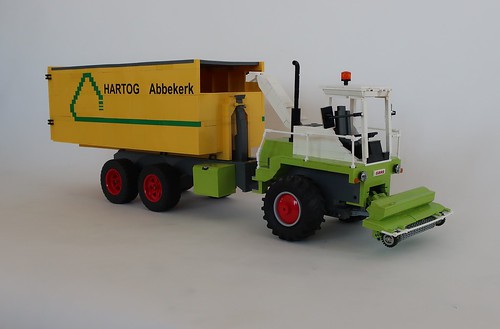
Cue Arian Janssens, whose dope DAF 95.360 Space Cab hook-lift and drawbar trailer are designed solely to transport the stuff.

Both the truck and trailer can tip their respective containers independently, and share them with the world’s weirdest lawnmower for filling during the cutting process.

Hash your way to Flickr via the links above to roll one up.

More Gas!

It seems like only yesterday that we posted a delightful ‘gasser’ style hot rod by Flickr’s Tim Inman. Because it was. Anyway, he’s published another in quick succession, this time based on a Chevrolet ‘Chevy II’, better known as the Nova, and inspired by several real Nova racers built back in 1964. The silly drivetrain and even sillier engine are perfectly period-correct, and there’s more of the model to see at Tim’s photostream. Click the link for more gas.

Taking the Mickey

The famed Fiat 500 was not the brand’s first city car. For that you have to go way back to 1936 and the Topolino, or ‘little mouse’ (which was also the Italian name for Mickey Mouse), a tiny 569cc, 13hp two-seater sold up until the 500’s introduction in 1955.

Designed for two, but often seen with four or five very uncomfortable people squeezed inside, the Topolino was one of the smallest cars in the world at the time, and a hugely successful one, with over half-a-million produced.

Important to Italy’s mobility as the Topolino was however, we wouldn’t think of it as the obvious choice for a ‘Gasser’ hot rod. Fortunately Tim Inman‘s mind works differently to ours, because the resultant creation is unhinged brilliance, and there’s more of Tim’s Topolino Gasser to see on Flickr. Click the link above to make the jump.

Forgotten Fuego

This slice of ’80s Frenchness is a Renault Fuego, a compact lift-back coupe built from 1980 to 1986 In Europe, and up until 1992 in South America.

Powered by a range of engines from a 1.4 to a 2.2, via 1.6 Turbo (this was the ’80s) and even a 2.1 turbodiesel, the Fuego was the best selling coupe in Europe and the UK at the time, and was the first car to feature steering-wheel-mounted stereo controls, one of the earliest available with remote central locking, and was once the fastest diesel production car in the world, with a top speed of, er… 110mph. It was even marketed in America where, conversely to Europe and the UK, no-one cared.

Despite its success in TLCB’s home market however, such is the rate of attrition of ’80s cars just eighteen Renault Fuegos survive on the UK roads today. Which is rather a shame, so here’s a brick-built homage to the forgotten French coupe, created beautifully in Model Team form by SIM CAMAT of Flickr.

Cunning brickwork, opening doors, a detailed interior, an opening bonnet, and a lifelike engine all feature, and there’s more of SIM’s brilliant Renault Fuego to see at his photostream. Click the link above to blip your key remote, get behind the controls on the steering wheel, and hit a diesely 110mph on a French autoroute.

Express Checkout

Hot rodders in the 1960s were TLCB Elf levels of nuts. From fire trucks to beer wagons, ‘show rods’ as they were known dismissed notions of getting in, seeing out, steering, and other such formalities in favour of ludicrous caricatures, and few were more cartoonesque than this, Ray Fahrner’s 1967 ‘Boothill Express’.

Based on an 1850s wooden funeral coach fitted with a Hemi V8, Ray’s creation looked so wild onlookers at the time doubted it could actually drive. Which it couldn’t. Annoyed by the naysayers (although they were correct), Ray’s team built a second ‘Boothill Express’, this time engineered to run, and took it to 130mph on the dragstrip. Which must’ve been terrifying. Still, at least if it all went wrong the coffin was right there to accommodate the remaining body parts.

Pictured here alongside one of the numerous toy versions that were inspired by the real car, Lino Martins has recreated Fahrner’s iconic funeral coach show rod brilliantly in brick form, including the Model-T steering, open bench seat, coffin curtains (with tassels), and the mid-mounted Hemi V8. Join the express checkout queue via the link above, and you can click here to find out more about the outrageous 1960s original.

Flying Across New York

Many Marvely-type superheros have flown across New York. Or run. Or swung on spiderwebs. Or been propelled by their supersuit/hammer/insertmagicspaceitemhere.

The real heroes of New York however, take the bus.

Nurses, firefighters, police officers, teachers… the people that keep NYC’s engine running, whilst simultaneously not being able to afford to live in it.

Cue the Metropolitan Transportation Authority’s New Flyer XD40 buses, transporting hundreds of unsung heroes across New York City every day.

This superb brick-built recreation of true hero transport comes from previous bloggee JLui15, who has not only captured the New Flyer and its MTA livery beautifully, he’s packed it with working functions, including motorised drive, steering, and opening doors controlled via an SBrick.

There’s much more of the New Flyer XD40 to see at Flickr, Eurobricks, and in the video below, and you can join the everyday heroes transiting New York on board via the links in the text above.

YouTube Video


Lamenting Lancia

As occasionally we do here at The Lego Car Blog, today’s post is a lament of Lancia.

One of the most innovative, technically advanced, and motorsport-winning car companies in history, Lancia have created some of the all-time great automobiles. Yet today they make only this. Which is probably worse than if they made nothing at all.

We’re heading back to the 1970s then, when Lancia made a whole range of wonderful (if poorly rust protected) cars, and this; the incredible Stratos HF.

Designed by Bertone (who pitched it to Lancia by just turning up and driving it underneath the security barrier), the Stratos was a mid-engined sports car designed for rallying. And rally it did, winning the World Championship three years in a row from ’74 to ’76. And unlike every other Lancia it couldn’t rust, being made from fibreglass.

Equally glorious (and rust-proof) is this spectacular replica of the Alitalia-liveried Stratos rally car, recreated brilliantly by Biczzz of Flickr. Beautifully-built bodywork, superbly accurate decals, and a replica Ferrari V6 ‘Dino’ engine underneath a removable rear clamshell make this a fine homage to Lancia’s glory years, and there more to see – including a lime green road-car version – at Biczzz’s ‘Lancia Stratos’ album.

Click the link above to go rallying in the mid-’70s, when Lancia were on top of the world.

City Cargo

LEGO have created an intricate Town/City universe over the years, with their own energy brand, postal service, and railway company. There have also been a number of cargo/delivery companies over the years, usually featuring some sort of box-and-arrow logo and mini-figures wearing humiliating uniforms.

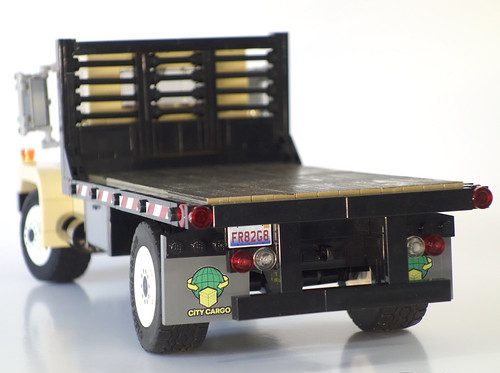
Cue LegoMarat’s excellent Model Team flatbed truck, based on none in particular but inspired by many, and proudly wearing LEGO’s ‘City Cargo’ box-and-arrow logo from the City set range.

The lovely detailing continues with ‘wooden’ planks lining the bed, life-like wheel bolts and reflective strip decals, opening doors and a detailed interior, and there are more superbly presented images to see at LegoMarat’s ‘Lego Flatbed Truck’ album on Flickr.

Don your humiliating uniform and head to your next City Cargo delivery drop via the link in the text above.

Apollo 10

May 18th 1969, and the tenth Apollo mission departed the Kennedy Space Centre to begin its eight day mission. Only the fourth U.S human spaceflight and the second to orbit the moon, the Apollo 10 mission was a rehearsal for the first moon landing that was to come just two months later, when – on July 20th 1969 – mankind’s relationship with our lunar satellite changed forever.

Cue a tenuous link to today’s car, the Apollo Intensa Emozione. No, us neither, but the Intensa Emozione (or ‘IE’ for short) is a carbon-fibre German supercar, “based on airflow and nature… marine animals in particular”, and powered by a naturally-aspirated Ferrari-derived V12.

Just ten Apollo ‘IE’s will be built, each costing almost $2.7 million (around 1% of the inflation-adjusted cost of the Apollo 10 mission), and having literally nothing at all in common with the moon landings beyond being very expensive. Still, it’s a considerably better name than another more well-known Ferrari V12-powered hypercar.

This exceptional brick-built replica of the Apollo ‘IE’ comes from previous bloggee 3D supercarBricks, who has captured the bodywork-inspired-by-marine-animals brilliantly. Opening gull-wing doors, 3D printed wheels, and superb presentation enhance the realism, and there’s more of the model to see 3D’s Apollo Flickr album. Blast-off to the moon via the link above.

Urally Good

We may mock President Putin as regularly as we can create a tenuous link to his dickwittery, but the country he dictates is an amazing one. Spanning from the Atlantic to the Pacific across eleven time zones, responsible for the first animal, satellite, and person in space, and with a history uniting fifteen separate countries into one bloc of… er, communist misery, Russia and the former Soviet Union are a major part of our current world.

They also make probably the best off-road trucks of anyone, which are needed to traverse a vast and wild landscape, with most having their roots in the Military. Founded in 1956, off-road truck-maker Ural shares this history, and still employs 4,000 people today building trucks like this, Vladimir Drozd‘s beautifully presented Ural crane truck.

With a working crane that rotates, elevates, extends, and winches, Vladimir’s Ural functions as good as it looks, and there’s loads more of his superb model to see at his ‘Ural Crane Truck’ album on Flickr. Take a look via the link above, or here for a tenuous link to Putin’s dickwittery.