Tag Archives: 1980s

Grand National Experimental

Ah Buick. Maker of boring cars for old people, and later re-badged Vauxhalls for old people, they’re about as interesting as a Brother’s Brick parts cataloguing evening.

Except in the late ’80s, when they went mad.

Working in partnership with McLaren, Buick took their soporific Regal sedan and turbocharged the 3.8 litre V6, with the resultant GNX producing almost 300bhp and a 0-60mph time of 4.6 seconds. In 1987!

Quite what they ate for breakfast that day we don’t know but we wish they’d eat it again.

Recreating the Buick ‘Grand National Experimental’ is Rolling Bricks, whose 8-wide Speed Champions scale model captures the aesthetic of the original brilliantly. There’s a detailed engine under the opening hood, room for two mini-figures, and there’s more to see on Flickr via the link.

LEGO 10300 ‘Back to the Future’ Time Machine | Set Preview

Great Scott! We’re going Brick to the Future!

This is it. The single coolest LEGO set ever made… it’s the brand new Creator Expert 10300 ‘Back to the Future’ Time Machine!

In partnership with Amblin Entertainment and Universal Pictures (but notably not the DeLorean Motor Company, probably because they went bankrupt before the first ‘Back to the Future’ movie was released, and most people don’t know the DeLorean was a real (and rubbish) car anyway…), LEGO have brought the most famous movie car of them all to life in brick form.

Constructed from nearly 1,900 pieces, 10300 measures 35cm long and features a mini-figure Doc Brown and Marty McFly, hoverboard, radioactive plutonium / a banana for flux-capacitor fuelling, and a light-up flux-capacitor too, putting LEGO’s new light-up part to much better use than on its debut on the 42127 The Batman Batmobile set.

And that’s not all, because 10300 allows builders to time travel between all three ‘Back to the Future’ movies, with a variety of accessories that capture the Time Machine’s various amendments and evolutions during the trilogy.

These include the hook used for lightening strike power in Part 1, the hover system (“Where we’re going we don’t need roads!”) enabling flight in Part II, and the more rustic western modifications that ensured Marty could get home in Part III, before the Time Machine met its destruction in front of a locomotive.

The ‘Back to the Future’ Time Machine set looks like an absolute triumph, and if you’re as excited as we are you can hit 88mph for yourself when 10300 reaches stores in April for around $170 / £140.

Coolest. LEGO. Set. Ever!

Accessibly Interesting

Having just posted a hugely valuable exotic car built from another hugely valuable exotic car, you might be surprised to learn that at The Lego Car Blog, we rather prefer the ordinary. So much so we’re running a building competition in search of boring vehicles.

You see, it’s easy to make a squillion-dollar supercar that precisely eight people will buy, not drive, and park in a garage hoping it will one day be worth two-squillion dollars, but it’s much harder to make something hum-drum fun.

It’s even harder these days, when the only thing that sells are angry-looking crossover-SUVs with too much power and too little handling finesse, but back in the 1980s, a number of affordable, interesting, fun cars could be had from car manufacturers who today wouldn’t know fun if it ran them over.

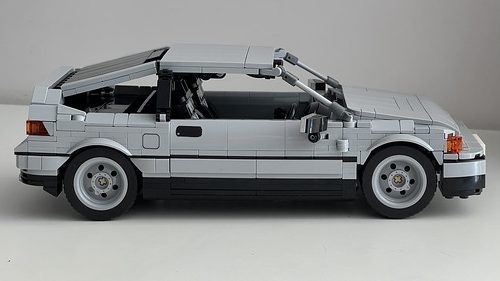
Honda were one such company, who – at the peak of their engineering brilliance – created a small 2+2 front-wheel-drive coupe built from standard economy-car parts and powered by a dinky (but clever) 1.5 or 1.6 litre engine. And that was the ‘sports’ model, base versions had a 1.3!

The result was fabulous, and a car that was infinitely more fun to drive than a BMW X7M or whatever the hell they’re trying to pass off as as a ‘sports’ vehicle this week.

Flickr’s Mihail Rakovskiy has captured the humble CRX beautifully in Creator style, recreating its ’80s aesthetic brilliantly and including opening doors, tailgate and hood, a superb interior, and a realistic brick-built version of the little Honda 4-pot that powered it.

It’s a fantastic homage to a Honda’s proof that power and price are no match for cleverly engineered affordable fun, and there’s much more to see at Mihail’s ‘Honda CRX’ album via the link above.

Maximum Five

Renault are weird. They’ve made wonderful cars, dull cars, terrible cars, and this… a supermini with a mid-mounted 1.4 litre turbo that produced – in race trim – around 380bhp. Back in the early ’80s!

That remarkable figure propelled the Renault 5 Maxi Turbo to the top step of the podium on its maiden event, at the 1981 Monte Carlo Rally.

This WRC success was to be relatively short-lived though, as the arrival of Group B and all-wheel-drive meant the Maxi Turbo was quickly outclassed on anything that wasn’t tarmac.

When an event was on tarmac though, the little Renault continued to be a formidable racer, finding success for the next two decades.

This lovely Speed Champions recreation of the legendary ’80s rally car was found by one of our Elves on Flickr, coming from Fabrice Larcheveque who has updated (and beautifully presented) a model he first created several years ago.

Authentic bespoke decals, a realistic interior, life-like engine bay, and even a roll-cage make for an exceptionally detailed Speed Champions creation, and there’s more to see – including a link to building instructions – at Fabrice’s ‘Renault 5 Maxi Turbo’ album on Flickr.

Click the link above to take a look and maybe recreate the 1981 Monte Carlo Rally on your desk at home. Not that we’re doing that right now of course, we’re much too grown up…

Acceptable in the ’80s

Things were different in the ’80s. Shoulder pads, ‘greed is good’, florescent clothes, cassette tapes, and Russian totalitarian oppression. Wait, that last one’s making something of a comeback…

Ferrari were big in the 80’s too, but whilst we’re glad they’ve stuck around today (unlike Russian totalitarian oppression), we still think they were better in the decade of parachute pants and the mix tape.

The reasons for this are three-fold; 1. Ferrari were more interested in selling cars than merchandise, 2. they hadn’t even thought of making an SUV, and 3. their cars were fabulous.

The 308 GTB, Testarossa, and – of course- the magnificent F40 graced countless ’80s bedroom walls, and Flickr’s Laszlo Torma has recreated all three beautifully in Speed Champions scale.

Laszlo has used the same cockpit piece for all three, yet with clever building techniques and smart attention to detail, each car resembles its real-world counterpart brilliantly.

There’s more of the classic Ferrari trio to see at Laszlo’s photostream, where a link to building instructions can also be found so that you can recreate these iconic ’80s supercars for yourself!

Theory of Evolution

LEGO’s Speed Champions range has evolved a bit over the years. Jumping from six studs of width to eight has upped the realism, as has a the more widespread use of decals, allowing for the recreation of real-world liveries and sponsorships.

Previous bloggee Fabrice Larcheveque has moved with the times as well, updating his Peugeot 206 T16 rally car to fit LEGO’s latest Speed Champions aesthetic, with it looking rather wonderful a as result.

Fabrice’s original 205 T16 featured on this site half a decade ago, and The Lego Car Blog has evolved a bit since then too, with the standard of presentation required to appear here considerably higher than it was back then. The incompetent writing and woeful site management remain though…

Fabrice’s significantly upgraded and perfectly presented Peugeot 205 T16 is available to view on Flickr, where building instructions are now available too. Click here to join the evolution.

Yellow Niva

The Soviet Union was full of terrible cars. This is not one of them.

The Lada Niva / VAZ-2121 is unibody 4×4, capable of going as far as a Land Rover (only more comfortably, as it had proper springs) and able to be easily worked on with limited tools. And it’s brilliant.

Unusually, the Niva was an in-house design – rather than using left-over bits of old Fiats – and so successful is it that is still being built today. Not for long though, as the Niva’s days are numbered, after which it’ll be replaced by a re-badged Dacia Duster courtesy of Lada’s parent company Renault.

Now we quite like the Duster, but it’s not a Niva, and it certainly can’t go as far as a Land Rover off road. Which means we suspect the original Niva will become quite a sought-after vehicle once production stops, not something you might expect of a Communist-era Lada.

This rather lovely Lego version comes from previous bloggee Legostalgie, who has evolved his previously featured design and has now made building instructions available. If you like the Niva as much as we do you can check out all the images of Legostalgie’s update, and find a link to building instructions, by clicking here.

Speed Champions 2022 | Set Previews

The first month of 2022 is almost done, and our Elves have been sneaking! Sent on a mission to infiltrate The LEGO Company’s HQ, they have to sneak for fear of being eaten by a guard dog, but those that do manage to avoid the teeth of the German Shepherds return as heroes, held aloft by their peers to Elven chanting, and awarded a meal token by us TLCB staff.

You’d think they’d have figured out this is a wildly insufficient reward, but the office catapult ensures a regular flow of ‘volunteers’. Anyway, on to their finds – the brand new for 2022 LEGO Speed Champions sets. And they’re corkers!

76906 – 1970 Ferarri 512 M

The first new set of 2022’s Speed Champions line-up is already one of our favourites ever, and we’ve only been looking at the box. The new 76906 1970 Ferrari 512 M is a glorious homage to the car that was… er, soundly beaten by Porsche at Le Mans. It did win the 12 Hours of Sebring though, and was regarded as equally fast as the conquering Porsche, just not as reliable.

LEGO’s Speed Champions version of the Ferrari 512 M looks magnificent, utilising a Star Wars canopy piece amongst some very cleverly printed parts to accurately capture the real car.

The historic livery means there’s no need for a smorgasbord of stickers, and LEGO have resisted the urge to include a pointless gantry or other trackside paraphernalia too, keeping the piece number, and – more importantly – price down to pocket money levels.

Expect 76906 to cost around $20 when it reaches stores later this year, and we absolutely love it.

76907 – Lotus Evija

The second new set for 2022 jumps forward from 50 years ago to, well… the future actually, as the Evija isn’t even out yet. 76907 brings another legendary car maker to the Speed Champions line up, and – we hope – opens the door for some of the greatest classic racing cars ever made.

But before we start fantasising about classic Team Lotus F1 cars (although their tobacco sponsorship liveries might prove a bit tricky these days…), the first Speed Champions Lotus is their newest model, and is interestingly pictured on the box navigating the driveway of Goodwood House.

247 pieces, relatively light stickerage, and a good approximation of the new supercar make 76907 a solid if not especially memorable effort, but a welcome addition nonetheless. We’re exited for more Lotus sets to come.

76908 – Lamborghini Countach

Yup, finally! The definitive 1970s-1980s supercar has made it into the LEGO Speed Champions range, and it’s every bit as good as the previous 76899 Lamborghini Urus isn’t…

LEGO have chosen a ‘Wolf of Wall Street’ spec Countach for 76908, which means a big wing, white bodywork, and a stronger ’80s vibe than parachute pants.

There are 262 pieces, including a mini-figure armed with a spanner (this is a classic Lamborghini after all), and some well chosen decals to enhance the model’s accuracy, without it being reliant upon them. A great effort, and well worth the expected $20 price when it arrives in March 2022.

76909 – Mercedes-AMG F1 W12 E Performance & Mercedes-AMG Project One

The longest title of the 2022 line-up goes to 76909, thanks to it being the first double-vehicle set within the new Speed Champions range, and because modern F1 cars have every sub-brand possible squeezed into their names for depressing marketing purposes.

Silly name aside though, it does look rather good. The Mercedes-AMG-F1-ReallyLongName does a great job capturing the real deal, with even the tyres matching those used on the actual racing car. There are of course lots of stickers, but they’re more appropriate here as real-world sponsorship liveries are effectively giant stickers anyway.

LEGO’s 8-wide replica of the much-delayed Mercedes-AMG Project One looks fine, if nothing more, and would probably be the weakest set within the 2022 line-up if sold on its own.

564 pieces, two mini-figures, and an ‘interactive digital building guide’ are included, for an expected price of around $30/£35.


76910 – Aston Martin Valkyrie AMR Pro & Aston Martin Vantage

The final new Speed Champions set of 2022 is this, the 76910 Aston Martin Valkyrie AMR Pro & Aston Martin Vantage.

With double the cars and double the pieces, but not double the price ($30 is expected), 76910 looks to be a good value addition to the line-up from a price-per-piece perspective.

Which is handy, as despite the slightly older starting age indicating more complicated building techniques, we’re less than sold on the visuals of either the Valkyrie or Vantage, which seem heavily reliant on stickers to replicate their real-world counterparts. Which is cheating, obviously.

Still, we expect 76910 will race off the shelves. A pair of lime-green Aston Martins can’t not appeal to a nine-year-old!

That’s the 2022 Speed Champions line-up, and it is – we think – mostly really good. The new sets will be on sale from March of this year, and should continue the roaring success of the franchise. More real-world classics please LEGO, they work beautifully! We’ll take that Ferrari 512 M…

One Part Three Speed

LEGO’s increase to eight studs of width for their Speed Champions range has added a dose more realism to the real world vehicles represented in brick form. Key to this change was a new windshield piece, which is somehow perfect for all manner of completely different supercars.

Previous bloggee Fabrice Larcheveque has utilised this part superbly, creating a myriad of instantly recognisable Speed Champions supercars centred around a uniform cockpit brick. We have three of his builds here today, with a Ferrari F40, Lamborghini Countach, and Ferrari 512 BB from left to right.

Each captures its real world counterpart brilliantly, with clever sticker use – as per LEGO’s official Speed Champions sets – making them even more authentic.

Building instructions are available and there’s more to see of these three ’80s supercars, plus many more besides, at Fabrice’s photostream. Take a look via the link.

Acceptable in the ’80s

And the 2020s it seems, as the once fairly unfashionable Ferrari Testarossa is now a bonafide millionaires’ toy, worth much much more than the entire contents TLCB office car park.

This one comes from Technic-building legend Lachlan Cameron (aka LoxLego), whose Technic recreation of the ’80s supercar includes a full remote control drivetrain, LED lights, custom (and really rather accurate) wheels, working suspension, a flat-12 engine, pop-up headlights, and opening doors, front trunk and engine cover.

There’s much more of the build to see at the Eurobricks discussion forum and on Flickr, plus you can read Lachlan’s interview here at TLCB in the Master MOCers series by clicking here.

*Today’s title song.

Life Begins at Forty

Or so say people over the age of forty. For Ferrari, with whom we have a love/hate relationship here at TLCB Towers, Enzo decided to celebrate his brand’s big 4-0 with a spectacular present to itself; a carbon-fibre, twin-turbocharged racing car for the road.

This was back in 1987 too, so the F40 was nothing short of a sensation. 35 years later and Ferrari’s big launch is an SUV…

Still, we suppose it’s not Ferrari’s fault that the best selling Lamborghini (by miles) is an SUV, the best selling Bentley (by miles) is an SUV, and the best selling Porsche (by miles) is an SUV, but the future of cars is looking bleaker by the day.

Which is probably why classic cars like the F40 are worth astronomical sums these days, as people rail against the SUVness of everything new.

Flickr’s LN TEKNIK is the builder giving us license to reminisce about ‘how things were better in the olden days’, with this gorgeous 1:10 scale Technic Ferrari F40.

Equipped with the full suite of Technic Supercar functions, LN’s recreation of the definitive Ferrari includes working steering, suspension, gearbox and engine, plus pop-up headlights, opening doors, and front and rear clam-shells. And some slightly dodgy looking non-LEGO wheels.

Which means in this post we’ve moaned about SUVs, non-standard wheels, and declared that things aren’t as good as they used to be. And the TLCB is only 10 – imagine how grumpy we’ll be in 30 years! Still, life begins then…

Do it Yourself Mr. Bean

Perhaps Mr. Bean’s greatest moment, driving a Mini via string and a mop from a chair mounted on the roof, has featured a here few times in Lego from. None have used this many bricks though!

Certified LEGO Professional Ryan McNaught has used over five thousand pieces to recreate the iconic TV scene, with Bean’s Mini, new armchair, and the man himself all wonderfully captured in brick.

Ryan’s build is part of ‘Brickvention 22’, and a host of other models from the Lego Show – built by a variety of talented creators – join Mr. Bean’s Mini in Ryan’s ‘Brickvention 2022’ album.

Click the link above to take a look at the Mini and the other Brickvention builds, and we’ll be featuring another of our favourites from the show here shortly!

Commie Combi

This beautiful blue creation is a Lada 1200 Combi / VAZ-2102, one of the defining cars of the communist-era Soviet Union and – in it’s earlier years at least – not actually a bad one.

Produced from 1970 until 1988, the Lada 1200 / VAZ-2102 was based on the Fiat 124, itself still in production and rather good too.

For the licensed version the Soviet engineers raised the Fiat’s ride height, strengthened the chassis, and increased the thickness of the bodywork steel to ensure the car could cope with Russian roads and winters, and replaced the rear disc brakes with aluminium drums, because… er, we don’t know. They were worse.

Anyway, the car was a success, with a million built in the the first three years alone, and exported to many markets where the Fiat version wasn’t already on sale (Fiat didn’t permit Lada/VAZ to compete directly with its own product).

TLCB’s home nation got the Lada 1200 in 1974, when the Fiat 124 was replaced by the newer 131, becoming the first Lada on sale in the market, and likely a brave purchase by consumers during the Cold War.

A thousand Lada jokes would follow, which was a bit unfair as the 1200 was fine, but many were probably as much to do with anti-communist sentiment as they were with automotive quality.

This lovely Model Team recreation of the Lada 1200 Combi / VAZ-2102 comes from Flickr’s Legostalgie, whose wonderful Lego replicas of Communist cars have appeared here numerous times so far. His latest captures the Lada brilliantly, with superbly accurate bodywork, opening doors, hood and tailgate, a life-like interior and engine, and even a trunk on the roof-rack.

There’s lots more to see Legostalgie’s ‘Lada 1200 Combi / VAZ-2102’ album on Flickr, and you can head to the Communist-era Soviet Union (or the United Kingdom) c1974 via the link in the text above.

Rolled Gold

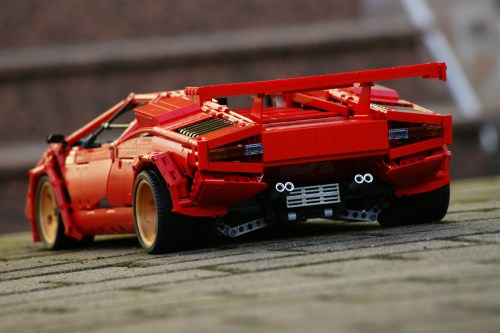
Let’s get the obvious bit out of the way. Those are not official LEGO wheels. But they are excellent. And the model riding atop them is even more so.

This spectacular Technic Lamborghini Countach LP500s is the work of Diego Auguanno, as presented by Polo-Freak of Brickshelf, and it’s about as accurate a Lego Lamborghini as we’ve ever seen.

Diego’s incredible creation utilises Technic panels, System bricks, and those custom golden wheels to beautifully replicate the real ’80s supercar, including a brick-built replica of the Countach’s V12 engine and its signature scissor doors.

Over thirty high quality images can be found at Polo’s ‘Lamborghini Countach LP500S’ Brickshelf album (plus you can buy building instructions at the designer Diego’s Facebook page) and you can take a look at all of this rolled gold via the links above.

Tofu Delivery

Delivering tofu in a Japanese economy car doesn’t sound like the type of story to create an automotive legend, but then stranger things have happened. The Toyota Corolla AE86 Trueno did indeed become an automotive all-star thanks to a cartoon tofu delivery driver, and they’re now worth approximately a $billion.

This wonderfully accurate 8-wide Speed Champions version by Jerry Builds Bricks captures the famous two-tone Trueno superbly, and there’s more to see of his Initial D legend on Flickr. Click the link above to place your order. What even is tofu anyway?