We love mediocrity here at The Lego Car Blog. Which is probably because we are ourselves deeply, completely, terminally, mediocre. And what’s more mediocre, automotively speaking, than a ’90s Toyota Starlet with try-too-hard pin-striping? It’s TLCB of cars. Only it’s well made and reliable.
This glorious example of Toyota’s mundane ’90s subcompact hatchback comes from Ilyabuilder724, and can fit two figures, includes an opening hood, and is fitted with try-too-hard pin-striping. Plus building instructions are available so you can build mediocrity at home. Take a look at all the imagery via the link above.
Winter is coming here at The Lego Car Blog Towers. But whilst us North Northern Hemispherers are steeling ourselves for it getting dark by mid-afternoon and defrosting the car both before and after work, our readers in the Southern Hemisphere are getting ready to enjoy sunny summer days.
Cue the perfect car for the sunshine, and one – in the US at least – named after it; the lovely Honda CRX / Del Sol.
Produced when Honda were at their glorious peak, the CRX / Del Sol brought affordable, economical, reliable fun to the masses, and in targa form open-top motoring too.
This fabulous Technic recreation of the Del Sol captures the real car brilliantly, and comes from previous bloggee (and TLCB Master MOCer) Nico71.
Featuring a removable transverse 4-cylinder engine driven by the front wheels, working steering via ‘HOG’ and the wheel, rear suspension, opening doors, hood and trunk, and a stow-able targa top, Nico’s model is as luminous inside as out, and you can see more of his fantastic Technic Del Sol at his excellent website (where building instructions can also be found), and via the video below.
Neither Ford nor Nissan are renowned as exotic car brands, yet each has made a vehicle that has shot straight to the top of enthusiasts’ wish lists, in the form of the Ford GT and Nissan Skyline GT-R.
Cue Alex Ilea, who has constructed this fantastic R34-generation Nissan Skyline GT-R solely using the parts from the official LEGO Technic 42154 Ford GT set. He’s used nearly every single one too, with just 33 (2%) of the original parts list left unused.
Working steering, an inline 6-cylinder engine, all-wheel independent suspension, plus opening doors and hood all feature, and you can take a closer a look (as well as find a link to building instructions) at the Eurobricks forum, you can view the complete gallery of images at Bricksafe, and you can find Alex’s other legendary ’90s Japanese sports car built from the 42154 Ford GT set by clicking here.
Well, if it’s not Eunos (Japan) or MX-5 (Europe). It is here at The Lego Car Blog too, as today’s post is this excellent Technic recreation of the first (NA) generation of Mazda’s iconic sports car.
Constructed by recent bloggee Brictric, this instantly recognisable model includes motorised drive, steering, four-speed gearbox, and pop-up headlights (all controlled remotely via BuWizz bluetooth battery), all-wheel suspension, plus opening hood, doors and tailgate.
Building instructions are available with lots more to see at the Eurobricks discussion forum. Find the answer to every enthusiast’s car question via the link above.
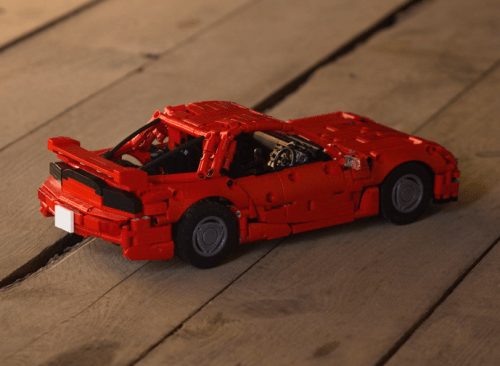
It’s the early-’80s, and everything is ‘turbocharged’; sunglasses, baseball caps, pens… plus, in rare cases, cars. This is one of them, the nuts Nissan Skyline KDR30 ‘Super Silhouette’.
First racing in 1982, the KDR30 was built on a tubular steel space-frame, with sort-of-Skyline sedan bodywork placed over the top, hence the moniker.
A 2.1 litre straight-4 engine was mounted upfront, attached to the mother and father of all turbos. The result was nearly 600 flame-splitting horses, powering the KDR30 to multiple race wins in Group 5 from 1982 to 1984. And many a Grand Turismo racer – as that’s how most readers will know this car – into the digital armco.
This spectacular brick-built replica of the Skyline KDR30 ‘Super Silhouette’ is the work of TLCB Master MOCer Nico71, who has recreated the formidable 1982 racer in astonishing detail.
Underneath the wonderfully accurate body – which wears the real car’s racing livery – is a fully remote controlled drivetrain, courtesy of a third-party BuWizz bluetooth battery, an L Motor powering the rear wheels, and a Servo the steering.
A detailed working replica of the 4-cylinder engine, and the massive turbo that accompanied it, can be found up front, with it – as well as the trunk and hood – easily removable.
3D-printed wheels complete the incredible realism, and the car is available to build in both remote control and manual configurations via Nico’s excellent building instructions, which he’s released alongside full details and imagery.
You can find them and the complete specifications at Nico’s website, the full gallery on Brickshelf, and you can watch both the model and the real car in action (the real one spits considerably more flame) via the video below.
Modifications are an integral part of the automotive scene. Mostly for the worse of course, as Brad in his garage is not going to better the five years and $billions in development completed by the world’s best engineers before each model to hits the market*.
Sometimes though, modifications do work – particularly when the aforementioned engineers embrace this likelihood – and no-one does that better than Japan.
Cue the wild Mazda RX-7 we have here today, which is not only depicting modifications to the real car, it’s also a model modifying another… well, model.
Constructed by builtbydave_, this ‘TCP Magic’ RX-7 is loosely based on a design by fellow bloggee 3D supercarBricks, and features significant aero enhancements, opening doors, and a beautifully detailed 20B 3-rotor engine underneath the raising hood.
There are more superb images of builtbydave_’s modified Mazda to see at his ‘TCP Magic Rx7’ album on Flickr, and you can magic your way there via the link above.
*Not including anything American from the 1990s of course. Or Fiat.
What we value, particularly our vehicles, depends very much upon time and place. The sixth generation Honda Civic, built from ’95 to 2000 (and its Rover 200/400 counterpart), is worth scrap money here in TLCB’s home nation. That is despite the fact they go on for ever, and shouldn’t really need scrapping yet at all.
In the Unites States however, the ‘EM’ Civic is both revered (and hated) as a staple of the tuner scene, and is rather sought-after. No doubt reverence for the mid-’90s Civic will rise in the UK too, as the numbers on the road dwindle to almost nothing, but for now many end their days doing this. There are thousands left on the roads in America though, with many tastefully modified (and many more rather less so) thanks to an abundance of tuning parts.
This neat Speed Champions recreation of the sixth-generation Honda Civic Si Coupe comes from Ilya M of Flickr, who has taken the former route to modification to rather smart effect. There’s an opening hood (with a detailed engine underneath), room for two mini-figures, and free building instructions available (100 TLCB Points to Ilya). Take a look via the link above to see more.
When is a Toyota not a Toyota? When it’s a BMW or a Subaru… At least if the JDM-fanatics of the internet’s comments section are correct.
They’re not correct of course, because a) the fanatics of any brand are morons, and b) because globalisation is the way the car industry operates, and has done for decades.
There are Toyotas that are Mazdas and vice-versa, Toyotas that are Subarus and vice-versa, Toyotas that are Suzukis and vice-versa… and the list goes on and on, including Peugeots, Citroens, Opels, Fiats, Volkswagens, Daihatsus, Chevrolets…
“But what about the Supra?”, the internet cries! Well that does use BMW bits, but they were arranged by Toyota. And put together by neither company. Plus – whisper it – there are BMWs with Toyota parts too…
Thus we’d happily have a Toyota Supra, or a GT86, each of which shares more than a little with cars from other manufacturers.
Cue newcomer builtbydave_’s awesome modified versions of the Toyota Supra and GR86, er… we mean Subaru BRZ, each wearing a wide-arch body kit that makes them even less Toyotary than when they left the factory.
Photographed brilliantly and featuring some clever building techniques, each ‘Toyota’ is well worth a closer look, and you can do just that at builtbydave_’s ‘Subaru BRZ’ and ‘Streethunter Toyota Supra’ albums respectively. Just don’t look too closely or you might find a BMW logo…
Despite what you’d think looking at the cars around TLCB Towers, you really don’t need a Range Rover to drive to the gym. Which is why we love the Suzuki Jimny. Small, light, and vastly more capable off-road than SUVs with five times the power, it’s the antidote to the AMG G-63, BMW XM, and every new Defender that will never ever get a wheel dirty. Yama Jason is the builder behind this one, outfitting his Jimny with a host of off-road goodies and picturing it where you’ll never see an Audi Q7. Join him away from the pavement via the link above.
Unlike your Mom, Kei-class microbuses are really very small indeed. However they manage to pack a whole lot into their tiny footprint, with room for four adults plus luggage, some feature all-wheel-drive, and a few are even fully-fitted campers.
Cue apachaihapachai‘s terrific Technic microbus which, despite measuring just nine studs by twenty-four, features a complete remote control drivetrain courtesy of an L Motor, a Servo, and a BuWizz bluetooth battery, all completely hidden inside a neat 1990s kei-bus body. There’s even an interior. Kinda.
It’s a miracle of ingenious packaging and you can find out how apachai has done it at the Eurobricks forum. Click the link above to squeeze inside.
Hailing from the golden era of Japanese sports cars, the ‘FD’ Mazda RX-7 was the third and final generation of the rotary-engined icon.
With assistance from twin-turbos, the FD’s 1.3 litre twin-rotor motor produced up to 276bhp, getting very hot and drinking a lot of oil in the process. It was also, in this writer’s opinion, perhaps the prettiest of all the ’90 sports cars, which is enough for many to overlook the ownership nightmare of that unique engine and enter a relationship of intense unreliability and ruinous expense. Which is probably a metaphor for something.
Anyway, this excellent Technic recreation of the RX-7 comes from previous bloggee Matthew Terentev, and includes opening doors, hood and trunk, plus a brilliantly accurate interior in very ’90s-Japan-appropriate black plastic.
There’s much more to see at Matthew’s ‘Mazda RX-7 (FD)’ album on Flickr, and you can click the link above to make the jump.
Once the world’s fastest production car, and winner of the 1995 Le Mans 24 Hours, this is the McLaren F1 GTR.
Following its victory at Le Mans (the first time either a manufacturer or team had won the race on their Le Mans debut), McLaren’s Ron Dennis and businessman Kazumichi Goh decided to take the car to Japan, forming McLaren Team Lark, and taking on the country’s domestic teams in the newly formed GT500 championship.
The Lark McLaren F1 GTRs were dominant, comfortably beating domestic rivals from Nissan, Toyota and Honda to win every GT500 race in 1996 bar one.
So dominant was the F1 GTR in fact, that the organisers effectively legislated it out of the championship, imposing so many restrictions on the team that they withdrew before the start of the ’97 season.
The result, after that single all-conquering year, was that the rest of the GT500 teams considerably upped their game. GT500 cars became much faster, more exciting, and more technologically-advanced, and thus the ongoing success of the GT500 Championship has more than a little to do with a little British car that entered for just one season some three decades ago.
This wonderful homage to the short-lived but spectacular Team Lark McLaren F1 GTRs comes from TLCB debutant brickengineeringdude, who has recreated the ’96 championship-winning racer brilliantly in brick form. 3D-Printed wheels, tyres decals, and a superb approximation of the Team Lark livery make brick’s F1 GTR instantly recognisable, and there’s much more to see at their photostream via the link.
But what of Team Lark and GT500? Well owner Kazumichi Goh went on to buy an Audi R8, and with it won the 2004 Le Mans 24 Hours, becoming only the second Japanese team to win the race outright. Meanwhile Japan’s GT500 championship has gone from strength to strength, but has never again been won by a non-Japanese car since the Team Lark McLarens of 1996…
It’s a digitally Japanese day here at The Lego Car Blog, as we have four virtual Toyota products to share with you. We don’t often blog digital creations here, but these are a) throughly excellent, and b) we’re as certain as we can be that they can be built for real, what with designer Peter Blackert (aka Lego911) releasing building instructions alongside the imagery, and having literally written the book on how to build Miniland scale vehicles.
Rule-breaking explained, on to Peter’s first pixel-based Toyota, which is the third-generation Celica, depicted here in face-lifted pop-up headlight form. Powered by a huge array of engines (although solely by the 2.4 litre in the US) the A60-generation Celica helped the Toyota brand gain a reputation for attainable sportiness, and you can see more of Peter’s version via the link.
Peter’s second model appearing here captures one of Toyota’s earlier attempts at a sports coupe, the decidedly un-sporty 1971 Crown Coupe. It looked lovely though, and the Crown station wagon is one of the most comfortable cars that this TLCB Writer has ever had the pleasure of journeying in. Jump back to 1971 via the link.
On to the early-’00s, and the single most dreary vehicle Toyota has ever created, the 2002 Toyota Camry. As we’ve highlighted here before however, dreary sells, with the Camry becoming the best-selling car in America in 2002. And 2003. And 2004. And 2005… You get the picture. There’s more to see of this one at Peter’s photostream via the link.
And finally… the Toyota that isn’t a Toyota, but heralded the arrival of the Lexus brand, the phenomenal Lexus LS400. Created to beat the best car in the world at the time (the Mercedes-Benz S-Class), the LS400 did just that, and is still lauded as perhaps the most thoroughly-engineered car ever produced. Peter’s Miniland-scale version captures the pivotal arrival of Lexus beautifully, and there’s more of the model to see at his photostream.
Further images of each design, details of the real cars, and links to building instructions can be found at Peter Blackert’s Flickr account via the links for each car in the text above, plus you can check out our interview with Peter and his published works by clicking the bonus link here.
We go from the beginnings of the hot hatch in a small factory in Scotland in the late-‘70s, to their zenith some 45 years later. Yes, the days of the hot hatch are numbered, what with imminent safety, CO2 and fuel legislation, which will effectively outlaw small, fast, fun cars in favour of EV crossovers. Sigh.
Still, they’re going out with a bang, with several hot hatches now making more power than even supercars of a few years ago.
This is Subaru’s last hurrah in the genre, the Japan-only Impreza WRX STI Spec-C.
Packing over twice the power of the world’s first hot hatch, the WRX STI Spec-C features all-wheel-drive, over 400Nm of torque, and a lightened and stiffened body.
This amazing Model Team replica of the ultimate WRX comes from Mihail Rakovskiy of Flickr, who has captured it brilliantly in brick-form, with opening doors, hood and tailgate, a life-like interior, and a superb recreation of the 308bhp turbocharged boxer engine.
There are more excellent images to see at Mihail’s ‘Subaru Impreza WRX STI Spec C’ album on Flickr – take a look at the zenith of the hot hatch via the second link in the text above, and you can jump back to its genesis via the first.
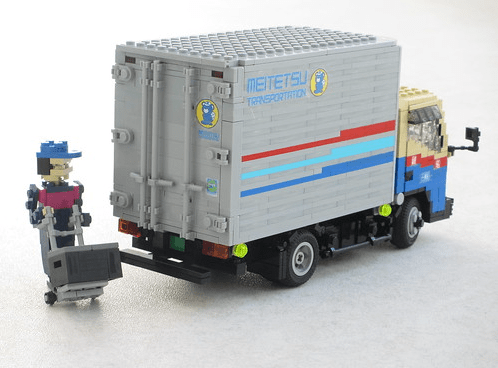
We haven’t written a post regarding golden air transport since we blogged about Donald Trump’s Air Force One showers*. Today though we’re back to golden air travel, courtesy of Ralph Savelsberg and this lovely Mitsubishi Fuso Canter box truck, wearing the livery of Japan’s ‘Meitetsu Golden Air Cargo’ company.
Ralph has captured both the truck and livery beautifully in Miniland scale, and there’s more of the Meitetsu Mitsubishi to see at his photostream. Click here for golden air delivery.