After several non-car posts one of our Elves finally returned to the office with a vehicle worthy of our blog name. This ace hot rod pick-up is the work of Flickr’s SM 01 who has continued working on his previously featured model. His rod now features a list of working functions so long we couldn’t fit them all here. To see what his creation can do take a trip to Flickr by clicking the link above.
Not a Car. Er, again.
This is not a car. But it is lovely. Dan42BR‘s Dampflok 109-13 steam locomotive was discovered on Brickshelf, and you can view all the photos via the link.
We promise the next post will definitely, positively be a car. Probably.
Classic Swoosh!
Who doesn’t like a swooshing classic spaceship?* No-one in TLCB Office that’s for sure! See more of billyburg‘s swooshing spaceman on Flickr at the link.
*If the answer to this question is you, normal car-related service will resume shortly.
Reimagine
The Second World War is endlessly glorified on TV, in video games, and in Lego. Whilst the reality was nothing glorious, it nevertheless captures the imagination of all of us who never served in the conflict, but who owe such an enormous debt to those who did.
TLCB veteran Kosmas Santosa is the latest a long line of builders to recreate scenes from the war years, however he reimagines things a little differently. Standing in the ruins of a nondescript wartime European village is a Titanfall mech, and never has a sci-fi build resided so comfortability in historical setting.
You can see more of Kosmas Santosa’s ‘Titanfall: World War II’ imagining on Flickr, and as we occasionally do here at TLCB, here’s a more important link that we’d like you to click if you have the time.
Swiss Jeep
We’re don’t think there are many old Jeeps in Switzerland. Clocks, chocolate, bankers and other stereotypes sure, but probably not Jeeps. Anyway, this mini-figure has taken his Jeep CJ to the Swiss Alps and it looks rather at home. Ewald Straßmann aka Brick Pimp is the builder, and you can see more here.
200 Club
Two hundred Lego pieces. It isn’t a lot is it? Especially if you’re aiming to build a functional Technic model.
Lego fan site Eurobricks has set the challenge of using just two hundred elements to create a whole new Lego Technic set. Here at The Lego Car Blog Towers we use two hundred bricks every time we build a steering rack, because we’re a bit rubbish, so we’re not really qualified to enter. Thankfully the interweb contains far more talented builders than us, and here are two such prudent engineers.
First up (above) is previous bloggee Jorgeopesi with his two hundred piece mini Technic front loader. He’s used the meagre parts count to produce a raising and tipping bucket, hand-of-God steering system and even pendular suspension on the rear axel. See more of his excellent mini front loader on Brickshelf via the link above.
Our second two hundred piece Technic model comes from fellow Brickshelf user Nikolyakov (also on MOCpages), and he’s also taken the machinery route. Nikolyakov’s mini combine harvester features a raising and lowering harvesting head – which also spins when the wheels are turned, hand-of-God steering, and posable unloading pipes. You can see more of his mini combine via the links above, and you can check out the rules, prizes and other entries in the Eurobricks two hundred piece challenge by visiting the Eurobricks site here.
Falconry
When we think ‘muscle car’ we usually picture an American behemoth with a massive V8 and two stripes painted over the bonnet. However that would be stereotyping the genre, because this is an Australian behemoth with a massive V8 and two stripes painted over the bonnet.
Australia’s muscle car tradition is as strong as the US’s, and whilst their road racers are derived from their US parent companies, they were very much home-grown down-under.
Sadly in recent times all mass vehicle production has, or will very shortly, cease in Australia, with GM (Holden), Ford and Toyota all abandoning manufacturing in the country. Doc Brown’s 1971 Ford Falcon XY GTHO remembers a time when the industry was flourishing, and you can see more of his Power Functions controlled Technic supercar at both Eurobricks and Flickr.
This is the Self Preservation Society…
This is the self-preservation society
The self-preservation society
Go wash your German bands, your boat race too
Comb your Barnet Fair we got a lot to do
Put on your Dickie Dirt and your Peckham Rye
Cause time’s soon hurrying by
Get your skates on mate, get your skates on mate
No bib around your Gregory Peck today, eh?
Drop your plates of meat right up on the seat
This is the self-preservation society
This is the self-preservation society…
Oh yeah, Miro Dudas has updated his previously blogged Mini Cooper to Italian Job spec! See more here!
Baja Bug
The builder of this Baja Bug, Piterx, says he doesn’t like it very much! He has set the bar very high with his previous builds (use the Search function at the foot of this page to see his previous work), but we like it a lot. It’s controlled via Lego Power Functions motors and it looks a blast to drive. You can let Piterx know whether you like it or not on Eurobricks.
Double Trouble
We’ve blogged quite a few classic vehicles here at The Lego Car Blog recently, so to bring a bit of balance we’d like to post a duo of cars so newly-released we’ve not even seen them on the road yet. Luckily though, the Elves rediscovered the page of our very promising Featured TFOL Alexander Paschoaletto, and his two latest cars; the 2014 Lamborghini Huracán, and the 2014 Subaru WRX STI*.
Making modern cars is getting harder, with lots of curves and angles appearing on everything from city runabouts to limited-run exotica, but Alexander has managed to pull off the curves found on these two nicely. See more of both creations via the links to Alexander’s pages.
*Our American readers may think the Subaru should read ‘2015’. Our marketing department refuses to time travel.
Humdinger
We are not fans of Hummer here at The Lego Car Blog. In fact it might be collectively our least favourite vehicle brand of all time. The Elves though – having no taste whatsoever – love this American institution, and so this post is for them.
Built by Technic legend Sariel, this Hummer H1 is one of the most complex and brilliantly engineered creations of the year so far. Containing four(!) XL Power Functions motors for drive, a remotely controlled high/low range gearbox, working indicator and reversing lights, windsreen wipers and a whole host of other functions, the only way to really see what it can do is in a suitably aggressive video complete with a hard rock soundtrack. Handily Sariel’s got that covered…
Dear Marie
One of our favourite aircraft builders returns to TLCB today. MOCpages’ Henrik Jensen‘s Lockheed P-38 Lightning ‘Marie’ is worth a click. See more via the link.
Super Sevens
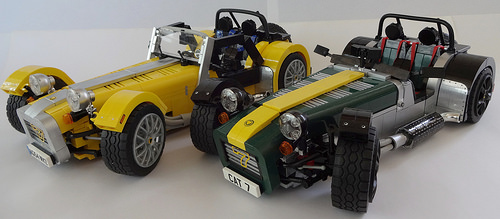
Originally designed and produced by Lotus, the remarkable Super 7 has been in production for well over half a century. Caterham Cars bought the rights to the design in the mid-’70s and it’s been the mainstay of their business ever since.
A wonderfully simple car in real life, the Super 7 is actually fiendishly difficult to recreate from Lego; just working out how to let the front wings turn with the wheels gives us a headache. Carl Greatrix wasn’t phased though, and he’s recreated the British icon with such attention to detail it’s quite possible his models are of higher quality than many real Sevens built by Caterham customers.
Much as we enjoy building things we think we’d leave the construction of a real Seven to the guys in the Caterham factory. Likewise we’re fairly sure that the quality of Carl’s builds will take some beating. See just how good his pair of Super 7s are by clicking the link to Flickr above.
42001 Mini Off-Roader Review
…or the Elves go Technic. Regular readers of this blog will remember that the Elves have “helped” us to build some of sets that we have reviewed, including some of the 3-in-1 Creator series. We decided that it was time to let them go solo with the smallest, cheapest Lego set that we have ever reviewed (we have to buy this stuff you know!).
After the usual explosive opening of the two bags of parts in this set, we helped the Elves to gather the pieces up into a pile and then realised that there were no tyres. These are packed loose in the box and had all rolled under The Lego Car Blog executive beer fridge and champagne chiller. Fortunately a skinny Elf fitted under the fridge. He was soon forced into the gap by his colleagues poking him with the axles from the kit. He reappeared a few seconds later with all four tyres and a Malteser that had rolled under there two months ago.
The Elves then set to work on book one of the two instruction books that come with the kit. “What?!?!” we hear you cry, “Two instruction books for a set with just 100 pieces?”. LEGO have come up with a new concept for this model. The first booklet builds a common chassis and then the second booklet has instructions for two alternative bodies to fit onto the chassis. A novel, fun concept, with lots of play and re-building potential.
The instructions are in the usual clear, LEGO format, with just a couple of parts per stage. This is slow for a Technic set but remember the starting age for this kit is just 7 years old. By stage 6, a 5-wide frame has taken shape, with swing arms for each wheel. The Elves had to resist the temptation to bash each part down hard and tight, so that the suspension would work on the finished buggy. The first Elf-fight broke out at stage 8, with the adding of the two elastic bands which make the “springs” of the suspension. The temptation to flick the bands at each other was too great to resist and order was only restored when both bands had vanished under the beer fridge. Annoyingly, for a set aimed at kids, LEGO provide the usual spares for some of the smaller, cheaper parts but don’t give you a spare elastic band. The skinny Elf was sent under the fridge again and this time returned with the elastic bands and something blue and furry: possibly left-over cheese nibble from the office Christmas party. The last stage of the instructions is to turn the chassis the right way up, though even the Elves didn’t really need a page of instructions for this.
The first body quickly builds up in typical Technic style, with some 1×1 round trans plates for front and rear lights. Stages 3 & 4 have a bit where you have to do things in the right order or pieces won’t connect but that’s the trickiest part of the build. Stage 12 requires strong fingers to insert a 2 stud-long axle and we had to do this for the Elves. After 22 short stages the Elves were left with a nice-looking, orange and grey, short-wheelbase off-roader. It rolls across carpets and desks and its long-travel suspension bounces really well. There’s space inside for a few of the smaller Elves and they had great fun zooming around the office until two of them were car-sick into the jacuzzi (again!).
The seven stud long axle, which pins the body to the chassis makes a very handy tool for disassembling the body to build the second version. As this set is aimed at younger builders, the instructions could perhaps be improved by including some pictures showing tips and techniques for pulling the model apart. Continue reading
Ringdingding-da-ding-da-ding…
We’re pretty sure that the Crazy Frog ranks amongst mankind’s greatest evils ever unleashed upon society. Despite the fact that this creation reminded us of that hated amphibian it is rather good and thus deserves its place here. Karf Oohlu is the builder and you can see more on Flickr.