Tag Archives: 1970s

Minnie Winnie

This startlingly well-constructed classic camper is a 1977 Dodge B100-based Winnebago, or ‘Minnie Winnie’, and it comes from 1saac W. who is on an absolute roll at the moment.

1saac’s creation captures the aesthetic of the real deal brilliantly, including a brick-built take on the classic Winnebago livery, and a subtle shift from six to seven wide from the cabin to the camper.

It might not be fast, nor beautiful, but it’s nevertheless one of our favourite small-scale creations of the year so far. Head to an American campsite in the late ’70s via 1saac’s photostream above.

What’s Brown and Smelly?

It’s time for another delve into the automotive curiosity cupboard that is the Eastern Bloc, a Communist alliance renowned for the oppression of millions, waiting lists that stretched into decades, and cars that were almost comically bad. This is one of them, the Wartburg 353.

As with many Communist creations though, the Wartburg was not a bad car when it launched in the late 1960s. A weird one perhaps, but not bad objectively speaking.

The 353 started production from a pinched BMW factory in 1966, and was powered by a 1 litre, 3-cylinder, 2-stroke engine that had its roots in a 1938 DKW. This made it as torquey as the larger engines in the west, and meant it had only seven major moving parts, but also made the car incredibly unrefined and polluting, leaving a cloud of burnt oil behind it whenever it went.

A unique freewheel system meant the 353 required no clutch to change gear, and the car was also front-wheel-drive, still fairly novel at the time, although the set-up imbued it with terrifying understeer characterises in the wet.

Despite the niggles, the Wartburg 353’s low price, reliability, and the fact it wasn’t a Trabant, led to success, and meant that – due to the ‘planned economy’ of East Germany – the waiting list stretched out to fifteen years for private citizens.

The 353 was also exported to several countries as the Wartburg ‘Knight’, presumably to bring in foreign currency (which must have been frustrating for those on the waiting list), as well as being used by the police and East German government.

Of course as time passed the 353 became increasingly outdated, and little was done to keep pace with Western products that were out of reach for those trapped behind the Iron Curtain. The government even repeatedly refused to upgrade the polluting 2-stroke engine, despite Wartburg’s engineers having developed working alternatives.

By the late-’80s the writing was on the wall, both for East Germany and Wartburg. The eventual addition of a modern 1.3 litre engine from the Volkswagen Polo in 1984 came too late, and the reunification of Germany finally killed the 353 – alongside many other long-obsolete East German offerings – in 1988.

This splendid Model Team recreation of the Wartburg 353 ‘Tourist’ is the work of previous bloggee Legostalgie, who has captured the East German family car beautifully in period-correct brown.

Opening doors, hood and tailgate, plus a detailed engine and interior all feature, and there’s lots more of the model to see at Legostalgie’s ‘Wartburg 353 Tourist’ Flickr album. Click the link above to join a fifteen year queue in East Germany sometime in the 1970s.

FJ40

If there’s one 4×4 cooler than the Land Rover Defender, this is it. The Toyota Land Cruiser FJ40 is an off-roading icon, and thus – like all things old and Japanese – it’s now worth about a million pounds.

However with the news that Toyota have become the latest auto manufacturer to partner with LEGO, we may one day see an official Land Cruiser set, which will be a far more attainable way to FJ40 ownership for this TLCB Writer, even with immense fame, glory and groupies that working for this site brings…

Until then though, regular bloggee Jonathan Elliott has created a Speed Champions scale Toyota Land Cruiser FJ40 so good we doubt LEGO will do any better should they decide to produce one. And it’s yellow.

Glorious attention to detail and ingenious building techniques are in evidence everywhere you look, and there’s more to see of Jonathan’s brilliant FJ40 at his photostream via the link.

Cotton Communism

From one iconic classic to another, although this one perhaps for very different reasons…

The Trabant 601 was a reasonable little car when it first launched in the 1960s, despite the shortage of metal in post-war Europe forcing its construction from cotton, and its two-stroke 600cc engine.

The cotton body meant that it didn’t rust, which – combined with a near monopoly in East Germany and a production run until the collapse of the Soviet Union some thirty years later – led to well over two million Trabants being on the roads at one point.

That number quickly fell once East Germans could buy Volkswagens and Opels instead though, as even by the ’80s the 601 was hopelessly outdated, such is the folly of Communism.

Cue this excellent Model Team version of the Trabant 601, built by Flickr’s Legostalgie who has recreated the classic cotton car superbly in brick form. A detailed interior, engine bay, and opening doors, hood and trunk are included, and there’s more to see at Legostalgie’s ‘Trabant 601’ album by clicking here.

Ghost Pirate

Disney’s ‘Pirate’s of the Caribbean’ managed to successfully* combine both pirates and ghosts, which – to any 8 year old or TLCB Elf – made it the coolest thing ever.

Their piratical spectres were beaten by a few decades however, by the U.S. Navy, whose ‘VF-84 Jolly Rogers’ squadron operated Phantom II jets from the USS Roosevelt in the 1960s.

Featuring a variety of pointy weapons, superb building techniques, and a ‘skull and crossbones’ tail-fin motif (which – to any TLCB writer – makes it the coolest thing ever), previous bloggee [Maks] has captured America’s ’60s fighter in stunning detail, and there’s more to see of his airborne ghost pirate via the link above.

*Ok, maybe not by the third one. Which was (and still is) one of the worst sequels of all time.

Back in the Dnepr

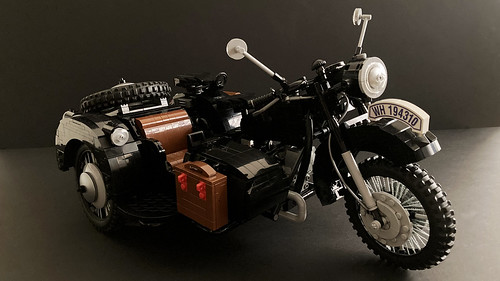
This wonderful creation is a KMZ-Dnepr K650, a Soviet Ukrainian motorcycle based on the 1930’s BMW R71. Whilst this version is 650cc, early bikes were fitted with a 98cc Wanderer engine design taken from Germany as part of reparations for World War 2, before KMZ’s own much larger 650cc was used for the rest of the design’s long production run.

Of course the BMW bit of the KMZ-Dnepr pre-dates war reparations, as the Soviet Union officially licensed the design from Germany before the two countries later went to war. In fact Germany and Russia held talks about becoming allies, with only Hitler’s ideological greed preventing Stalin from agreeing. Had they found common ground then this TLCB Writer would probably be typing this in German.

Fortunately Hitler and Stalin didn’t team up, and Germany invaded the Soviet Union just a year after the deal to license the BMW R71 was signed. This led – rather oddly – to the bike fighting on both sides of the conflict; the BMW version for the Axis Powers and the Soviet IMZ-Ural copy for Russia.

Production of the KMZ-Dnepr version shown here commenced in Ukraine in 1946, and continued right up to the fall of the Soviet Union, with both civilian and military versions produced. This beautifully presented replica of the KMZ-Dnepr K650 comes from KMbricklab, making their TLCB debut, and depicts the German-Russian-Ukrainian bike in both civilian and (awesome) military two-wheel-drive sidecar variants.

Gorgeous detailing and clever building techniques are evident in abundance and there’s lots more of KMbricklab’s superb build to see at their ‘KMZ-Dnepr K650’ album on Flickr. Click the link above to make the jump to Soviet-era Ukraine.

*Today’s lightly butchered title song.

Just Like a 911. Sort of.

The Porsche 911 is not the only rear-engined rear-wheel-drive European car. In fact there were loads, including Volkswagens, Tatras, Skodas, the Smart ForTwo, and – of course – Fiats.

Following the phenomenally successful 500, Fiat followed up with another rear-engined, rear-driven design, the near five-million selling 126.

Much of the 126’s technology was based on the 1950’s 500, which – considering it was produced in Polski-Fiat 126p form until the year 2000 – is both an astonishing achievement and rather frightening.

It’s the Polski-Fiat version we’re featuring here today, a car that mobilised Poland, although only if you were prepared to wait years or had communistical connections. Recreated in a fetching ‘hearing-aid beige’ / ‘baby-sick yellow’, Legostalgie‘s Model Team replica of the 126p captures the real car wonderfully, with a near perfect exterior, detailed interior, plus opening doors, front trunk and engine cover, with a realistic two-cylinder engine underneath.

Legostalgie has presented his model beautifully, and there are more top-notch images available to view at his ‘Polski Fiat 126p’ album on Flickr – click on the link above for all the drawbacks of a 1970’s Porsche 911, but none of the thrills…

Nice Tan

White LEGO bricks, like nerds, don’t particularly like strong sunlight.

The gradual yellowing of white pieces exposed to UV is subject to much debate within the nerdier corners online Lego community, from applying hydrogen peroxide to restore parts to their original hue, to – more nerdily – sealing bricks inside darkened rooms or even never taking them out of their box. Which is quite fantastically pointless.

Cue previous bloggee seb71, who has not only allowed his white pieces to yellow, he’s positively embraced their ageing.

Seb’s brilliant classic motorcycle deploys some properly yellowed Technic wheels, matching their sunlight-induced cream to a seventies-tastic brown and white aesthetic for a beautifully period-correct look.

There’s more of Seb’s well-tanned classic bike to see at his photostream, click the link above to take a look and then get out in the sun – it’s good for you and maybe even your LEGO bricks too.

Captain Pugwash

LEGO have produced several Porsche 911 sets, from Speed Champions to Technic, but there’s still room for fan-made models of the famous rear-engined sports car.

This is one of them, a beautifully built and photographed 911 Carrera by Flickr’s Dornbi, and unlike most 911 builds (including one of Dornbi’s own past creations), his latest Porsche sports no wings, stripes, or racing numbers, simply being a base naturally-aspirated narrow-body classic, and we think it’s all the better for it.

There’s more to see of Dornbi’s stunning classic 911 by clicking here, and if you can figure out today’s title a hundred TLCB Points to you!

Whole Lotta Lada

We like crap cars here at TLCB. The office car park features several. OK, by ‘like’, we mean ‘own’, but we do genuinely like it when they’re built from Lego bricks.

This is one such crap car, the Lada 1200 / VAZ-2101, and whilst the car-based efforts of communism were almost uniformly terrible, there is a lot to like about the Lada 1200.

Developed from the then decade-old Fiat 124, the Lada 1200 actually had a throughly excellent base, as back in the 1960s Fiat were one of the most forward-thinking and technologically advanced manufacturers* in Europe, with the Fiat 124 winning the European Car of the Year award in 1967.

The Lada 1200 was therefore actually quite a good car when it was launched, with a strengthened chassis, more advanced overhead cam engine, and the Fiat’s one key foible – rust – almost eliminated by Lada and VAZ’s use of much thicker steel and paint.

Of course decent engineering can be very much undone by poor build quality, limited competition, and corner cutting, which sums up communistical manufacturing nicely, and thus the Lada (and Soviet cars in general) quickly became known for being total crap. And that was even when compared to rivals like the Austin Allegro.

We’ll much rather take this one then – which features build quality on a level never achieved in Lada factory – from TLCB newcomer Legostalgie.

Legostalgie’s Model Team recreation of the Lada 1200 / VAZ-2101is superb, with opening doors, hood and trunk, a detailed engine and interior, and infinitely better build quality than the real thing.

Neatly pictured on a grey sofa (we think!), Legostalgie also proves you don’t need a professional set-up to Photo like a Pro, and there’s more to see of his wonderful Lada 1200 / VAZ-2101 model on Flickr by clicking these words.

*What the hell happened?

Seventies Stripes

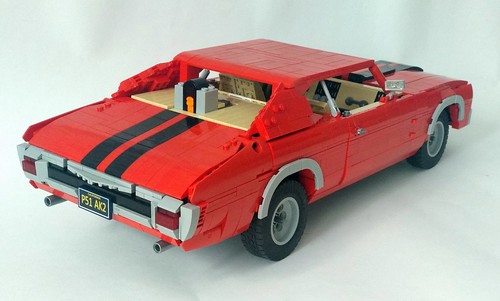
That’s probably not what the ‘SS’ part of the Chevrolet Chevelle SS’s name stood for, but it may as well have been if you’re a TLCB Elf. They really like stripes.

This magnificent fully RC recreation of the 1970 Chevelle SS by Jakub Marcisz features two most excellent stripes over its hood and trunk, which by TLCB maths add at least 50bhp.

Power Functions remote control equips Jakub’s model with drive and steering, there’s a two-speed gearbox, all-wheel suspension, opening doors, hood and trunk, and LED lights.

A sizeable gallery of images is available via Jakub’s ‘Chevrolet Chevelle SS 1970’ album on Flickr, plus you can see full details and a video of the model in action at the Eurobricks discussion forum here.

Towering Inferno

This is the NASA ‘Launch Umbilical Tower’, designed to send the world’s most powerful machine – the Saturn V rocket – into space, and carried by the world’s heaviest land vehicle.

LEGO’s enormous 92176 NASA Saturn V set has allowed space fans to conduct their own bedroom-based lunar missions, but the ‘blast-off’ bit (in this writer’s opinion, the coolest bit) requires a few additional accessories not supplied by LEGO…

Fortunately Janotechnic of Eurobricks – here making his TLCB debut – has the answer, not only building this incredible 1:110 scale Technic Nasa Crawler and Launch Umbilical Tower, but doing so from three official LEGO Technic sets; the 42055 Bucket Wheel Excavator, the 42082 Rough Terrain Crane, and the 42098 Car Transporter.

That expansive parts supply has enabled Jano to equip his B-B-B-Model with a huge array of motorised functions, including drive and steering, crane rotation, retractable support swing-arms, and even a working lift within the tower!

It’s an incredible creation and one that (in simplified form below) you can build for yourself, as building instructions are available. There’s more of Jano’s amazing NASA Crawler and Tower to see – including a video of the model’s motorised and mechanical functions – at the Eurobricks forum. Click the link above and prepare to blast-off!

A Whale of a Time

We’re not sure why whales are renowned for having such a good time, but we guess their partying reputation fits with the matra ‘Go Big or Go Home’.

Whatever the reason, Porsche decided that their 911 could do with being a bit more whaley in the 1970s, and fitted it with a huge ‘whale tail’ spoiler. And a turbo.

Said turbo added to the whaley fun, providing absolutely no power at all for a long time, and then suddenly all the power at once. This meant ’70s 911 Turbo drivers did indeed have a whale of a time right up until the point when they were upside-down in a field. That’s ‘Go Big or Go Home’ again we suppose…

This brilliant Porsche 911 Turbo comes from barneius, who has recreated the whale-tailed classic superbly in 8-wide Speed Champions scale. There are more beautifully sharp images available to view on Flickr, where you can also find a link to building instructions so that you can recreate chronic turbo lag and snap oversteer in miniature at home!

Click the link above to have a whale of a time!

Fast Running Camel

Cheap ubiquitous ‘Peoples’ Cars’ have a habit of becoming off-roaders. There are Baja Beetles, beach buggy Beetles, the Mini Moke, and – if those are too fast for you – the Citroen Mehari.

Based on the already off-road capable 2CV and ironically named after a fast-running camel, the Mehari kept the 2CV’s 602cc two-cylinder engine and added plastic body panels and a removable roof, creating a kind of off-road roadster. Just a very slow one.

This superb Speed Champions scale recreation of the plastic snail comes from TLCB regular Jonathan Elliott, which is both built and presented beautifully, and there’s more to see at the link.

Dodgy Drag

This Elves are very excited today. Not only does this excellent 1970 Dodge Challenger feature a hood scoop (Elf points), many drag racing modifications (more Elf points), and a brick built nitrous kit (even more Elf points), it’s fully remote controlled too, with LEGO’s monstrous Buggy Motor driving the rear wheels.

A Servo powers the steering, not that you’ll really need that at the drag strip (in this case TLCB office corridor), there’s working suspension (independent front and live-axle rear), plus opening doors, hood, and trunk.

It’s a mega bit of kit and one we fully intend to drive up and down the corridor to much Elven whooping until the battery is flat. Whilst we get on with that arduous testing you can check out more of Michael217’s awesome creation at both Eurobricks and Bricksafe – click the links to take a look!