Tag Archives: Fiat

Polishing a Fiat

It might seem like the posts here at The Lego Car Blog are simply a scattergun of whatever the Elves have found that meets our criteria, but no – just look at the seamless and completely non-coincidental links running through the last few posts; a Ma.Ktober mech that looks like a Jurassic Park dinosaur followed by the Jurassic Park Jeep and said dinosaur, and an ancient little Fiat followed today by an even more ancient little Fiat. Exactly.

Anyway, this ancient little Fiat is a 126p, a cheap 1970s rear-engined city car that unbelievably endured until 2000 in Polish Polski-Fiat form. Over three-million Fiat / Polski-Fiat 126s were produced during its 28 year production run, and this excellent brick-built homage to one of Europe’s most popular people’s cars captures the real Polish 126p in wonderful detail.

Working suspension, posable steering, opening doors, front trunk and engine cover, an accurate engine, and a superbly life-like interior all feature, and there’s much more to see – including a link to building instructions – courtesy of SIM CAMAT on Flickr.

Click the link above to take a look, whilst we try to somehow link whatever the Elves find next with a 1970s Fiat…

[Insert Tweet About Boyfriend]

The Fiat 500 might be very nearly as old as the car it’s pretending to be, but thousands of people still buy it each year in TLCB’s home nation and they all seem to be, um… girls of a certain type.

This is particularly true for the 500c variant, which has a sort of pram-esque canvas roof that can pile up where the back window should be.

Cue newcomer brictric and their lovely Technic recreation of the Fiat 500c. Constructed in roof-down configuration, brictric’s Fiat comes complete with working steering, all-wheel-suspension, opening doors, hood and boot-lid, adjustable seats, a (mildly inaccurate) piston engine, and bodywork as orange as the girls that drive it.

There’s lots more of brictric’s Fiat 500c to see on both Eurobricks and Flickr, and if you’re fortunate enough to live somewhere where ‘Fiat 500 Girls’ aren’t a thing, you can educate yourself here, here and here.

The Beast of Turin

Four cylinders, twenty-eight litres, 290hp, and many flames. Fiat’s incredible S76 – nicknamed ‘The Beast of Turin’ – was built to claim land speed records, thanks to that astonishing engine that was also used to power airships.

This wild Technic interpretation of the 1910 racer was found by one of our Elves on Eurobricks, and comes from JoKo, who has created a working approximation of the S76’s enormous engine complete with functioning double overhead cams, valves, and timing chain.

Control+ components allow for remote control drive and steering, there’s leaf-spring suspension, a working hand-crank, and – perhaps most importantly – a marvellously moustachioed gentleman sitting in the cockpit.

Fire up all 28.4 litres via the link above, and click here to see (and hear!) the real Beast of Turin come to life.

500 Green Bottles…

Here at The Lego Car Blog we do not understand America’s obsession with enormous pick-up trucks. Seemingly used to carry only an American flag, a ‘MAGA’ bumper sticker, and an anti-vaxxer in denial of the election result, they’re a world away from the pick-up we’ve got here.

This is the Fiat 500 Camioncino, a tiny two-seat pick-up truck, capable of carrying… well, not very much. But easily what most American pick-ups seem to.

The cutesy brick-built version pictured here today is the work of Nuno Taborda, who has based it upon the official LEGO 10271 Fiat 500 set, much like the real Camioncino was adapted from the 500 city car too. With the rear seats, roof and bodywork replaced by a load bed fitted above the rear-mounted engine, there’s space for a few dozen green bottles to make their way to the piazza. And that’s considerably more than what’s in the beds of 95% of American pick-up trucks.

Join Nuno trundling across Italy in a pick-up truck small enough to fit in the bed of an F-150 via the link above. And there’s not a bumper sticker in sight.

Taking the Mickey

The famed Fiat 500 was not the brand’s first city car. For that you have to go way back to 1936 and the Topolino, or ‘little mouse’ (which was also the Italian name for Mickey Mouse), a tiny 569cc, 13hp two-seater sold up until the 500’s introduction in 1955.

Designed for two, but often seen with four or five very uncomfortable people squeezed inside, the Topolino was one of the smallest cars in the world at the time, and a hugely successful one, with over half-a-million produced.

Important to Italy’s mobility as the Topolino was however, we wouldn’t think of it as the obvious choice for a ‘Gasser’ hot rod. Fortunately Tim Inman‘s mind works differently to ours, because the resultant creation is unhinged brilliance, and there’s more of Tim’s Topolino Gasser to see on Flickr. Click the link above to make the jump.

Tinder Lies

This is a Dino 246, the late-’60s to mid-’70s Ferrari-that-wasn’t-a-Ferrari.

The Dino 206 and 246 compared favourably with the Porsche 911 and other sports cars of the time, but the 2.0 and 2.4 litre V6 Fiat engines fitted were considered too entry-level for the main Ferrari brand, despite Ferrari upping the horsepower figure by 20bhp.

By ‘upping the horsepower figure’ we do mean that literally; Ferrari’s number may have been 20bhp higher than Fiat’s, but the engine was identical. It’s the ’60s motoring equivalent of adding a few inches to your height on Tinder…

Despite the outright lies we do rather like the Dino, and time has been kind to it, with a quick search revealing the Dinos for sale today are all listed as ‘Ferraris’. And they probably have an extra 20bhp in the performance figures too.

This lovely Speed Champions recreation of the not-quite-a-Ferrari comes from Flickr’s Thomas Gion, who has captured the Dino 246 GT beautifully. There’s more to see at Thomas’ ‘1969 “Ferrari” Dino 246 GT’ album‘ on Flickr – take a look via the link above whilst this TLCB Writer makes a minor amendment his Tinder profile.

Floating Fiat

Fiat, like many of motoring’s earliest names, began as much as an aircraft manufacturer as an automotive one. By 1969 though, the aircraft division had been separated from Fiat’s vehicle group, which – as anyone who has owned a 1970s, 1980s, 1990s, or even 2000s Fiat will testify – was probably a very good thing indeed. Fiat electrics at 30,000ft don’t bear thinking about…

Bravely returning Fiat to the clouds however is Brick Spirou, who has modified the official LEGO 10271 Fiat 500 set into something rather more airborne. Four funky repulser engines equip Brick’s Fiat for the skies, whilst the giant engine-lid-mounted rear wing is presumably mounted upside-down for lift rather than downforce.

There’s more of Brick Spirou’s 10271 Fiat 500 hovercar to see on Flickr via the link above, plus you can click here for a bonus LEGO set that has also received the hovercar treatment.

Also Available in Blue

The charming 10271 Creator Expert Fiat 500 set became a firm favourite when it joined LEGO’s ever growing line-up of officially licensed vehicles last year. Although we still don’t know why it comes with an easel.

Whilst the primrose yellow hue of the original set suites the Fiat 500 perfectly, the humble Italian city car was also available in a range of other pastel colours in the 1960s, and LEGO have decided to release a new version of the 10271 set in this lovely light blue.

Becoming 77942, the new Fiat 500 set is identical to the yellow version, only in, er… blue (with even the pointless easel updated accordingly).

On sale in the UK now, 77942 will hopefully roll out elsewhere (otherwise expect some ludicrous pricing on eBay), and could perhaps signal a wider multi-colour strategy from LEGO for successful sets?

Our picks would be the 10265 Ford Mustang updated in Bullitt green, or maybe even a Herbie-d 10252 Volkswagen Beetle!

Build-a-Fiat

LEGO’s 10271 Creator Fiat 500 set is a fine addition to their officially licensed line up. Even if we don’t understand why it comes with an easel.

However being a Creator set, 10271 isn’t particularly technical. Cue TLCB Master MOCer Nico71, who has constructed a similarly-sized sixties Fiat 500 in Technic form with a whole heap more functionality. Although no easel.

Nico’s Fiat looks the part, with a combination of axles, lift arms and flex tubes recreating the 500’s famous shape, under which is a working rear-mounted two cylinder engine driven by the rear wheels, functioning steering, front and rear suspension, plus opening doors, front trunk and engine cover.

It’s a lovely build (that would make an excellent set too), and one that you can recreate for yourself at home as Nico has made building instructions available.

There’s more to see on Eurobricks, and at Nico’s excellent website, plus you can read his interview in the Master MOCers series here at The Lego Car Blog via the link in the next above.

YouTube Video

Just Like a 911. Sort of.

The Porsche 911 is not the only rear-engined rear-wheel-drive European car. In fact there were loads, including Volkswagens, Tatras, Skodas, the Smart ForTwo, and – of course – Fiats.

Following the phenomenally successful 500, Fiat followed up with another rear-engined, rear-driven design, the near five-million selling 126.

Much of the 126’s technology was based on the 1950’s 500, which – considering it was produced in Polski-Fiat 126p form until the year 2000 – is both an astonishing achievement and rather frightening.

It’s the Polski-Fiat version we’re featuring here today, a car that mobilised Poland, although only if you were prepared to wait years or had communistical connections. Recreated in a fetching ‘hearing-aid beige’ / ‘baby-sick yellow’, Legostalgie‘s Model Team replica of the 126p captures the real car wonderfully, with a near perfect exterior, detailed interior, plus opening doors, front trunk and engine cover, with a realistic two-cylinder engine underneath.

Legostalgie has presented his model beautifully, and there are more top-notch images available to view at his ‘Polski Fiat 126p’ album on Flickr – click on the link above for all the drawbacks of a 1970’s Porsche 911, but none of the thrills…

It’s as Easy as AC B

We love receiving comments here at TLCB. It means people actually read this stuff. Well, when we say we love receiving them, it does depend a little upon what we receive.

Automated spam for various exciting sounding drugs, offers of ‘help’ to ‘grow our audience’ and ‘give me instruktions’ comments arrive in their hundreds, but in-between all of that nonsense we do get some gems. Such as this one.

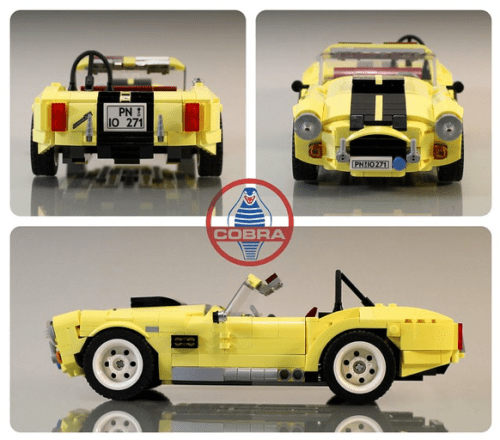
Suggested by a reader this is Firas Abu-Jaber’s AC Cobra, built solely from the parts found in the official 10271 Fiat 500 set. So excellent does it look that we wouldn’t have guessed that it has been constructed from the pieces of a single LEGO set, with opening doors, hood and trunk, a detailed interior, and even a realistic engine bay.

There’s loads more to see of Firas’s fantastic 10271 AC Cobra B-Model at his Flickr album by clicking these words, and if you’d like to suggest a creation or leave feedback about anything else (preferably not exciting sounding drugs or offers to ‘help’ to ‘grow our audience’ though), you can get in touch via the Contact page here.

Beast of Turin (Probably)

The inline four-cylinder petrol engine is the most commonly fitted engine to cars the world over. The optimum balance between smoothness, power, efficiency, and er… cheapness, the inline-4 needs only one cylinder head, there are always two cylinders going down as two go up, and when mounted transversely it takes up little space.

Despite all those worthy attributes however, these days the inline 4-cylinder can be seen as a bit dull, despite the efforts of the world’s best engineers to liven it up. Back in the earliest days of motoring though, it was anything but.

Bentley’s amazing ‘Blower‘ racing cars used 4-cylinders, and so too did Fiat, who – in 1911 – fitted a four-cylinder engine to their S76 World Record Car of twenty-eight litres capacity. The result was quite fiery, and allowed the ‘Beast of Turin’ to hit an unofficial top speed of over 130mph.

It’s this car that Joe Maruschak‘s ‘Vintage Race Car’ most closely resembles, itself being fitted with a working 4-cylinder engine utilising LEGO’s suitably vintage square pistons and featuring pushrod-operated valves.

A hidden Power Functions motor brings Joe’s creation to life and there’s more to see of his mighty 4-cylinder racing car on Flickr via the link above.

My Other Other Car’s a Fiat…

The Fiat 500 has been a runaway success across Europe. Over two million have been sold to date, despite the design remaining virtually unchanged in fourteen years of production.

Fiat, unused to building a car that people actually like, subsequently decided that literally everything they make should be a 500[something]. This has unfortunately led to hideous monstrosities like thiswhich have been about as successful as storming the U.S. Capitol building in the hope of overturning a legitimate election.

However unlike Fiat, LEGO’s ace 10271 Creator Fiat 500 set is proving not only a hit, but also one that can be used to create a range of other vehicles that don’t just look like a regular 500 has died at sea and washed up on a beach months later.

Cases in point are these two brilliant B-Models, each built only from the parts found within the 10271 Fiat 500 set, and each managing to successfully create something new and excellent from the recycled parts.

First up (above) is monstermatou‘s marvellous 1920s Citroen 5HP Trefle, which captures the real car so well you’d be hard pushed to know it’s an alternate (which explains why monstermatou very nearly won TLCB Lock-Down B-Model Competition with one of his past builds). Building instructions are available and there’s more to see on Flickr via the link above.

Today’s second 10271 alternate comes from a past official LEGO set designer no less, the incredibly talented Nathanael Kuipers, who has turned the little classic Fiat into a 1950s pick-up truck.

Cleverly using the Fiat’s interior pieces to make up for the shortfall in available bodywork bricks, Nathanael’s B-Model includes opening doors, hood and tailgate, and building instructions are available too.

Click the link above to check out more of Nathanael’s B-Model at his photostream, and if you own a 10271 Creator Fiat 500 set, perhaps see what you can create from it! You’ll easily do a better job than Fiat have managed with the real thing…

My Other Car’s a Fiat

LEGO’s brilliant 10265 Ford Mustang set has been turned into all sorts of B-Models by the enterprising online community. So too has the equally marvellous 10271 Fiat 500 set, but this is the first time one set has been used to create the vehicle from the other!

This excellent 1960s Ford Mustang fastback comes from Flickr’s Gerald Cacas, and it’s been built only from the parts found within the 10271 Fiat 500 set. Like the official LEGO version Gerald’s model includes opening doors, trunk and hood, under which there’s the option of fitting a gloriously oversized hood-protruding engine. Combine that with it being both yellow and adorned with racing stripes and you have a car almost made for TLCB Elves.

There’s more of the creation to see of Gerald’s Ford Mustang 10271 Alternate Build album, where you can also enquire about building instructions should you wish to convert your own 10271 Fiat into Ford’s iconic ’60s pony car.

Now if only someone could build a Fiat 500 from the 10265 Ford Mustang set to complete the circularity…

My Other Car’s a Fiat

Fiat’s original 500 was small, very cheap, and designed to mobilise the the masses, with over 3.5 million built during a production run that lasted two decades. The beauty of LEGO of course, is that you can turn anything into anything, as published author Peter Blackert (aka Lego911) has proven with his beautiful 1935 Auburn 851 ‘Boat-Tail’ Speedster.

Produced for the super wealthy for just one year and in tiny numbers, the Auburn 851 Speedster is about as far removed from the diminutive Italian peoples’ car as it’s possible to get. With a 4.5 litre straight-eight (and an optional supercharger), the Auburn Speedster’s engine was nine times larger than the Fiat 500’s with four times as many cylinders, and provided it with a top speed double that of the Fiat.

However Peter’s wonderful replica of the Auburn 851 Speedster has more in common with the little 500 than it may appear, as it uses only the recycled parts from the official 10271 Creator Fiat 500 set in its construction, even repurposing the Fiat’s canvas sunroof to form the Auburn’s convertible top.

It’s a superbly diverse alternate and there’s lots more to see of Peter’s brilliant Auburn Boat-Tail B-Model at his photostream. Click the link above to turn your Fiat into something altogether more dashing!