This TLCB Writer isn’t thinking about pizza (it’d be thin and crispy all the way), but rather pondering the ingenious nature of this ‘Heavy Communications Rover’ by The Brick Artisan. According to Brick, when dust storms or Blacktron agents disrupted satellite transmissions, a fleet of just four Heavy Communications Rovers could be used to communicate ‘seismically through a planet’s interior’, giving the entire surface network coverage. Mrs Mavis’ pot plants are shaking on her windowsill four thousand miles away and she’s convinced they’re taking to her, but it’s a small inconvenience to keep the Federation’s messages flowing. You can pick up the story at The Brick Artisan’s photostream via the link above, whilst this TLCB Writer orders a pizza for some reason.
EMU
Not the running bird type (we’re not sure why things are avian-themed today), but this rather beautiful Japanese National Railways 583-series ‘EMU’ train, built and photographed superbly by TLCB debutant Orient R. Minesky.
Orient has eschewed the usual plain background set-up (that admittedly we usually prefer) for gorgeous (and incredibly life-life) outdoor photography, making his stunning EMU train appear almost real.
Head to Orient’s photostream via the link above for all of the wonderful on-location imagery.
The Osprey is Dead
Like the Dodo, and those pointy-beaked flappy dinosaurs that killed everyone in Jurassic World, the Osprey is dead. At least LEGO’s version is. Following a petition by the German Peace Society, the new 1,636 piece set due for release in 2020 has been cancelled, on the grounds of it being a military vehicle (which we suppose it is), a category that LEGO have steadfastly tried to avoid in the past.
LEGO’s statement on the cancellation reads;
The LEGO Technic Bell Boeing V-22 Osprey was designed to highlight the important role the aircraft plays in search and rescue efforts. While the set clearly depicts how a rescue version of the plane might look, the aircraft is only used by the military. We have a long-standing policy not to create sets which feature real military vehicles, so it has been decided not to proceed with the launch of this product.
We appreciate that some fans who were looking forward to this set may be disappointed, but we believe it’s important to ensure that we uphold our brand values.
Which probably means if you managed to get hold of a LEGO Technic 42113 Bell Boeing V-22 Osprey set before the cancellation it’ll soon be worth at least $1 billion to those nerdy collectors who never take the bricks out of the box.
We’re not sure what we think about this one. We were rather surprised that LEGO released a military aircraft as a set (even one with no weapons), but we’re more surprised that they’ve now cancelled it, given the huge amount of work (and money) that will have gone into developing it for sale.
We guess we’ll stick to firing the machine guns on the 10262 Aston Martin DB5 007 set or the cannons on a LEGO pirate ship to get our LEGO violence fix instead.
Let’s Get Ready to Ramble!

This is a Nash Rambler Palm Beach, a concept car from 1956 styled by Pininfarina that sadly never made production but that unusually still exists today.
This beautiful Model Team recreation of the Palm Beach comes from Tim Inman of Flickr, who had replicated the stunning ‘50s lines superbly in Lego form, complete with a realistic straight-6 under the hood and an accurately detailed interior behind the opening doors.
There’s more to see of Tim’s Nash Rambler concept at his photostream; click the link above to head to an American motorshow c1956.

*Today’s travesty of a title song. It reached #1 in TLCB’s home nation. The same country that brought the world The Rolling Stones, The Beatles, Queen, and Oasis. We’re not sure what happened in ‘94.
Neo-Classic Nightmares

Simultaneously harmlessly brilliant and magnificently creepy, Flickr’s Blake Foster sure knows how to both delight and terrify in equal measure.
This Neo-Classic Space walking rover features the usual perennially smiling Classic Spaceman, but riding atop a mechanised body of horror.
There’s more to see of Blakes’s ‘AT-CST’ at his photostream; Click the link above to make the jump or alternatively try here for something featuring a bit less dread.
The Van

Almost every car manufacturer makes vans these days, however in Europe there was a time when there was pretty much just one; the Ford Transit.
So ubiquitous was Ford of Europe’s product that for decades the words ‘van’ and ‘Transit’ were interchangeable, like ‘vacuum cleaner’ and ‘Hoover’, or ‘hot tub’ and ‘Jacuzzi’.
Those days are long gone with the Transit now one of many, but Flickr’s Jonathan Elliott remembers a time when the Blue Oval had van market domination with his wonderfully pretty 6-wide Mk1 Transit.
Jonathan has captured the original Transit beautifully and there’s more to see at his photostream here.
Seeing Red

Another day, and another Elf returned to the dilapidated hovel that is TLCB’s office.
Triumphantly we might add, for it was riding atop this superb SBrick-controlled RC trophy truck by offroadcreations of Eurobricks. Whereupon it immediately went on the rampage and squashed as many of its colleagues as it could. Because of course it did.
Servo steering and XL drive combined with independent front and live axle rear suspension made the Elves on the floor easy pickings, so whilst we tidy up and possibly take a few of the casualties to ‘Elf Hospital’ you can see more of offroadcreations’ Technic trophy truck at the Eurobricks forum via the link above.
Bolt from the Blue
This funky-looking thing is an LMP2 racer, Le Mans’ second tier racing category. It comes from dls7223685 of Eurobricks and despite its smooth Model Team exterior it’s packed with motorised functionality.
LEGO’s new Control+ bluetooth brick is placed in the centre, allowing the two L drive motors and the steering motor to be operated remotely via a mobile device. Full suspension is also present, with all of that hidden beautifully inside the tastefully stickered bodywork.
There’s more of dls’s ‘Azura LMP2 Racing Car’ to see at the Eurobricks forum, including images of the internal working, and you make the jump to view them by clicking here.
Hippocampus Helicopter
The seahorse is a funny little animal. Delicate looking but with bony armour, they swim upright, have no scales, and the female gives birth to eggs which the male then carries before giving birth live young. That’s shared parenthood right there. It’s also not like a horse in any way, but most things in the sea seem to be named after things on land that they aren’t really like.
Cue the Sikorsky UH-34D Seahorse, which isn’t really like either the sea or land based versions of it’s namesake either. But it is quite a cool device, being one of the last piston-engined helicopters in use in the U.S Navy, operating from the mid-’50s to the 1970s. This one, built by [Maks] of Flickr, is in a rather fetching (and highly visible) orange due to its use in the arctic, and has been quite wonderfully recreated.
Finding the orange parts needed to construct this model must have been tricky as it’s a rather rare colour, and you can see the excellent fruits of [Maks]’s efforts at his photostream. Swim over to Flickr in an upright fashion via the link above.
Lactose Intolerant
This lovely coffee and cream coloured DAF FAN CF truck, followed by a huge dumping trailer (ah… now the title makes sense!) was discovered by one of our Elves today and comes from previous bloggee and DAF-building specialist Arian Janssens. Brilliant detailing is in evidence throughout and both the trailer and truck’s load areas feature working dumping mechanisms. Which after coffee and cream some readers might need. If you’re still none the wiser try clicking here, and you can see more of Arian’s dumping DAF via the link above. Take a look at that whilst this TLCB writer awaits a call from the editor about ‘inappropriate blog themes’…
Shafted
Motorbikes, like pedal bikes, tend to use a chain to transfer power from the engine to the rear wheel. However they’re usually (but not always) slightly more powerful than the average human, so the chain is often the weak point. Plus it can eat trouser legs and flick oil all over the place, thus the shaft-drive was developed.
Working in the same way a car’s driveline does, the chain is replaced by a rotating shaft and a gear assembly, which makes a shaft-drive more expensive and heavier than a chain, but better in pretty much every other respect. Plus it sounds a bit rude.
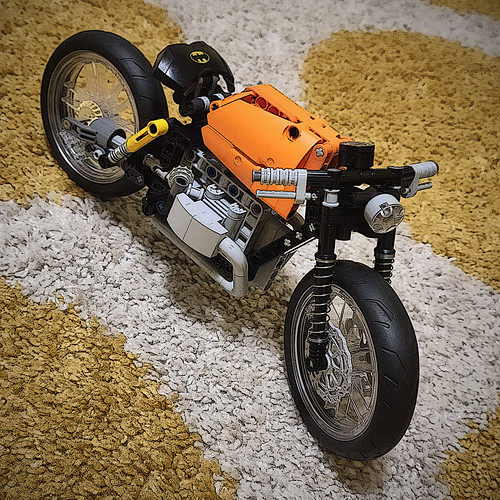
Flickr’s František Hajdekr has chosen the latter option for his Technic BMW-esque motorcycle, a brand that has used shaft-drive designs for much of their range (including the R 1200 GS Adventure immortalised in the ace 42063 Technic set). Working steering, rear suspension, and a seat made from Batman’s chest also feature, and you can see more of František’s shaft-driven bike at his photostream via the link.
Race to the Bottom
The early days of flight were perilous ones. Aeronautical understanding was limited and building materials more so, meaning things that operated a long way from the ground were made out of bits of wood and chickenwire. However by the late 1920s mankind’s incredible rate of progress (no doubt helped by the otherwise totally pointless First World War) had made flying relatively safe and normal. Except in one area; Speed.
Like racing cars of the era, racing planes were fantastically dangerous, pushing the limits of physics and effectively working by trail and error, when error often meant death. This is one example from the time, the bonkers Savoia-Marchetti S.65 racing seaplane, designed for the 1929 Schneider Trophy race. With two 1,050bhp V12 engines mounted fore and aft of the pilot, the S.65 proved so unstable it didn’t get airborne at all and the Italian team behind it returned to Italy for more development.
On Lake Garda in 1930 the trails continued, and on the forth attempt the seaplane took to the air in a glorious rush of wind and noise. Whereupon it stalled, crashed into the water, and sunk to the bottom taking its young pilot with it. Thankfully although recovered the S.65 did not attempt to fly again, but a failure though it was it did look rather wonderful, as does Henrik Jensen‘s marvellous mini-figure scale recreation, pictured here in a neat diorama depicting the plane before its fateful flight attempt.
There’s more to see of Henrik’s excellent Savoia-Marchetti S.65 at his photostream – head to Lake Garda in 1930 via the link in the text above, but maybe watch from a distance.
Stalin’s Cat
It wasn’t the British or the Americans that sacrificed the most in the Second World War, but Russia, with more lives lost than almost every other country put together. It was fitting then that it was Stalin’s army that victoriously made it to Berlin first to end the war in Europe.
Things quickly changed once the common enemy was defeated though, with Stalin killing millions of his own people to add to the wartime total, and the Soviet Union developing nuclear weapons to match the U.S, ushering in a decades-long Cold War.
Stalin’s wartime victory (and totalitarian regime) led to everything being called something with ‘Stalin’ in it, including the vehicle in this post. Built in Stalingrad, the Stalinec T130 bulldozer was actually an American Caterpillar manufactured under licence, despite the fact the two countries were on the verge of annihilating one another.
We’re not sure if Joseph Stalin ever drove a Stalinec, but he was probably pleased it – like everything else – was named after him, even if underneath it was actually designed by evil capitalist Americans. This lovely Lego recreation of the Stalinec T130 comes from Flickr’s martin nespor, who has also built an impressive Skoda Xena / LIAZ 400 Series truck and low-loader trailer to transport it.
All three models are beautifully constructed and detailed, with both the Skoda Xena and Stalinec T130 featuring remote control drive and steering via bluetooth. The Skoda also includes integrated LED lighting and authentic stickerage to add to the realism, whilst the Stalinec T130’s blade can raise and lower via Power Functions too.
A wealth of imagery is available via Martin’s ‘Stalinec T130’ album on Flickr – click the link above to make the jump to check out the complete gallery of Stalin’s Cat, and here to see more of the more modern Skoda Xena transporting it.
Making the Grade
Slow, ponderous, usual looking, yet servicing the needs of countless motorists*, road graders are always the bridesmaid when it comes to LEGO. They have appeared as B-Models several times over the years, but we don’t think that they’ve ever made it onto the front of the box. Which is shame really, as they’re more technically complex than much of what drives on the roads they help to build.
Helping to rectify this is Jundis of Eurobricks, who has built this amazing Technic Caterpillar 120M2 motorgrader with an enormous array of functions.
Pneumatics allow the front blade and rear ripper to raise and lower, whilst the middle blade can move up, down, sideways and tilt, thanks to three separate pneumatic cylinders. The model features a variety of mechanical functions too, including working steering (both via the front wheels and central articulation), plus blade turning, pitch, and lateral movement.
It’s a properly clever creation and one that’s definitely worth a closer inspection. Head to the Eurobricks forum via the link above to read the Caterpillar’s full build details and watch a video of all those functions at work.
*Just like your Mom.
Forest Pigs
Rallying was big business in the 1980s. With few rules making for wild cars, the WRC attracted as much attention as Formula 1, and Porsche wanted a piece of it, despite the unlikely suitability of their road-going products. Of course Porsche had a plan; their incredible all-wheel-drive 959, which would have been ideally placed for the WRC’s top-tier Group B once it was finished.
Unfortunately for Porsche the banning of Group B meant the 959 never got the chance to properly compete (although this did mean that the car raced in Paris-Dakar instead, becoming one of the most wonderful and weird winners in the event’s history), but before then Porsche still wanted a rally car whilst the 959 was in development. Cue the 911 with a giant wing on the back.
The 911 of the 1980s was of course only rear-wheel-drive though, meaning that the SC/RS version homologated for rallying stood very little chance against the all-wheel-drove competition in the WRC, but it was still a quick car. Switching to the lower-spec European Rally Championship proved smart, where Porsche’s stop-gap rally car was prepared by Prodrive and took several wins.
These two spectacular recreations of the Porsche 911 SC/RS come from TLCB Master MOCer Dennis Glaasker aka Bricksonwheels, who has faithfully recreated the ’80s icon in astounding detail. Each 1:14 scale model replicates a real version of the 911 rally car, with the famous Rothmans and Belga team liveries brought to life in incredible realism thanks to fellow previous bloggee JaapTechnic’s decal-producing wizardry.
Opening doors and engine covers reveal an interior and engine as beautifully recreated as the stunning exteriors, and there’s loads more to see of both 911 SC/RS models at Dennis’ ‘Porsche 911 SC/RS in Lego (1:14)’ album on Flickr. Click the link above to head to a forest in Belgium sometime in the 1980s.