Tag Archives: 1940s

Flight of the Fascists

This beautiful aircraft is a CANT Z.506 Airone floatplane, one of the fastest, most-advanced, and highest flying aircraft of the 1930s. Powered by three Alfa Romeo radial engines, the Z.506 was first developed as a luxury airliner, wherein it set numerous aeronautical world records.

Such success inevitably led to the development of military versions, with the design used by the Italian Airforce for maritime patrol, bombing and torpedo operations, first in the Spanish Civil War (leading to the Franco dictatorship) and then by Italy’s own dictator Mussolini in the Second World War, where it played a significant role in Italy’s invasion of Greece, and bombing French North Africa. Yay fascisim.

Anyway, 1930s and ’40s Dictator willy-waving wasn’t really the CANT Z.506’s fault, and the aircraft continued to fly long after Mussolini was deposed and Italy switched sides, operating in search and rescue until 1959, which is far more noble.

This one is isn’t a search and rescue aircraft though, instead being an early example from the Spanish Civil War, thusly equipped with four machine guns and a 1200kg bomb payload. Flickr’s Eínon is the builder behind it, and there’s more to see of their brilliant Lego version of the CANT Z.506 Airone at their photostream. Click the link above to join the 1930s fight for fascism…

My Other Car’s a Land Rover

The original 1948 Land Rover (long before it was called a ‘Defender’) was a vehicle borne out of necessity. Luxury car maker Rover needed to restore revenue after the war, but with Europe in ruins and steel rationing in place, car production wasn’t going to get running for some time.

The need for a utilitarian off-road tractor was obvious though, and thus – with surplus aluminium and left-over airplane cockpit paint – the Land Rover was born. What is less known however, is that the first Land Rover prototypes used the chassis from another surplus wartime item; the Willys Jeep.

It’s fitting then that this incredible Willys Jeep MB, complete with a Browning machine gun and an M3 37mm anti-tank gun in tow, is constructed solely from the official (and excellent) LEGO Icons 10317 Land Rover Defender 90 set.

Built by TLCB Master MOCer Eric Trax, this astonishing alternate includes a range of wartime accompaniments, from the aforementioned weaponry to jerry cans, radio equipment, and ammunition boxes, with the beautiful Jeep itself also featuring steering and suspension.

The result is so perfect you’d never know it was built using such restricted parts – which makes it much like the original Land Rover – and there’s much more to see, including a link to building instructions, at Brickshelf and the Eurobricks forum.

Battle of Britain

There are a few machines of the many that were borne out of the Second World War that changed the course of it. The Russian T34-85 tank, the American Willys Jeep, and this; the British Supermarine Spitfire.

First flying just before Britain entered the conflict, the Spitfire became the backbone of the Royal Air Force’s defence of the skies over the British Isles, which – had they been lost – would have enabled a German invasion and likely a very different world to the one we live in now.

Produced throughout the entire conflict, both the Spitfire and the formidable Rolls-Royce Merlin engine that powered it were upgraded and improved multiple times in just a few years, with the design operating not only with the Royal Air Force but with several Allied partners, with this example representing a unit flown by the Canadian Air Force.

It’s the work of Juliusz D., who has captured a ‘clipped wing’ variant of the Supermarine Spitfire LF Mk. XVIe beautifully in brick form.

Wonderful building techniques, excellent decals, and top quality presentation make this a model worth a closer look, and you can take to the skies over Europe in 1944 in the defence of liberty via the link above.

Easter Cors-Hare

Today’s title is about as tenuously linked to Easter as it’s possible to get, but seeing as egg-laying rabbits have about as much to do with Easter as a 1940s fighter aircraft, we’re going with it.

This is a US Navy Vought Corsair, made Eastery with only a minor spelling amendment, created and presented in this wonderful vignette by Nicholas Goodman of Flickr. Pictured in the Solomon Islands in 1944, Nicholas has deployed superb attention to detail, using fantastic building techniques, custom mini-figures, and hiding a few period-correct easter eggs in the vignette too.

See, it was Eastery all along!

There’s more to see at Nicholas’ photostream and you can head to the Solomon Islands in 1944 via the link in the text above, or alternatively click here for something actually Easter-related.

I Fold

The results of the last TLCB poker night have caused this writer to owe a substantial beer-based debt to our editor (You have until Monday. Ed.). Knowing when to fold is everything it seems, and whilst this writer definitely doesn’t, TLCB newcomer Dan Nguyen sure does, with this wonderful 1940s Vought F4U Corsair.

Being a carrier-based fighter, the F4U Corsair needed to fit inside flight-deck lifts and on-board hangars, and as such featured wings that could fold neatly upwards whilst in storage before returning to their horizontal position for flight.

Dan’s model captures this feature beautifully, using some cunning techniques to recreate the Vought’s complex wing shape and fuselage, and enhancing the realism further with accurately replicated US Navy decals.

There’s more to see at Dan’s ‘Vought F4U Corsair’ Flickr album, and you can learn when to fold via the link in the text above.

Tank Hunter

Does anyone else remember that fiendishly addictive early computer game in which the player was tasked with manoeuvring around a seeming infinite plain populated by the outlines of various 3D shapes, hunting and destroying enemy tanks? Just us? OK.

Anyway, perfect cubes and prisms aside, the concept of hunting tanks was based on reality, with specific machines (themselves looking rather like tanks) designed for their destroy enemy counterparts.

This is one such device, the Sturmgeschütz III tank-hunting assault gun, as deployed by Germany during the Second World War (and Syria until 1973).

Handily known as the STuG III, it saw service on almost every front, from Russia to Europe to Africa, and proved very successful at destroying Allied armour.

This excellent fully remote controlled Lego version of the STuG III comes from TLCB favourite Sariel, who – despite the model measuring just 32cm in length and weighing under 1kg – has packed in drive and steering, fully suspended tracks, and an oscillating and slewing gun barrel, all powered by a LEGO battery and controlled via bluetooth courtesy of a third-party SBrick.

There’s more to see of Sariel’s STuG III at his Flickr album of the same name, plus you can watch the model in action via the video below. Go tank hunting across a plain of cubes via the links!

YouTube Video

Lufthansa in Lego

This is a Douglas DC-3, a 1930s to 1940s propellor airliner that was one of the defining moments in air travel. Faster, safer and quieter than previous airliners, the DC-3 was one of only a few that could cross the continental United States (with three stops), and be profitable from passengers alone.

So good was the DC-3 in fact, that many are still in use today, some eighty to ninety years since they were produced. Recent bloggee Tobias Munzert is the builder behind this one, creating it beautifully Lufthansa colours.

If you’re wondering whether a 1930s American aircraft being flown by Germany’s national airline may have been a bit awkward at the time (as we were), Lufthansa was founded a decade after the end of the Second World War, when – even with jet airliners transforming air travel – the DC-3 remained a reliable and competitive aircraft for airlines across the world.

Tobias’ brick built version captures the iconic vintage airliner superbly, and there’s more to see (including a link to building instructions so can create one yourself) at his photostream. Fly over to Flickr via the link above.

War in the Wheat

As is currently playing out in Ukraine, thanks to the murderous dick-bag Vladimir Putin, war can have a catastrophic effect on food production. But food production must continue, even when an invading enemy is standing amongst your crops.

Recent bloggee SirLuftwaffles travels back eighty years to the last time a murderous dick-bag brought war to Western Europe, with this wonderful scene depicting an Opel Blitz 3-ton truck parked in occupied France during the Second World War.

SirLuftwaffles has made free building instructions for the truck available and there’s more to see at his photostream. Click the link to take a look.

Where Eagles Dare

1968’s ‘Where Eagles Dare’, starring Clint Eastwood and Richard Burton, is widely regarded as one of the finest war movies of all time. That’s despite it featuring hairstyles, make-up, pharmaceuticals, and a red bus from a decade (or even two!) later than the time of its setting.

Said bus, a 1952 Steyr, stars prominently in the closing scenes, as the characters make their escape to an airfield where a Junkers JU-52 is waiting.

This brilliant brick-built recreation of that iconic ‘Where Eagles Dare’ scene is the work of SirLuftwaffles, who has captured not only the wrongly-cast Steyr bus and Junkers JU-52 from the movie wonderfully, he’s placed them within a stunning forced-perceptive alpine setting that looks so good we feel as though we’re making the escape too.

Style your hair for the ’60s, climb aboard a ’52 bus, and head to a snow-covered European airfield in 1944 via the link above.

Railroad Inspection

This is a Volvo PV 831, built from the end of the 1930s, through the ’40s and ’50s, primarily as a taxi. However this PV 831 has swapped one form of public transport for another, as there won’t be any fare-paying passengers sitting in its back seat.

Instead this PV 831 has been adapted to run on the rail tracks, in order to perform its job as an inspection vehicle for Sweden’s railways. Built by Flickr’s SvenJ, a third-party motor and bluetooth receiver bring the model to life, and there’s more to see at his ‘Volvo PV 831 Railroad Inspection Car’ album. Click the link above to inspect some Swedish tracks in the 1940s.

Skytrain

‘Skytrain’ might be a slightly ambitious title, but nothing moved as many troops about during the Second World War as the Douglas DC-3 / C-47. In fact so reliable is the DC-3 that many are still in use today, some eighty years on from when the plane first saw service, ferrying people and objects to and from the world’s most inhospitable places.

This lovely recreation of the iconic aircraft comes from SirLuftwaffles of Flickr, and – full disclosure – it’s digital. But you can’t tell, as SirLuftwaffles has used only readily available pieces, real-world construction methods, and produced a render that is really very good indeed.

There’s more to see including full build and digital design software details at SirLuftwaffles’ photostream – take to the skies with 27 other troops via the link in the text above.

Das Boot

15,000 pieces, 4½ years, and 1.8 metres. A few of the astonishing statistics associated with Ciamosław Ciamek‘s breathtaking 1:38 scale Second World War U-Boat.

Constructed in six sections, each with a removable sides to reveal the spectacular detail within, Ciamosław’s incredible mini-figure scale replica of a German ‘Typ VII C U-Boot’ accurately recreates the control room, front and rear messes, bow, engine rooms, and stern, all of which were designed digitally before being built from thousands of LEGO pieces.

A crew of dozens of mini-figures are shown throughout the interior of the boat, many operating the equipment, engines, and weaponry, whilst others are off-shift in the mess.

It’s a jaw-dropping creation, with hundreds of images across two albums required to capture the model’s scale and complexity, and you can check out the first of these on Flickr via the link in the text above. Click it, sit back, and take in the most amazing World War 2 creation you’re likely to see in 2022…

Cartoon Traction Avant

This wonderfully cartoonish Citroen Traction Avant was discovered by one of our Elves on Flickr today. Constructed by KMbricklab, a wealth of clever techniques have been deployed to accentuate the classic Citroen’s features, and there’s a whole lot more of the model to see on Flickr. Click the link above to forward yourself there.

Hauling up Hills

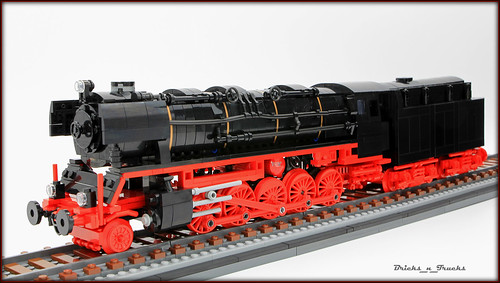
This is a BR44, a heavy steam locomotive built from 1926 to 1949 to haul giant loads across Germany’s mountainous regions.

Able pull 1,200 tons through the hills, or 600 tons up steep inclines, the BR44’s were hugely impressive machines. We suspect much of what they hauled from the late-’30s was rather different from that originally intended though, with a simplified versions (ironically given the least simple title of ‘Übergangskriegslokomotives’) designed to speed up production during Germany’s phase of, er…. European ambition.

This brilliant brick-built recreation of the BR44 comes from Bricks_n_Trucks, who has not only replicated the design beautifully, there are two Power Functions L-Motors and a BuWizz 2.0 hidden inside to bring it to life.

There’s more of Bricks’ creation to see on Flickr, and you can travel into the mountains of wartime Germany via the link in the text above.

Wheat Season

It’s wheat season. Not here in TLCB’s home nation, where everything is under a thin layer of ice, but somewhere it probably it is.

Regular bloggee 1saac W. is bringing in the wheat harvest back in the 1950s, with his lovely brick-built Ford 8N tractor and ’49 Chevrolet pick-up.

A neat Technic-pin field of wheat stands behind the classic farm due, and there’s more to see of both the Ford 8N and the Chevy at 1saac’s photostream.

Grab your hay fork and head to 1950s rural America via the link in the text above.