The World’s Most Expensive Recovery Truck

This astonishing creation is a fully working replica of the U.S Glomar Explorer, constructed by Master MOCer and world-renowned builder Paweł ‘Sariel’ Kmieć, and you’re in for a truly remarkable story…

It’s 1968, and the Soviet ballistic missile submarine K-129 has been lost with all 98 crew, plummeting over 16,000ft to the ocean floor. It’s just a few years after the Cuban Missile Crisis and the Cold War is very real indeed. The Soviet Union is looking for its lost submarine, but 150 miles in the wrong place. The U.S. however, knows where it is…

And so begins one the strangest and most expensive recovery efforts in history, as the CIA commission the building of a ship designed solely to pluck the wreck of K-129 from the seabed to learn its secrets, without the Soviet Union knowing.

Costing $1.4billion, it was one seriously expensive recovery truck, although of course its true purpose was hidden behind a ‘drilling for magenese’ cover story, fronted by millionaire aviator and film-maker Howard Hughes.

Six years later and the 50,000 ton 600ft long ship was ready. Named the Transocean Glomar Explorer, it was positioned above the wreck using radio beacons (GPS being some way off) and the CIA began the enormous recovery of the 330ft, 2,700 long ton (before it was filled with water) nuclear-armed submarine.

A giant claw dropped through a moon pool in the centre of the ship, gripping the wreck of K-129 and winching it to the surface. However during the 16,500ft ascent a mechanical failure occurred, and two thirds of the submarine broke loose and sunk back to the ocean floor, taking with it the sought-after nuclear missiles and code book. However, two nuclear-tipped torpedoes and cryptographic machines were recovered, along with the bodes of six crew members, which were not returned to the Soviet Union, but back to the sea.

The Glomar Explorer was purposeless after the mission was (partly) completed, and in 1976 it transferred to the U.S Navy for storage in a dry-dock. In 1978 however, the ship was leased to test prototype deep sea mining equipment, before being converted to a drilling ship in the 1990s. It was finally scrapped in 2015.

Recreating this incredible feat of engineering is Sariel, whose floating brick-built replica of the Glomar Explorer measures over 3 metres in length, uses 60kg of LEGO pieces, and can really (partly) recover a lost Soviet submarine, thanks to a fully working recreation of the monumental grapple crane fitted to the real ship.

We won’t write too much more here as there’s really only one way to appreciate this spectacular build – take a look at the video above (or click here to find it in the Eurobricks discussion), and watch how one of the most impressive Lego creations of all time was built, and how it can recover nearly all of a brick-built submarine from the bottom of a swimming pool…

Beautiful Letdown

It amazes this TLCB writer how many Range Rovers there are around TLCB Towers.

These massively-financed, privately-plated wealth statements are rather beautiful of course, both inside and out, and particularly so when compared to rivals such as this abomination. Or this one. Or this one.

However Range Rovers remain a triumph of brand image and beauty over substance, being some of the worst built and most unreliable products you can buy anywhere in the world, with near-Tesla levels of shoddy workmanship.

Perhaps both Land Rover and Tesla the best automotive examples of the shallowness of our social media society, one that values exterior sheen and a projection of success over substance or quality. And, looking at the numbers, maybe they’re on to something…

Thus our preference would be this neat Speed Champions style version of the Range Rover Velar, as built by TLCB regular SP_LINEUP. SP has captured the sleek SUV superbly, and not being constructed by JLR it’s sure to be far better constructed and more reliable than the real thing.

Head to Flickr via the link above to see more of one Range Rover Velar that won’t fall apart.

*Today’s title song.

Cream Wrangler

Today’s title might sound like some sort of dairy-based burglar, but we’re actually referring to this most excellent 6-wide Jeep Wrangler TJ by regular bloggee 1saac W, which comes coloured in an unusual cream and light brown combo.

Cunning parts usage including mini-figure hands for mirror brackets, half of a Lego lever for wiper arms, and a whole lot of sideways clear 1×2 plates make this one of the most realistic small scale Wranglers we’ve seen, and there’s more to see of 1saac’s cream 4×4 on Flickr via the link.

Competition Coupe

Inspired by a drag racing shop local to him, Tim Henderson has recreated this vintage dragster that competed in the ‘Competition Coupe’ class. It’s inspired by the real dragster Lil’ Honker and there’s more to see on Flickr via the link.

Pestilence

This horrifying creation is ‘Pestilence’, a spindly mech described thusly by its creator; “Cries of suffering echo from the wake of this Horseman’s travels. No area of the planet is spared as contaminate spreads far and wide from the bowels of this mechanical beast”.

We would say thankfully it’s only sci-fi, but it’s probably more accurate to say it’s more like a mechanised DuPont; whose carcinogenic pollutant from producing teflon is now in every single organism on earth, or Volkswagen; who knowingly poisoned the air breathed by millions by cheating emissions regulations.

A more current analogy of course, is the global Coronavirus pandemic, created by shocking animal welfare and food production standards. The U.S. President is very keen to point out Coronavirus is ‘China’s fault’, yet is simultaneously reducing America’s meat production regulations, which already result in a faecal and disease contamination rate ten times higher than that of TLCB’s home nation.

Builder Adam Dodge has included a mini-figure in the driving seat of this mechanical plague, and it is perhaps the most apt metaphor for what’s causing the suffering of both our planet and ourselves…

Kamaz 5511 | Picture Special

This astonishingly realistic creation is a Kamaz 5511, and it’s so beautifully built and presented that it looks like a die-cast model. It comes from previous bloggee Krzysztof Cytacki (aka dirtzonemaster), and not only does it look truly exceptional, it features a range of realistic manually-operated functions too.

All-wheel suspension allows the Kamaz to be driven both on and off-road, there’s working steering, and highly detailed interior inside the cab, which tilts to reveal an authentic working V8 engine driven by the truck’s wheels. Lastly Krzysztof’s model also features a brilliant tipping bucket, operated by a large linear actuator and a hand-turned mechanism.

A huge gallery of over forty stunning images is available to view on Flickr, which showcases not only the truck’s beautiful exterior, but each of the highly detailed working components found within it. Click the link above to join us there.

Evolution of the Camel

The camel – our favourite humped, even-toed ungulate – did not start out as a large desert-dwelling domesticated animal. The camel’s beginnings, around 50 million years ago, are more rabbity. Later it had grown to around the size of a goat before, c5 million years ago, evolving into a nine-foot tall arctic-living creature, whose hump may have existing to help it survive the cold.

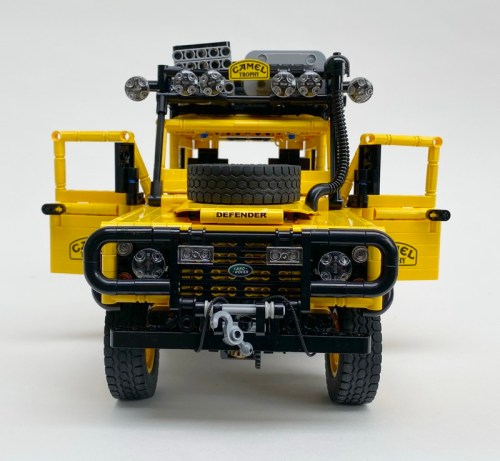
The Camel is an animal that’s gone through a bit of change, and so too has newcomer Fabiomaster‘s Land Rover Defender in Camel Trophy spec. Which is as seamless a link between two barely related things as you’re likely to find.

Beginning as an off-road chassis by TLCB Master MOCer Sheepo, the design evolved into a Land Rover Defender Camel Trophy in the hands of RM8, whose Sheepo-based creation appeared here four years ago.

Fast-forward to 2020 and the design has subtly evolved again, with Fabiomaster updating the Defender with the latest parts and unique off-road accessories, presenting it beautifully as you can see here. So it’s not really Fabiomaster’s creation, but rather the work of three builders over the course of several years, and it looks properly good as a result.

There’s more to see of Fabiomaster’s Land Rover Defender Camel Trophy on Eurobricks via the link above, and you can follow the evolutionary tree back through RM8’s version to Sheepo’s original chassis via the links in the blog text.

Wet Nellie

The second most famous Bond Car of all time is actually the best. Discuss. This is ‘Wet Nellie’, the Lotus Esprit S1 from 1977’s ‘The Spy Who Loved Me’, that ‘transformed’ – by the push of a button – into a submarine. And nothing in the world is cooler than that.

Suggested by a reader, this is Paul Nicholson‘s fantastic recreation of the aquatic sports car, and not only does it look absolutely spot-on, it transforms too, with the wheels tucking in to reveal submarining fins, and the rear fins and propellers also folding out from within. Of course it wouldn’t be a classic Bond Car without some evasive weaponry too, and Paul’s Esprit duly replicates the front missile launcher, mine layer, and the rear missiles (that really fire) used by Roger Moore to escape Karl Stromberg’s henchmen.

It all adds up to something that would make a superb official LEGO set, and whilst LEGO don’t have a Lotus license, they do have a 007 one, with Paul’s model constructed in a matching scale to the 10262 Aston Martin DB5 ‘Goldfinger’ set. Plus how cool would it be to add Lotus to LEGO’s ever growing list of vehicle manufacturer partners?

There’s much more to see of Paul’s incredible creation at his Flickr photostream, where you can ask him to add it to LEGO Ideas where it would surely get 10,000 votes so we can all buy it one day. For what it’s worth TLCB would be at the front of the queue. Get wet via the link above.

Scuderia Stirling

What? A green Ferrari? Despite TLCB competition winner James Tillson’s previous form, this magnificent Technic Ferrari 250 GTO isn’t built in a  colour that would make the Tifosi throw things at their screens. Because Ferrari really did make a green one, and only one, for the late racing legend Sir Stirling Moss. Which makes it probably the coolest 250 GTO of them all.

Featuring an accurately replicated V12 engine linked to a five-speed gearbox, working steering and suspension, plus opening doors, hood and trunk, James’ Technic 250 GTO is a truly beautiful thing, and – unlike the real car – you don’t have to be Sir Stirling Moss to get your hands on one, as James has made building instructions available.

There’s more to see of this stunning creation at James’s photostream and on Eurobricks, where you can watch a video demonstrating the model’s features and find a link to the instructions so that you can build it for yourself.

Furry Road

Don’t worry, we’re not referring to one of your Mom’s old movies.

TLCB Elves are grumpy today. Despite a slew of finds they missed this one, which we instead saw on The Brothers Brick. And they love Mad Max. We’re not sure they follow the plot, but stuff explodes quite regularly and that seems to please them.

Anyway, those of you with a keener eye will have noticed that something is amiss with Michael Kanemoto‘s rendition of the ‘V8 Interceptor’ from the movie, what with it being red and yellow and driven by a cartoon dog.

That’s because Michael’s ‘V8 Interceptor’ is part of a wider ‘Fab Max’ collaboration, mixing LEGO’s primary-coloured 1980s Fabuland theme with George Miller’s post-apocalyptic road movie, and in doing so creating a desolate wasteland inhabited by cute (but violent) anthropomorphic critters. Kinda like TLCB Towers.

Complete with officer Max “Bark”-tansky of the Fab Force Patrol there’s more to see of Micheal’s ‘Fab Max V8 Interceptor’ via the link above (plus you can also find the original black version of the car which is frankly boring by comparison), and – if you’re as in to this theme as we are – you can see another ‘Fab Max – Furry Road’ creation blogged at TLCB by clicking here.

White Box

Now this is a common sight. Or it was – trucks have short lives in TLCB’s home market so it’s a long time since we’ve seen a 1990s one – but a blank white trailer being hauled by a nondescript tractor unit? They’re everywhere. And in the mid ’90s they didn’t come more nondescript than a DAF FT 95.

The Ford Mondeo of trucks, these mid-’90s DAFs didn’t really seem to be styled, they were just sort of motorway furniture, like bridges and road signs, but this Model Team recreation by TLCB regular Arian Janssens is no less brilliant for that.

Superbly well replicated, Arian’s DAF FT 95.500 ‘Super Space Cab’ is so realistic it’s starting to blend into the background already. Take a closer look at his Flickr album via the link above.

Star Ferry

Hong Kong’s Star Ferries are this TLCB writer’s favourite ferries in the world. Which is a niche list, but they’re still at the top. Criss-crossing Victoria Harbour between Hong Kong Island and Mainland Hong Kong, they cost about 20¢ and surely have one of the most stunning urban backdrops of any journey.

If you haven’t travelled on them however, Vincent’s LEGO Creation can offer the experience at a fraction of the scale, thanks to this utterly bewitching replica complete with a beautifully detailed mini-figure interior and full LED lighting.

Vincent has deployed some spectacular building techniques in his quest to create a perfect Star Ferry scale model, making this one of the finest creations of any sort that we featured here this year, and there’s loads more to see at Vincent’s photostream. Click the link above, pay 20¢, and enjoy the best ferry crossing in the world.

Universally Speaking*

This 1950s East German oddity is not a tractor. It is, apparently, a RS09 ‘universal carrier’, and we’ve deliberately chosen an image that hides just how weird it is. Powered by a two cylinder diesel engine that made about one bhp, the RS09 was produced from the mid-’50s until the mid-’70s, and could be attached to any number of Communistical mechanised items.

Built by Jundis, this smart Technic recreation of the RS09 features a straightforward digging bucket in place of some of the weirder attachments, and also includes a working two-cylinder piston engine with power-take-offs, a mechanically raising/lowering drawbar linkage, and an oscillating front axle with steering.

There’s more to see of this Radschlepper 09 Universal Carrier on Eurobricks, where you can see further imagery including a photo of the decidedly strange real thing, and where Jundis assures us some of the weirder attachments are soon to follow. Click here to check it out.

*Today’s title song

Mr. Kleinstein’s Steam Powered Amusements

Today at TLCB we’re trumpeting this glorious traction engine and trailer built by previous bloggee Nikolaus Löwe (aka Mr_Klienstien), who has opened up his own steam-powered amusement arcade!

Frogger, Time Crisis, and Sega Rally probably aren’t included, (and we’re not really sure what a steam powered amusement might consist of. Well, we had some ideas but they’re definitely not right), but you can see more of the beautiful traction engine that would power them along with the trailered living accommodation that accompanies it at Nikolaus’s ‘Showman’s Engine ‘ album on Flickr.

Click the link above to let one rip!

Book a Service

The lovely vintage workshop scene was discovered by one of our Elves on Flickr today, and whilst it doesn’t feature any racing stripes it does use no less than sixteen LEGO train track switch pieces throughout the build. See if you can spot them with a trained eye* hidden in Mrs. Miller’s library van and the garage surrounding it courtesy of Jonas Kramm. Click the link to switch* over to Flickr.

*Hah!