Keep it Simple

We are not a complex, multi-facited bunch here at The Lego Car Blog. In fact we’re a bit crude, and rather unsophisticated. Which might be why we like the Jeep CJ2, and Jonathan Elliott‘s excellent brick-built recreation of it. A simple model of a simple vehicle, Jonathan’s build demonstrates that well-chosen pieces combined with thoughtful presentation can match models ten times the parts count, and there’s more of Jonathan’s CJ2 to see at his photostream.

And it was all Yellow*

Look at this van
It’s not one shade nor hue
Quite a thing to do
Built in mostly yellow

1saac W
Decided old not new
Patina’s right on cue
Varied types of yellow

So click the link above
To show this build some love
‘Cos it’s kinda yellow

*Sorry Coldplay. Here’s the link to how it should go…

Pre-Revolutionary Travel

This is a Russo-Balt C24/40, one the Russian Empire’s earliest cars, originally founded in Riga (now in Latvia) before production moved to St Petersburg. Funded by Germany, designed by a Swiss engineer, and built in Russia (or its empire), the Russia-Balt was an early example of excellent cross-border collaboration.

Of course that didn’t last long, and the Russo-Balt company switched to making military aircraft (of Sikorsky design, who would later create many famous U.S helicopters), before Lenin’s Bolshevik October Revolution closed the factory, Sikorsky fled to France, and the company director was murdered whilst attempting to flee to Finland. Which means that if not for the Bolshevik’s brutality, Sikorsky may never have left Russia and gone on to design the aircraft that opposed it during the Cold War. It’s a funny old world.

Today the remnants of the Russo-Balt company in Latvia builds trailers and, er… this, but we’re staying with the company’s origins and its early C24/40, built here in both ‘Torpedo’ luxury car and work-van form by Flickr’s Kirill Simerzin.

There’s more of each version (plus a third) to see at Kirill’s photostream, and you can head to the pre-revolutionary years of the Russian Empire’s automotive industry via the link in the text above.

City Cargo

LEGO have created an intricate Town/City universe over the years, with their own energy brand, postal service, and railway company. There have also been a number of cargo/delivery companies over the years, usually featuring some sort of box-and-arrow logo and mini-figures wearing humiliating uniforms.

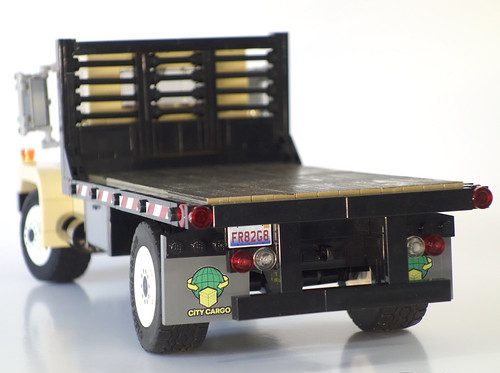
Cue LegoMarat’s excellent Model Team flatbed truck, based on none in particular but inspired by many, and proudly wearing LEGO’s ‘City Cargo’ box-and-arrow logo from the City set range.

The lovely detailing continues with ‘wooden’ planks lining the bed, life-like wheel bolts and reflective strip decals, opening doors and a detailed interior, and there are more superbly presented images to see at LegoMarat’s ‘Lego Flatbed Truck’ album on Flickr.

Don your humiliating uniform and head to your next City Cargo delivery drop via the link in the text above.

Black Box

A few months ago the coolest car we’ve ever published appeared on this page. A mildly modified Volvo 242 Coupe, it was everything we could want in a 1980s Volvo. Except of course, to be a proper 1980s Volvo, it should’ve been an estate…

Now its maker Stephan Jonsson has constructed a station wagon counterpart, in the form of this fabulous Volvo 245, also lightly modified and fitted with a brick-built T6 Turbo engine. There’s even a tow-bar. Don’t be fooled by that rear ‘spoiler’; it’s a wind deflector for a caravan.

We’ve never wanted a car more, and there’s more to see of Stephan’s wonderful Volvo 245 T6 Turbo at his album of the same name. Click the link above to make the jump.

Apollo 10

May 18th 1969, and the tenth Apollo mission departed the Kennedy Space Centre to begin its eight day mission. Only the fourth U.S human spaceflight and the second to orbit the moon, the Apollo 10 mission was a rehearsal for the first moon landing that was to come just two months later, when – on July 20th 1969 – mankind’s relationship with our lunar satellite changed forever.

Cue a tenuous link to today’s car, the Apollo Intensa Emozione. No, us neither, but the Intensa Emozione (or ‘IE’ for short) is a carbon-fibre German supercar, “based on airflow and nature… marine animals in particular”, and powered by a naturally-aspirated Ferrari-derived V12.

Just ten Apollo ‘IE’s will be built, each costing almost $2.7 million (around 1% of the inflation-adjusted cost of the Apollo 10 mission), and having literally nothing at all in common with the moon landings beyond being very expensive. Still, it’s a considerably better name than another more well-known Ferrari V12-powered hypercar.

This exceptional brick-built replica of the Apollo ‘IE’ comes from previous bloggee 3D supercarBricks, who has captured the bodywork-inspired-by-marine-animals brilliantly. Opening gull-wing doors, 3D printed wheels, and superb presentation enhance the realism, and there’s more of the model to see 3D’s Apollo Flickr album. Blast-off to the moon via the link above.

Urally Good

We may mock President Putin as regularly as we can create a tenuous link to his dickwittery, but the country he dictates is an amazing one. Spanning from the Atlantic to the Pacific across eleven time zones, responsible for the first animal, satellite, and person in space, and with a history uniting fifteen separate countries into one bloc of… er, communist misery, Russia and the former Soviet Union are a major part of our current world.

They also make probably the best off-road trucks of anyone, which are needed to traverse a vast and wild landscape, with most having their roots in the Military. Founded in 1956, off-road truck-maker Ural shares this history, and still employs 4,000 people today building trucks like this, Vladimir Drozd‘s beautifully presented Ural crane truck.

With a working crane that rotates, elevates, extends, and winches, Vladimir’s Ural functions as good as it looks, and there’s loads more of his superb model to see at his ‘Ural Crane Truck’ album on Flickr. Take a look via the link above, or here for a tenuous link to Putin’s dickwittery.

The Ultimate Driving Machine

The future of BMW M-cars is electric. And automatic. The current M2 is already confirmed to be the final manual M-car, and – if the horrendous new BMW XM is any indication – the future of BMW’s M-division looks fat, almost comically ostentatious, and immensely, unfathomably, ludicrously ugly. Make your own ‘Your Mom’ joke.

Which is probably why the original 1980s BMW ‘E30’ M3, weighing under 1,200kgs and powered by a four-cylinder engine that made less than 200bhp, is being seen as something of an antidote to the overblown ridiculousness of today’s M-cars.

This lovely Technic recreation of BMW’s M-car high water mark was found on Eurobricks, and comes from previous bloggee apachaiapachai. There’s remote control drive and steering courtesy of LEGO’s Control+ motors and app, opening doors, and that’s it. Which makes it every bit as wonderfully simple as the real E30 M3.

There’s more to see at the Eurobricks forum, and you can take a look via the link above.

Brickin’ Baja

One of the coolest liveries in motorsport has got to be Toyota’s diagonal sunset-coloured TRD striping. Seemingly unchanged since the ’80s, said livery has appeared on everything from NASCARs to Baja trucks, and it’s the latter we have here today.

Built by SpaceHopper, this superb Toyota T100 Baja off-road truck features Control+ remote control drive and steering, working suspension, a fully-caged interior, stunning attention to detail, and – most importantly – a simply brilliant recreation of Toyota’s famous TRD livery.

There’s more of Space’s Toyota T100 Baja model to see at both Flickr and Eurobricks, and you make the jump somewhere in the desert via the links above.

Greener Beemer

The seventies has some wild colours. And brown. Mostly brown in fact, but no matter, because this super-slammed ’70s BMW 2002 tii is gloriously green.

PleaseYesPlease is the builder and you can see more of his greener Beemer on Flickr via the link.

Typical Porsche Driver

Porsche – as per Bentley, Rolls-Royce, Aston Martin, Lamborghini and almost every automotive brand – are today mostly an SUV manufacturer. Sigh.

But they haven’t abandoned their roots quite as much as would first appear, as they – like Lamborghini – have off-road vehicles as much a part of their early history as their current line-up.

Many of these were of a military purpose designed for a certain moustachioed maniac, which Porsche don’t seem keen to highlight in their corporate history, but Porsche also built tractors, such as this rather cute Porsche-Diesel Standard 218.

Powered by a two-cylinder 25bhp air-cooled diesel engine, the Standard 218 could be outrun by even the fattest TLCB Writer, but unlike the fattest TLCB Writer it could also lift over half-a-ton on its three-point-hitch.

This lovely Model Team replica of the Porsche-Diesel Standard 218 recreates the tractor (and hitch) beautifully, with superb attention to detail paid in particular to the Porsche’s visible mechanical parts.

TLCB newcomer dimnix is the builder behind it, and there’s more to see of this excellent classic Porsche-Diesel at their Brickshelf gallery. Click the link above to jump back to when an off-road Porsche didn’t mean an aggressively-driven Cayenne.

Cool Box

Like the Ford F-150 in America, the Honda Super Cub in East Asia, and the Toyota Corolla almost everywhere, the Mitsubishi Fuso Canter is background street furniture for a huge proportion of the world.

Built in half-a-dozen countries, across eight generations and six decades, and re-badged as a Hyundai, Nissan, plus a host of other brands, the Canter is one of the most widespread and ubiquitous vehicles on the planet.

This one is a fifth generation fridge truck version, as used in their thousands to deliver food produce in the world’s restaurant back-streets. It comes from Max Ra of Flickr, who has recreated the Canter brilliantly, picking out the details of what is essentially a white box to create an instantly-recognisable brick-built replica.

There’s more of the model to see at Max’s ‘Mitsubishi Canter 5th Generation Refrigerated Truck’ album, and you can take a look at all the images via the link in the text above.

Wreck-It Ralph

This impressive looking rotator wrecker tow-truck was discovered by one of our Elves on Flickr. It comes from regular bloggee Ralph Savelsberg (aka Mad Physicist), who is usually found building models rather larger, yet despite being only nominally mini-figure scale, Ralph’s wrecker packs in an astounding amount of detail.

This isn’t just visual either, as the truck’s towing boom can elevate, rotate and winch, and there’s more of the model to see at Ralph’s photostream. Click the first link link in the text above to head there, you can check out Ralph’s Master MOCers interview via the second, and click here for the LEGO Model Team set that may have provided some inspiration.

Paving the Way

Diversity is the corporate buzzword of the 2020s. Here at The Lego Car Blog we’re not one to be left behind, so proving our diverse nature is this, a Hanta Machinery BP31W5 asphalt paver.

Yes this website might usually feature giant trucks or racing cars, but without machines like the BP31W5, we – as a society – would be nowhere. That’s probably a metaphor for something…

Anyway, whilst we figure out if we’ve accidentally written something curiously insightful, you can see more of the BP31W5 courtesy of Y Akimeshi of Flickr; click the link to pave the way.

Shelby GT350 | Picture Special

LEGO’s Speed Champions range has brought some fantastic replicas of awesome real-world cars into pocket-money brick-built attainability. And a Lamborghini Urus.

LEGO also recently increased the scale of their Speed Champions sets, taking the range from six-studs in width to eight, bringing a corresponding improvement in detail too. But even at eight studs wide, the official Speed Champions sets are no match for this…

Built by TLCB debutant Szunyogh Balázs (aka gnat.bricks), this beautiful Shelby Mustang GT350 – complete with a superbly detailed engine under an opening hood, and even a realistic drivetrain – amazingly measures only eight studs in width, yet packs in Model Team levels of realism.

It’s possibly the finest Speed Champions creation that we’ve seen yet, and there’s much more to see of Szunyogh’s Shelby GT350 on Flickr. Click the link above to take a closer look, or here to see LEGO’s own (six-wide) Speed Champions Mustang to appreciate just how good Szunyogh’s version is.