Tag Archives: 1980s

Pair of Martins

The Lego Car Blog Elves, fed only when they find a blog-worthy creation, could be called ‘competitive’. By which we mean they’re willing to use Max Verstappen levels of ruthlessness to win.

This inevitably leads to regular Elf fights at TLCB Towers, which we wouldn’t particularly mind, if it weren’t for the tidying up and occasional trips to ‘Elf Hospital‘.

Fortunately today we could keep the peace, as two Elves returned each with a blog-worthy creation by the same builder.

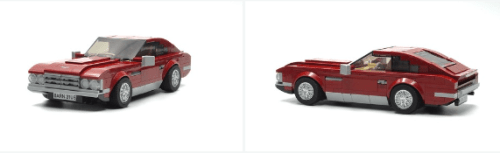
This gorgeous pair of classic Aston Martins comes from barneius of Flickr, the first (above) being a stunning V8 Volante, and the second (below) a DBS.

Both were effectively the same car, hence the accurate similarities between them, and there’s more to see of each classic Aston via the link above. Take a look whilst we distribute two meal tokens to a pair of lucky Elves.

Mighty Metro

It’s the early-’80s, and British Leyland has a new small (and surprisingly good) car on its hands. The Metro, first sold as an Austin and later a Rover, rapidly became a best seller, with over 130,000 sold in 1983 in the UK alone. Aiming to capitalise on this success British Leyland decided to take the Metro racing, and the pinnacle of motorsport in the mid-’80s was rallying’s monstrous ‘Group B’.

Bearing a physical resemblance (but little else) to road-going cars, Group B racers featured tubular-steel space-frames, mid-mounted engines, and trick all-wheel-drive systems, and the Metro got the lot.

Developed by Williams Engineering, the Metro 6R4 gained a mid-mounted naturally-aspirated V6 engine, loosely developed from the all-conquering Cosworth DVF Formula 1 unit, a glassfibre body, and MG badges – to better align it with the hot-hatch versions of the road-going Metro. For homologation purposes customers could actually buy a road-going 6R4 too, which must’ve been a wild thing to take to the shops.

The new Metro 6R4 rally car debuted at the end of 1985, taking a podium at its first event. However, by just the middle of the following year, it was all over.

After a series of fatal accidents, Group B was banned mid-season, and the 6R4 – along with rest of the Group B field – was orphaned. Without a global series in which to race, Rover sold the cars on, but their motorsport life wasn’t over. Rallycross and British rallying became the 6R4’s new home, and in the hands of privateers the cars became formidable opponents, winning so frequently the rules had to be tightened to restrict them.

The 6R4’s V6 engine also went on to a rather interesting new life… but you can read about that another time.

Thus, despite such a short life in world rallying, the Metro 6R4 remains one of the most iconic and fearsome cars ever borne out of Group B, and previous bloggee Samolot has paid homage to the unlikely rally star with his incredible Technic replica.

Under a one-piece removable body Samolot’s 6R4 features a mid-mounted V6 engine, all-wheel-suspension, and a remote controlled all-wheel-drive system with working steering courtesy of LEGO’s Power Functions motors. Custom decals recreate the ’80s works livery, there are opening doors, bonnet and hatch-back, and there’s more of the model to see – including photos of the trick all-wheel-drive chassis – at the Eurobricks forum.

Click the link above to take a look at the maddest Metro ever built.

Just the Tip

Whilst we like trucks here at The Lego Car Blog, we don’t really know much about them. The engine denominations of British family cars from the ’60s, sure. Trucks… not so much.

Cue our surprise then, when one of our Elves found this magnificent DAF FT 2600 truck complete with an enormous tanker trailer, and we discovered it tips. We didn’t even know tankers could do that.

Every day’s a school day, and we have previous bloggee Arian Janssens‘ brilliantly detailed Model Team DAF FT 2600 and tipping bulk trailer to thank for our education.

Both truck and trailer are superbly constructed and photographed, and you can take a look up close via Arian’s photostream. Click the link above for just the tip.

Crack Commando Corvette

In 1972, a crack commando unit was sent to prison by a military court for a crime they didn’t commit. These men promptly escaped from a maximum security stockade to the Los Angeles underground, whereupon they bought a GMC van and a C4 Corvette, painted a giant red stripe down the side of each, and were somehow completely untraceable to the government.

No, we don’t understand how that works either, but no matter, because it allows us to publish this brilliant brick-built Chevrolet Corvette C4 (complete with a giant red stripe), as driven by the ‘A-Team’s Arthur Templeton “Faceman” Peck. Or someone rather more visually appealing.

Flickr’s László Torma is the builder behind it, instructions are available, and you can head to the Los Angeles underground via the link in the text above.

The Living Daylights

Controversial opinion of the week; The Timothy Dalton era Bond films were the best Bond films.

OK, ‘best’ is definitely subjective, but they were perhaps the most accurate to the books. They were dark, rather violent, and a magnitude less absurd than the Roger Moore era movies that preceded them.

1987’s ‘The Living Daylights’ also benefited from a fantastic Bond Car; the awesome Aston Martin V8 Vantage. Fitted with a set of skis, laser hubcaps, rockets, and a rocket motor (Less absurd!? Ed.), 007’s Vantage was rather more highly specified than the police Lada 1500s in pursuit, culminating a snowy car chase that involved a fishing shed and a cello.

OK, perhaps they were just as absurd (our editor has likely interjected already somewhere above to this end…) (Sure has! Ed.), but the Vantage was still awesome.

Cue (or ‘Q’, hah!) this marvellous Speed Champions recreation of Bond’s Aston Martin V8 Vantage from ‘The Living Daylights’, as built by previous bloggee barneius of Flickr. Complete with skis and a rocket motor, barneius’ build is ready to take on a whole fleet of police Ladas, and you can join the chase on a frozen lake somewhere in Czechoslovakia via the link above.

Foxbat

It’s 1970, and the Cold War is approaching its coldest. The U.S have taken images of an unknown Soviet fighter plane, and they’re terrified.

It’s massive, with huge wings, and looks highly manoeuvrable. The aircraft is the MiG-25, a supersonic interceptor and reconnaissance plane, armed with-air-to-air missiles, powerful radar, able to climb to the edge of space, and still to this day one of the fastest aircraft ever created.

This phenomenal Model Team recreation of the fighter that defined the Cold War is the work of previous bloggee [Maks] of Flickr, who has recreated the MiG-25P ‘Foxbat’ in stunning detail. Working landing gear, four air-to-air missiles, and accurate markings all feature, and you can pretend you’re U.S intelligence worriedly studying grainy images c1970 via the link in the text above.

Virtually Toyotas

It’s a digitally Japanese day here at The Lego Car Blog, as we have four virtual Toyota products to share with you. We don’t often blog digital creations here, but these are a) throughly excellent, and b) we’re as certain as we can be that they can be built for real, what with designer Peter Blackert (aka Lego911) releasing building instructions alongside the imagery, and having literally written the book on how to build Miniland scale vehicles.

Rule-breaking explained, on to Peter’s first pixel-based Toyota, which is the third-generation Celica, depicted here in face-lifted pop-up headlight form. Powered by a huge array of engines (although solely by the 2.4 litre in the US) the A60-generation Celica helped the Toyota brand gain a reputation for attainable sportiness, and you can see more of Peter’s version via the link.

Peter’s second model appearing here captures one of Toyota’s earlier attempts at a sports coupe, the decidedly un-sporty 1971 Crown Coupe. It looked lovely though, and the Crown station wagon is one of the most comfortable cars that this TLCB Writer has ever had the pleasure of journeying in. Jump back to 1971 via the link.

On to the early-’00s, and the single most dreary vehicle Toyota has ever created, the 2002 Toyota Camry. As we’ve highlighted here before however, dreary sells, with the Camry becoming the best-selling car in America in 2002. And 2003. And 2004. And 2005… You get the picture. There’s more to see of this one at Peter’s photostream via the link.

And finally… the Toyota that isn’t a Toyota, but heralded the arrival of the Lexus brand, the phenomenal Lexus LS400. Created to beat the best car in the world at the time (the Mercedes-Benz S-Class), the LS400 did just that, and is still lauded as perhaps the most thoroughly-engineered car ever produced. Peter’s Miniland-scale version captures the pivotal arrival of Lexus beautifully, and there’s more of the model to see at his photostream.

Further images of each design, details of the real cars, and links to building instructions can be found at Peter Blackert’s Flickr account via the links for each car in the text above, plus you can check out our interview with Peter and his published works by clicking the bonus link here.

Hot Hatch Genesis

Despite what Volkswagen would have you believe, the Golf GTI was not the world’s first hot hatchback. Nope, that honour goes to a little factory in Scotland that was originally part of the Rootes Group.

Rootes owned a variety of successful British brands, including Hillman, Humber, Singer and Sunbeam, before they were acquired by Chrysler in 1967, who then proceeded to ruin them.

In just a few short years the whole thing was loss-making, and the French government – fearing the demise of the French brands that Chrysler also owned – encouraged Peugeot-Citroen to purchase the remnants, which they did. For a dollar.

The result was the return of the Talbot name, which was applied to various Rootes products including their Sunbeam small hatchback. It was a design Chrysler kept hold of too, being quite a good one, successfully selling a very similar looking model as the Dodge Omni / Plymouth Horizon in the US.

In Europe, Peugeot-Citroen wanted to raise the profile of the reborn Talbot name, and so they decided to go motor racing, with Group B rallying their chosen route. Fortunately for them, Chrysler had already developed a sporty version of the Horizon / Sunbeam, having turned to Lotus for the development, but didn’t have time to launch it before the sale to Peugeot-Citroen.

Thus when it finally arrived, the 150bhp Sunbeam Lotus wore a Talbot badge, becoming the world’s first hot hatchback, and duly winning the World Rally Championship in 1981.

Such immediate success meant that Talbot become a household name, which must’ve pleased Peugeot-Citroen. Or so you would have thought. By the mid-’80s they’d killed it, with the marque lingering on a van for few a years before disappearing completely.

Still, SIM CAMAT of Flickr does remember the Talbot Sunbeam Lotus, and has paid homage via his wonderful Model Team recreation of the world’s first hot hatchback.

Beautifully accurate, SIM’s Sunbeam features opening doors and hood, a highly detailed interior complete with folding seats, and a stunning removable replica of the 2.2 litre slant-four Lotus engine that powered the car to the ’81 World Rally Championship.

There’s lots more of the model to see at SIM CAMAT’s photostream, and you can head back to the often-forgotten genesis of the hot hatchback via the link in the text above.

400-Pieces to F40

The Ferrari F40, even with the immense fame and riches brought in by running this site, is a long way out of reach. Thus the closest this TLCB Writer is going to get to one is in the brick, but fortunately Flickr’s Fuku Saku has it covered, with his stunning 8-wide rendition of the Maranello masterpiece. As realistic as small-scale building gets, Fuku has recreated the F40 in stunning fashion, and he’s released instructions so that you can own the iconic Ferrari too. 400 pieces is all it takes, and you can find out more at Faku’s ‘Ferrari F40’ album via the link above.

Kodiak Moment

This fantastic creation is a first generation Kodiak C70, a 1980s medium-duty truck marketed across both Chevrolet and GMC for a variety of applications.

Built by TLCB Master MOCer Nico71, this outstanding Technic recreation of the American workhorse captures the Kodiak’s no-nonsense exterior beautifully, but it’s what’s underneath that is most impressive.

Featuring a remote control drivetrain linked to a V8 piston engine under the opening hood, Nico’s model includes all-wheel-drive, servo steering, suspended axles, a locking fifth wheel, opening doors, and either bluetooth control via the LEGO Powered-Up app or IR Control via LEGO Power Functions.

There’s more of the truck to see at Nico’s Brickshelf gallery, where a link to building instructions can also be found, you can watch the model in action via the video below, and you can read Nico’s Master MOCers interview here at The Lego Car Blog to learn how he builds models like this one via the first link in the text above.

YouTube Video

Monaco ’88

‘2001: A Space Odyssey’, the Toyota Corolla, and the Monaco Grand Prix. All simultaneously the greatest examples of their respective genres, and also the most boring.

But Formula 1 in Monaco wasn’t always a procession. Before the cars were the size of school buses, which these days makes overtaking impossible, Monaco could put on quite a show.

Back in 1988, even with the complete dominance of the McLaren-Honda MP4/4, the ’88 Monaco Grand Prix delivered. Twenty-six cars started – two of which were even called ‘Megatron’ (seriously, look it up!) – just ten finished, and Ayrton Senna was the class of the field.

Out-qualifying his team-mate Alain Prost by a staggering 1.4 seconds, Senna led the race by almost a minute… until he didn’t. A momentary lapse of concentration eleven laps from the finish and he hit the wall, whereupon he exited his broken McLaren and walked home.

Prost took the win (his forth and final Monaco GP victory), followed by Gerhard Berger’s Ferrari some twenty seconds back. Which means there’s perhaps some artistic license with the cars’ proximity in alex_bricks‘ stunning 1988 Monaco Grand Prix vignette, but in every other respect this is a spectacularly realistic homage to the Monte Carlo street race.

Recreating the circuit as it was in the late-’80s required Alex to watch old race footage (which is surely some of the most fun research required to build a Lego model), matching his brick-built version of the Mediterranean Principality to the televised imagery from the time.

The result is a replica of the streets of Monaco as they were in 1988 so perfect we can practically hear the noise from the Formula 1 cars bouncing off the walls of the buildings, with Alex displaying his incredible build at the Brickfair show earlier in the year.

Fortunately he’s uploaded a few images to Flickr too, so you can join TLCB Team immersing themselves in Monaco in 1988 via his photostream. Click the link above to head the greatest race on the Formula 1 calendar, long before it was boring.

Just like a Porsche

Skoda, one of the seemingly infinite number of brands operated by the Volkswagen Group, churn out absolutely competent yet stupedously dull boxes by the hundreds of thousands, as is the current Volkswagen Group diktat. Boring sedans, boring SUVs, boring crossovers, boring hatchbacks… Skoda make them all, and they are all quite fantastically bland.

There was a time however, pre-Volkswagen (and pre-capitalism…) when Skoda were much more interesting. Worse. But interesting.

This is probably Skoda’s most successful car from the communist era, the 120/Estelle. Launched in the late ’70s, the 120 was a compact rear-wheel-drive sedan powered by either a 1litre or 1.2 litre engine mounted in the rear. Yup, just like a Porsche 911.

The Skoda 120 also shared a few other Porsche 911 attributes, including motorsport success – regularly winning its class in rallying, and – rather less positively – the 911’s penchant for throwing itself into a hedge, despite it packing just 50bhp.

Still, that at least made the 120 interesting, as did its side-hinged front trunk, out-dated technology, likelihood of overheating, and incredibly low price.

Which means we’d take this lovely mid-’80s Skoda 120/Estelle by Flickr’s Legostalgie over a modern rebadged Volkswagen box all day, with his beautiful Model Team version including a detailed rear-mounted engine under an opening engine cover, a life-like (and suitably plasticky) interior inside four opening doors, and the weird side-hinged front trunk.

There’s more of this superbly-presented Skoda to see – including building instructions – via the link above, where you can also navigate to Legostalgie’s plethora of other Eastern European oddities, all of which are vastly more interesting than a modern Skoda SUV.

Forgotten Fuego

This slice of ’80s Frenchness is a Renault Fuego, a compact lift-back coupe built from 1980 to 1986 In Europe, and up until 1992 in South America.

Powered by a range of engines from a 1.4 to a 2.2, via 1.6 Turbo (this was the ’80s) and even a 2.1 turbodiesel, the Fuego was the best selling coupe in Europe and the UK at the time, and was the first car to feature steering-wheel-mounted stereo controls, one of the earliest available with remote central locking, and was once the fastest diesel production car in the world, with a top speed of, er… 110mph. It was even marketed in America where, conversely to Europe and the UK, no-one cared.

Despite its success in TLCB’s home market however, such is the rate of attrition of ’80s cars just eighteen Renault Fuegos survive on the UK roads today. Which is rather a shame, so here’s a brick-built homage to the forgotten French coupe, created beautifully in Model Team form by SIM CAMAT of Flickr.

Cunning brickwork, opening doors, a detailed interior, an opening bonnet, and a lifelike engine all feature, and there’s more of SIM’s brilliant Renault Fuego to see at his photostream. Click the link above to blip your key remote, get behind the controls on the steering wheel, and hit a diesely 110mph on a French autoroute.

Brick Space

Here at The Lego Car Blog we are fairly useless when it comes to science fiction builds. Still, they do feature from time to time, despite TLCB Team understanding literally nothing whatsoever about the source material.

With such elaborate fictional spacey contraptions it can be easy to forget that space travel exists today, and is not simply reserved for science fiction. In fact from 1981, it was almost routine.

Such normality was the result of this; the NASA Space Shuttle, a reusable low-orbital air/spacecraft able to deliver people and things to and from space. Five shuttles were constructed and operated 135 missions between them, before the three surviving units were retired in 2011.

This fantastic Technic recreation of the Shuttle pays homage to the design that normalised space travel, and comes from previous bloggee Jeroen Ottens who has packed his model with a suite of Power Functions motors to bring it to life.

The landing gear, cargo-bay doors, robotic arm lift and rotation, satellite solar cell unfolding, and aircraft pitch/roll surfaces can all be controlled remotely, thanks to some very clever packaging and a gearbox to multiply functions, with more to see at both Flickr and the Eurobricks forum.

Click the links above to head on a routine mission into space, plus you can click here to read our review of LEGO’s official Technic 8480 Space Shuttle set from 1996 that shares many of this model’s working features.

Black Box

A few months ago the coolest car we’ve ever published appeared on this page. A mildly modified Volvo 242 Coupe, it was everything we could want in a 1980s Volvo. Except of course, to be a proper 1980s Volvo, it should’ve been an estate…

Now its maker Stephan Jonsson has constructed a station wagon counterpart, in the form of this fabulous Volvo 245, also lightly modified and fitted with a brick-built T6 Turbo engine. There’s even a tow-bar. Don’t be fooled by that rear ‘spoiler’; it’s a wind deflector for a caravan.

We’ve never wanted a car more, and there’s more to see of Stephan’s wonderful Volvo 245 T6 Turbo at his album of the same name. Click the link above to make the jump.