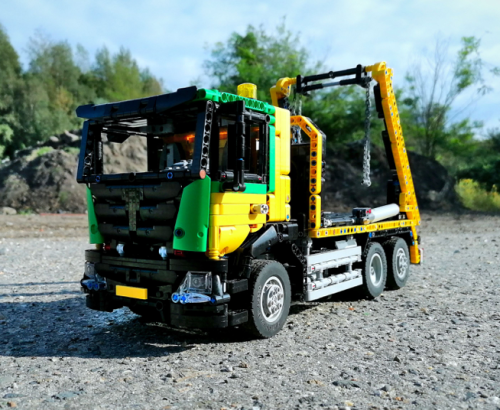
Cab-Over-Banana

Curvy, yellow, delicious, and contained within its own handy wrapper, the banana is a wonderful fruit. Equally curvy, nearly as yellow, and highly delicious (if you’re a TLCB Elf), Tauriel1‘s hot rodded cab-over got the Elves most excited. Until they found out it’s digital, meaning it can neither be ridden on or chewed.

Still, it does look absolutely marvellous, and if you’re wondering ‘why don’t TLCB publicise more digital builds?’, it because they rarely look like this.

Newcomer Tauriel1 has an array of digital creations in their photostream and you can view more of the ‘cab-over’ featured here alongside their other designs on Flickr. Click the link above to make like a banana and split.

Flight of Fancy

This is not a car, and nor is it a real aircraft, instead coming from the video game ‘Ace Combat’. It’s also a bit nonsensical, being Japanese but named after a Welsh dragon, however… it looks so cool!

Built by Corvin Stichert of Flickr, this beautifully detailed mini-figure version of the fictional ‘X-02 Wyvern’ fighter captures the variable geometry design brilliantly, and there’s more to see at Corvin’s ‘X-02 Wyvern’ album. Click here to fly over to the complete gallery.

And to Our Future. No Matter Who it May Take Us up Against, or Where…

It’s the early ’80s, perms are big, jackets are leather, and 200mph, self-driving, talking cars exist only in the imagination. And then NBC shoved C-3PO into the dashboard of a Pontiac Trans-Am. Perms remained big and jackets remained leather, but the 200mph, self-driving, talking car was now a reality, on screen at least.

The Knight Industries Two Thousand (K.I.T.T) became the coolest car for every eight year old in ’80s America, and even though most of the technology it featured is now hilariously out-of-date (even Mrs. TLCB Writer’s compact hatchback can do more* today), it’s still one of the most famous and enduring TV cars of all time.

Capturing K.I.T.T superbly in mini-figure scale, László Torma has constructed a 6-wide version of the camp coupe complete with a mini-fig Michael Knight, and he’s made instructions available too so that you can build your very own. Head to Laszlo’s photostream via the link above to take “a shadowy flight into the dangerous world of a man that doesn’t exist. Michael Knight, a young loner on a crusade to champion the cause of the innocent, the powerless, and the helpless in a world of criminals that operate above the law“. It doesn’t get any more ’80s than that!

*OK, it can’t do 200mph, despite the way Mrs. TLCB Writer drives it.

Skip This

Trucks such as this one always seem to have fancy names when LEGO produce them. Not at this blog though, where they are simply known as a ‘skip lorry’, seeing as they’re a lorry with an, er… skip. Said skip is usually full of an old bathroom, ripped out of an old lady’s bungalow when the new owners moved in, and all the junk from the neighbourhood lobbed into it by every house within walking distance whilst it was on the road.

Previous bloggee Damjan97PL/damianPLE’s fully RC Technic skip lorry is so realistic we’re surprised it doesn’t come with an old lady’s bathroom in the skip on the back to be honest, but besides that rather glaring omission he’s nailed it.

An SBrick provides bluetooth control for the motorised drive, four-wheel steering, raising/lowering rear axle (with automatic steering detachment when raised), and the skip loading arm, whilst there’s also a working six-cylinder engine underneath the tilting cabin, manually operated stabiliser legs and functioning suspension too.

There’s more of Damain’s remote control skip lorry to see at both the Eurobricks forum and at his Bricksafe gallery – click the links to chuck your rubbish on top of an old lady’s bathroom.

Sideways in the Soviet Union

Matthew Terentev’s Volga/GAZ-2402 station wagon has appeared here before, being a somewhat unusual choice for a Technic ‘Supercar’, with working steering, engine, and suspension. He’s now gone a step further though, replacing the miserable inline 4-cylinder engine with a V8 (which the real 2402 was actually available with), and he’s added a whole host of other exciting modifications including lowered suspension, aero, and – most importantly – racing decals and stripes, which are worth at least an extra 200bhp on their own.

We’re not sure how suited a Volga/GAZ station wagon is to drifting (about as much as your Mom is to the 110m hurdles we suspect), but because we’re rather sad here at TLCB we love unlikely cars turned into racers. Plus the Elves would’ve have rioted had we not blogged a drift car with racing stripes.

There’s more to see of Matthew’s drifty GAZ-2402 station wagon (and the unmodified permit-only family car on which it’s based) at his photostream. Go sideways in the Soviet Union via the link above!

LEGO Engineering Fundamentals – Interactive eBook | Review

It’s been a Technic-filled day at TLCB, but are you looking at some of the models featured here and wondering how they work? From steering and suspension, to ratchets, walkers, gearboxes – LEGO Technic can be used to create any mechanism you can think of. And probably a lot you can’t.

And that’s where Jorge Moreno Barrios’ eBook ‘LEGO Engineering Fundamentals’ shines, as the first 3D interactive guide to creating incredible mechanisms (and the basics too) from LEGO Bricks.

We were given access to an early copy of Jorge’s eBook, which is available to purchase through Apple Books, to assess how it works. And how it works is rather brilliant.

‘LEGO Engineering Fundamentals’ is divided into five chapters, each of which features 3D interactive renders of the subject;

1. LEGO brick alignment (effectively the measurements needed to build)
2. A complete 3D catalogue of LEGO Technic parts, sorted by use (e.g. ‘steering’, ‘gears’ etc.) with part numbers
3. Simple machines, consisting of levers, pulleys, wedges and screws
4. Basic mechanisms, including gears, ratchets, cams, chains, and junctions and linkages
5. Basic structures

Each render can be rotated on any axis, allowing the reader to see it from any angle, with the moving components rotating/sliding/lifting on a loop as if they were built from real bricks. Rotating the subject also reveals Jorge’s explanation of the render in question, with key words highlighted to ease understanding. If that sounds complicated it isn’t, and it works wonderfully. Naturally we can’t share the interactive element here, but hopefully the static images we’ve included will provide some insight.

In the examples above the inputs and outputs turn on the screen, with all the components of each mechanism following suit. Many of these are very simple pulleys and levers, taking readers through the basics of both Technic building and machines in general, but some – despite the ‘basic’ in the chapter titles – delve into advanced physics, recreating the beautifully intricate designs by noted engineers and kinetic sculptures. Again, each of these is completely interactive, and is ‘alive’ on the screen running through its mechanised loop to demonstrate how the design works in practice, with some looking really rather incredible indeed.

It’s mechanisms such as these we think readers will find most useful, as ‘LEGO Engineering Fundamentals’ provides a toolbox of options for ‘I want my creation to do [this], but I don’t known how’.

So is the eBook perfect? – It is Version 1 after all.

Not yet, as there are a few of refinements we’d like to see for v2, chief among which is a contents page. The ‘How this book works’ animation also didn’t work on our copy, and there a few official LEGO sets rendered within the book that are – we think – used as examples of either parts or mechanisms in action, but without any explanation. A brief ‘Set No. [xxxx] uses pneumatic cylinders and a basic lever. You can find details of these on pages [x]’ would definitely help to explain their context. The same is true for a few mechanisms that don’t have descriptive text – often because it isn’t needed, but we would prefer at least a title for every render as a minimum.

Verdict
Despite a few obvious improvements, the basics behind ‘LEGO Engineering Fundamentals’ are superb, and the first time you rotate a moving mechanism on screen to see the explanation appear you do go ‘Ooooh!’. Well we did anyway.

It’s also the first book we’ve received here at TLCB that has actively made us want to try creating new things, things we would never have thought of on our own, nor had the engineering capability to do. For that reason alone we can’t recommend ‘LEGO Engineering Fundamentals’ highly enough.

For now, this is a four star book. With a few tweaks for v2, it’ll be an easy five.

★★★★

Buy LEGO Engineering Fundamentals eBook via Apple Books here

Big Red

The halls of TLCB Towers were a bustling place today. Several Elves have recently returned with finds, TLCB staff were pretending to be busy to avoid sweeping up the cage room, and the Le Mans 2020 livestream was ticking over in the corner. All of which meant we were thoroughly distracted from the Elf proudly riding atop this rather brilliant remote control Caterpillar D10 bulldozer until it was too late.

‘Too late’ in this case means we now have a bit more than sweeping up to do, as several Elves have been smeared across the corridor (and over the front of the bulldozer) thanks to builder keymaker‘s inclusion of four Power Functions motors and a third-party BuWizz bluetooth battery, controlling the drive, steering, and ripper and blade mechanisms.

Individual suspension on the tracks’ jockey wheels plus track tensioners meant the blade stayed at Elf-smearing height even if one of them went under the tracks, whilst a working V8 engine, detailed cabin and engine bay, and opening doors and tool compartment add to the realism, if not the Elf-smushing capabilities.

We now have some considerable floor cleaning to do, as a number of our smelly little workers were caught off guard and fell victim the the D10’s blade, then tracks, then ripper, which doesn’t sound fun at all. Whilst we get on with that you can see more of keyworker’s most excellent creation at both the Eurobricks forum via the link above, or on Bricksafe, where over forty high quality images are available to view.

Lastly, if you’re wondering how mechanisms such as those found on keyworker’s ‘dozer work then come back to The Lego Car Blog later today where we’ll be sharing an awesome new tool that does just that!

Lime Horse

Painting a Ferrari in Lamborghini green will probably get you a ‘Cease and Desist‘ letter from Ferrari’s over-zealous legal department, but seeing as this one is constructed from left over bits of Lamborghini, it makes sense. Flickr’s James Tillson is the builder behind this lime green Ferrari Dino 246, and he has form, winning TLCB’s Lock-Down B-Model Competition with his previous Lamborghini-to-Ferrari conversion. His Ferrari Dino features the usual Technic Supercar functions and there’s more of the build to see at his photostream – click here to take a look before Ferrari write him an angry letter.

Striped Skyline

It’s an entirely Technic day today here at The Lego Car Blog, starting with this; LoMaC‘s neat Nissan Skyline R34, complete with a working six cylinder engine, steering, and opening doors, hood and trunk. Oh, and some Shelby-esque racing stripes, which means it gets the Elves’ seal of approval. Building instructions are available and there’s more to see on Flickr via the link.

Neon Swooosh!

Which is like a regular ‘Swooosh!’, only with more noble gas. This is Sylon-tw‘s ‘Cyber Neon Circuit’ racer, complete with ginormous glowing engines, a pair of rather interesting looking mini-figure pilots, and the coolest directional road sign we’ve ever seen. Click the link above to join the race!

By the Hammer of Thor

The wise words of Ron Burgundy there, as today we have a recreation of one of the final two Koenigsegg Ageras built before production ended, the FE Thor.

Built by the aptly-named 3D supercarBricks of Flickr, this incredible recreation of one the worlds rarest, fastest, and most expensive hypercars includes opening front and rear clamshells, a removable roof, and custom LEGO-compatible 3D-printed wheels and windshield surround pieces.

There’s more to see of the Agera FE Thor at 3D’s photostream via the link above, plus you can buy the building instructions and the custom pieces used to create it at 3Dsupercarbricks.com here.

Air Pirate

Is there anything cooler than a fighter jet with a skull and crossbones painted on it? The answer is no, and thus here’s Lennart Cort‘s Grumman F-14 Tomcat resplendent in VF-84 ‘Jolly Rogers’ livery. See more at the link!

Game of Bricks – Light Kit (10271 Fiat 500) | Review

It’s review time here at The Lego Car Blog, and on this occasion we thought we’d share the love and offer the product we were supplied to one of our readers. It just so happens that the reader in question owns a considerably more professional Lego site than we do…

So, over to Balasz at the brilliant Racing Brick, as he switches on one of Game of Bricks newest kits, bringing LED lighting to the lovely LEGO 10721 Fiat 500 set;

TLCB kindly offered me a light kit by Game of Bricks for the Creator Expert 10271 Fiat 500 kit. This happened months ago, but due to some logistical issues on both sides (thanks Coronavirus, Ed.), I only had a chance to try it now.

The 10271 lighting kit comes in a nice black box, but it only has the logo of the manufacturer on it. I’m not sure if you get any additional identification if you order multiple light kits, but mine didn’t give any clues as to which LEGO set it belonged to.

Inside the box I found five numbered plastic bags and a battery box, and as you can see there’s not any extra documentation or anything in the box besides the hardware, which is a good thing if we think about the environment, but it makes the project a bit challenging if we are looking for some building instructions.I tried to go first to the web page of Game of Bricks and the product page of the Fiat 500 light kit, but there’re no instructions there.

As the text says I can ask for pdf instructions, but I was hoping to find them without the need to reach out to the team.As always Google helped me out; apparently Game of Bricks have a page for their instructions and I managed to find the one for the Fiat 500. I already installed some light kits from other manufacturers and the instructions were very similar, I can say that the steps for this set are pretty easy to follow.

The tiny LEDs and the cables are also familiar, if you ever saw a 3rd party light kit then there won’t be any surprises.

Installing the front lights is a pretty straightforward exercise, although I was a bit surprised that only the upper lights got a replacement piece instead of the LEGO pieces, the lower ones had to be squeezed under the transparent round 1×1 piece.Under normal circumstances there’s exactly zero space between the transparent piece and the stud below it, so even with this super thin wire it will be a bit off and you need to push it in place carefully.

The rear section has similar challenges to solve, and we get a light strip for the roof with an adhesive tape to attach to the sunroof. I decided not to attach it, as the cables can be arranged to hold it in place.All cables will meet at the bottom, where you need to attach them to a splitter piece, although the tiny connectors are not the easiest to handle, and you need some extra arrangement if you want to keep your model movable.

The battery box requires 3 AAA batteries and includes a USB connector. If you have a smaller power bank or something similar then it might be a good idea to change it, as the one in the kit barely fits in the model. It is also challenging to turn on and off, as you need to remove it to be able to access the button.

However the end result looks great, and can really spice up a display model. The modular design is a big plus, all my previous light kits were hard wired together so it was not possible to add only certain sections of them to a model. For example, if you don’t want to use the cabin light in the Game of Bricks kit then you can simply detach it whilst leaving the rest of the LEDs in the model.

The only thing I’d like to change if I wanted to display the set permanently with LED lighting installed would be the power source, if only to make the on/off button more accessible!

Thanks to Balazs from Racing Brick for taking a look over Game of Bricks lighting kit for the 10271 Fiat 500 set. You can find this kit, along with all of the Game of Bricks kits for official LEGO vehicles, at their website, and you can check out Racing Brick too by clicking here!

Le Mans 2018

This spectacular array of racing cars is the entire Le Mans 2018 GTE Pro grid, just one of the four categories that compete side-by-side at the world’s greatest motor race.

Built over two years by Lasse Deleuran, all teams and driver combinations from the GTE Pro class of 2018 are present, with Ferrari, BMW, Aston Martin, Chevrolet, Ford, and the race-winning Porsche squad recreated brilliantly in Miniland scale, many of which have featured here individually over the last two years.

Instructions for every single GTE Pro car are available for free, and you can see more of each racer and find the link to recreate your very own Le Mans 2018 GTE Pro grid via Lasse’s photostream by clicking here.

Rat Cat

Heavy duty applications such as pick-ups, trucks, boats, and trains all benefit from the fuel efficiency and torque that diesel engines offer.

However the passenger car market, which here in Europe was once around 50% diesel, was sold a lie. Now realised, the diesel car market has collapsed, and manufacturers can’t get rid of their diesel products soon enough.

However an engine type that’s noisy, dirty, and obsolete may be wholly unsuited to a small European shopping car (apart from to dodge CO2 taxation), but it’s literally everything you could want in a rat rod!

Cue Sin City Motors’ wild Caterpillar diesel engined half-track rat rod, recreated here by TLCB favourite Redfern1950s in superb form.

Red’s Model Team interpretation of Sin City Motor’s spectacular creation captures the insanity of the real rat rod beautifully, and there’s a whole lot more to see on Flickr via the link!