Fifteen Horsepower of Fun

We’ve featured some very cool, very fast motorbikes here over the years. The Honda Mini Trail ‘Monkey Bike’ is not one of them.

However we would take this diminutive 125cc practical joke of a motorcycle over literally any other two-wheeled machine, because it’s hilarious.

Powered by a 15bhp 125cc engine (or engines even smaller), Honda’s Mini Trail is not going to win any off-road competitions, but it going to make the rider look very funny, and that’s reason enough for us to love it.

This near-perfect Technic replica of the Mini Trail 125cc comes from ianying616, and we can confirm that with a TLCB Elf strapped atop, it’s just as funny as the real thing. Click the link above for 125cc of fun!

Dodgy Restomod

Despite the title this is not a badly-restored classic, ‘repaired’ in Billy-Bob’s garage in the hope of making a quick buck. No, restomods, when done well, are rather excellent, bringing modern tech (cooling systems, brakes, suspension etc.) to cars from a very different era of performance. Flickr’s Brick Flag has turned his very capable hand to restomoding his own ’60s Dodge A100 model, in the final of his five ‘forward-control’ classic vans. There’s more to see of Brick’s excellent creation on Flickr via the link above, and you can see all five brilliant classic vans side-by-side by clicking here.

Centodieci

This is the Bugatti Centodieci, a Chiron-based, $9million, 10 unit hypercar. But if you’re a bit short of $9m, Fabrice Larcheveque has the answer. Suggested by a reader, Fabrice’s Speed Champions version of the Centodieci captures the real car rather well, despite wheels that are Speed-Champions-but-not-hypercar appropriate, and there’s more to see on Flickr via the link.

Game of Bricks – Light Kit (10277 Crocodile Train)* | Review

*Plus a few Speed Champions kits.

Being lazy, er… we mean tremendously generous, we’re handing over to another reader today for a review of more LED lighting kits for the 2020 LEGO sets, courtesy of LEGO-compatible LED lighting experts Game of Bricks. John Olive is the lucky recipient/willing reviewer, who has fitted some twinkly lights to his 10277 Crocodile Locomotive, and a few Speed Champions sets too – over to John!

Lights are only good for 3 things. Driving in the dark, for decorating a Holiday tree, and for lighting up LEGO sets. You know that feeling you have when you’ve finished building an official set that cost you an arm and a leg, and you have the desire to take your build to the next level? Well, for a good price it’s time to look to lighting your set or own creation with a good set of lighting kits.

While the current lineup of LEGO lighting kits are few and far between, a majority of builders have to turn to 3rd party vendors for all their lighting needs.

I had the distinct pleasure of getting hooked up with some lighting kits from Game of Bricks. Curious on the build quality and lighting ability, I had 3 kits sent to me in the United States. Two were for Speed Champions sets and the third was for the 10277 Crocodile Locomotive.

While shipping did take a little while, I was pleasantly surprised that when the package arrived, the kits were packaged nicely in thin black boxes. Inside all 3 kits, were the necessary components for each set and all came with a disclaimer packet. I was thrown off for a hot second because there weren’t any installment instructions and I didn’t know which lighting kit was for which set. I was quickly corrected by my 6 year old as he noticed a sticker on each kit with the set number on there. Go figure.

I had to refer back to the website for instructions as the kits didn’t come with an installment guide which was conflicting with their website offer of having instructions in every set. The instructions online were geared towards folks that have built the corresponding set already, so it included tear down instructions prior to adding the lights. This was extremely helpful for the Speed Champions sets and Crocodile. With only receiving digital instructions, I don’t hold that against them as I prefer to use digital instructions. The pictures were clear and provided a close up view of what was happening. I may have been distracted by the model’s fingernail in some pictures, but as I replicated the instructions on my own desk, it was apparent that Game of Bricks had given some thought in this phase of the installment. While the sets I reviewed were somewhat newer, hopefully older sets have the instructions right out of the box. Just in case customers don’t have the internet.

Let’s get to the actual kits.

The quality of the lighting kits was high just by the look and feel of the components. The website promises top notch quality, and while I’m unsure of the specific requirements to that, my experience with lighting kits confirms that it’s true. The extremely thin Connecting Cables are wound tightly and I didn’t notice any unraveling wires when running the cables in between the plates and bricks. Connecting the cables to a light strip has to be done ​very carefully​ and will be rewarded with an audible click when it slipped in there correctly.

*Veteran tip: A classic technique requires you to use your fingernail to push the connector into the port when dealing with such small components.*

Once cause of concern when dealing with any kind of lighting kit is the size of the LEDs used, but luckily Game of Bricks comes through with the perfect size. On the Crocodile Locomotive set, there are several 1×1 translucent clear pips that mimic the lights.

The LEDs from GOB fit nicely inside the pip. On the flip side, the light kit for the 75894 Mini Cooper S Rally & 2018 Mini John Cooper Works Buggy came with 2 sets of pips that had small holes that snaked the connecting table inside for you. This was because the Crocodile lights had their clear pips connected to a brick that allowed the cable to be hidden. When it comes to creating lighting kits, attention to the smallest detail allows for an easy installment. Spending time with a set when developing these clever little work-arounds is important because not only does it need to be installed correctly, the cables need to be hidden in order to pull off that realistic component of the set. No one likes a gorgeous set with clunky wires being exposed. With that, Game of Bricks is going to receive good marks when it comes to hiding cables.

While it makes sense to light up a locomotive like the Crocodile, Speed Champions sets like the MINI or Jaguar were a wild card for me. In all my years going to brick shows, it is rare to see those small cars being lit up because it becomes difficult to hide those clunky battery boxes. Luckily the battery boxes provided in the lighting kits aren’t much bigger than a zippo lighter, and comfortably hold 3 triple A batteries. Just make sure that you are hiding that box behind the set as it is clear that these lighting kits are more for display than for running trains on a train layout. A nice little tidbit is having the on/off switch on that battery box and some sets like the Crocodile include a secondary battery box for two 3 volt round batteries. This extremely thin box allows for installment underneath the set and is hidden from view. The finished models shined brightly in all the right places. For example, on the Crocodile Locomotive, the main cabin’s lights shine a dull yellow, mimicking this 1919-1986 model, while the lights at the front and rear “snouts” shone a bright white light. I appreciated the thought behind those decisions.

Having so many options for kits leads to the biggest question that I will leave to others to debate. Are there certain LEGO sets that should be MODed for lighting kits or are there sets that should not be lit?

Game of Bricks throws all that into the wind with their wide selection of lighting kits and says, you shouldn’t let anybody tell you what LEGO set to light up. Their catalog of lighting kits is ever growing, and just by the looks and experience of using their lighting kits, it’s hard to not think of a LEGO set they don’t have a kit for. If they don’t have one available, you can make suggestions which I appreciate as a consumer.

As LEGO continues to pump out new sets, Game of Bricks appear to be doing a great job of creating new kits for them. With their robust catalog of kits, and accessories for your own creations, I believe that Game of Bricks is here to light up the competition.

Little Red Wagon | Picture Special

It’s 1965, and drag-racers Jim Schaeffer and John Collier have got their hands on a Dodge A100 ‘forward-control’ truck. The pair decided to install a 426 Hemi in the bed, and any non-essential items were removed. The resulting ‘Little Red Wagon’ was the world’s fastest 1/4 mile truck, setting an eleven second time at the first attempt. However, the modifications also tilted the weight bias rearward a bit…

The unintended consequences of this rear-biased weight distribution were a vehicle that proffered to drive only on its back wheels, and in fact the ‘Little Red Wagon’ could complete an entire 1/4 mile race without the front wheels ever touching the ground.

Such crowd-pleasing shenanigans caught the attention of Dodge, who not only used the ‘Little Red Wagon’ in commercials, they all arranged for its purchase by Super Stock Champion Bill Golden to use as the first ‘competition wheelstander’, a class it created single handedly.

Of course having your front wheels in the air limited steering somewhat, and the ‘Little Red Wagon’ crashed in 1969. And 1971. And 1975. That last wreck took the truck out of service, and Golden converted a new truck to continue his wheel standing antics, setting the Guinness World Record for the longest (at nearly 3/4 of a mile!) in 1977 and racing it until his retirement in 2003.

Today a recreation of the ‘Little Red Wagon’ tours alongside the wrecked original, whilst Golden’s own replacement wheel standing truck sold for over $500,000 in 2009.

Flickr’s Brick Flag, who is fast becoming one of our favourite builders here at TLCB, has converted his own Dodge A100 model into a ‘Little Red Wagon’ wheelstander, with his spectacular Model Team version amalgamating the different versions of the real truck that were built over the years.

Superb design, detailing, and decals are evident in abundance and there’s heaps more to see at Brick’s ’60s Dodge Little Red Wagon’ album on Flickr. Click the link above to head down the drag strip on just your back wheels, and here to see the real ‘Little Red Wagon’ in action courtesy of a glorious period video!

Two Tiny Tractors

We often feature enormous, hugely complex models here at The Lego Car Blog. Whilst these are amazing accomplishments, they can feel a little unachievable for many Lego builders, particularly those with a parts to talent imbalance. But it’s definitely better to be that way round, as talent can almost always make up for a deficit in pieces.

These two tremendous micro-scale tractors by Flickr’s František Hajdekr are proof that you don’t need a million bricks and an unlimited budget to build something of blogworthy excellence. Each is constructed from just a handful of common parts, yet capture their subject matter perfectly with beautiful presentation too.

There’s more to see of František’s excellent-yet-simple creations at his photostream via the link above, and to get a few tips on how you can present your models as professionally as these two take a look at our photography tips here.

Julius Jr’s Journey

We hadn’t heard of Julius and Clancy before, but a quick Google reveals the cartoon critters by Paul Frank are every bit as terrifying as Brickbaron‘s brick-built versions.

Horrific though they undoubtedly are, so are most children’s TV characters (we mean, just look at a Teletubbie), and their message is a sweet one, as evidenced by this catchy tune – which maybe a few politicians should watch. Plus cheaply animated kids cartoons are a lifesaver for parents the world over, however disturbing the protagonists may be.

Anyway, back to the creation; Julius and Clancy are in a tuk tuk for some reason, which Brickbaron has presented beautifully. Built using a range of excellent techniques there’s more to see of Julius and Clancy’s tuk tuk taxi ride on Flickr, where we’re sure a wholesome song can’t be too far off…

Turbo

Is there anything more Turbo-y than a classic Porsche 911 Turbo? We’d say no, and not just because ‘Turbo-y’ isn’t a word.

This is SP_LINEUP’s 964-series 911 Turbo, and it is remarkably lifelike considering the scale. Opening doors and front-trunk are included, as is a detailed interior, and there’s more to see at SP’s photostream here.

Swiss Stork

This is a Fieseler Fi-156 Storch, a short take-off and landing aircraft designed in Germany in the late 1930s. Oddly, despite Germany being a bit of a bad neighbour at the time, it was also built in the Soviet Union (before the German invasion) and France (during and after the German invasion).

One country not invaded was neutral Switzerland, which is where this Fi-156 Storch (or Stork in English) hails from, being used in the Alps for search and rescue.

Built by Flickr’s daviddstone, this brick-built recreation of the Swiss Stork captures the design brilliantly, including wing and landing-gear struts, skis for snow landings, and a lovely Swiss Cross tail-fin.

There’s more to see of daviddstone’s creation at his photostream – click the link above to fly over the Alps in the 1940s.

LEGO Technic 42118 & 42119 Monster Jam | Set Previews

LEGO’s officially licensed vehicles continue with two more new-for-2021 sets! 42118 and 42119 join the Technic range as the pull-backs for 2021, and like the 42109 ‘Top Gear’ rally car, each is licensed to not a car brand, but to an entertainment company.

‘Monster Jam’ is a North American stadium institution, in which monster trucks freestyle around an arena filled with squashed cars, dirt ramps, and a whooping beer spilling crowd. Which sounds great. Because it is.

Two of the main protagonists are ‘Grave Digger’ and ‘Max-D’, which LEGO have chosen to recreate for their 7+ Technic sets.

It’s normally at this point when we’d deride the new pull-back sets for being total garbage, but this year we can’t. Because they’re awesome.

Each set contains around 250 pieces (although there’s no ramp this time – which surely these were made for – but you can build one of those at home), including excellent wheels and tyres, and a giant Jolly Roger/Angry Chief flag.

Expect 42188 and 42119 to cost under $20 when they reach stores next year, and for Monster Jam arenas built from books, cushions, toy cars, and other household objects to appear in homes everywhere. Good stuff.

Not All Ferraris are Red….

This is a Ferrari 250 GTO, a car numbering less than 40 units and today worth roughly three squillion dollars. They are most famously red of course (as highlighted by the beautiful Model Team version we featured here earlier this week), however a handful of GTOs have strayed from the Ferrari corporate uniform over the years, one being Sir Stirling Moss‘s bespoke green car, and another being this; No. 112, painted – magnificently we think – in the colours of Sweden.

Now owned by a billionaire (what Ferrari 250 GTOs aren’t?), the unique 250 GTO was raced in Europe during the 1960s by Swedish racing driver Ulf Norinder, who competed very successfully in some the continent’s most prestigious events.

This incredible replica of that uniquely painted car comes from previous bloggee and Lego-building legend Jens M., who has recreated No.112 in astonishing detail. A lifelike engine resides under the opening hood, the trunk opens to reveal the fuel tank, and a realistic interior is accessible through the opening doors. Plus, most importantly of course, it’s blue with a big yellow stripe down the middle.

It’s one of the finest Lego cars we’ve featured this year, and there’s more to see of Jen’s stunning creation at his ‘Ferrari 250 GTO album‘ on Flickr. Click the link to make the jump to this one-of-a-kind classic racer, and you can see an equally brilliant brick-built 250 GTO in the more traditional red via the link in the text above if you missed it earlier in the week.

Buggy Blues

It’s been a while since the last mass Elven smushing here at The Lego Car Blog Towers. The Elves are wising up to the dangers of being out in the open for too long, a suspiciously unguarded Smartie, or attending the scene of a recent smushing to point and laugh, all of which carry the risk of a remotely operated Lego creation bursting out and running you over.

Today though, none of the above mattered; because two Buggy motors, monster suspension, and a BuWizz bluetooth battery are enough to outrun even the wiliest of Elves.

JLiu15’s LEGO Studio is the builder behind this beautifully presented ‘Azure Racer XL’, and it’s one of the most capable Elf-squashing machines that we have ever seen. And one of the fastest. Good as LEGO’s own new remote controlled 42124 Off-Road Buggy set looks we doubt it will be anywhere near as quick as this.

The trail of flattened Elves in the halls of TLCB Towers is evidence of the Azure Racer’s pace, and there’s much more of the build to see at JLui15’s ‘Azure Racer XL’ album on Flickr. Click the link above to see all of the excellent imagery, whilst we reward a deliriously happy Elf with a meal token, and get a spatular to pry its squashed brethren out of the carpet.

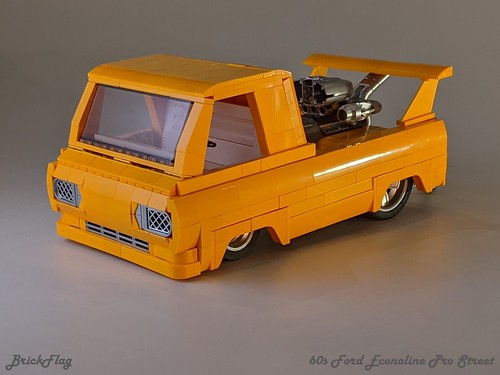
Orange Juice

Flickr’s Brick Flag has appeared here twice recently, with his excellent American 1960s ‘forward control’ vans, the Dodge A100 and Ford Econoline. We tend not to feature the same builder repeatedly in quick succession, but had we not today there would have been an Elven riot. Plus, – more importantly – we think this is bloody cool too.

The reason for the Elves’ excitement is obvious; Brick Flag‘s latest build is bright orange, features a racing stripe, wheelie-bar, ground-scraping stance, a huge rear wing, oh – and it has ‘some sort of turbo jet boat engine directly on its rear axle’, to quote the builder. This has also allowed for a bench seat to be fitted in place of the original two-seat set-up, which sounds safe.

Even Brick Flag admits this ‘makes no sense whatsoever’, but if you’re a TLCB Elf few things do, and that’s the way they like it. There’s more to see of Brick’s wildly modded ‘Pro Street’ ’60s Ford Econoline at his photostream – click the link above to fire up ‘some sort of turbo jet boat engine’ and become an orange blur.

Game of Bricks – Light Kit (42107 Ducati Panigale) | Review

It’s nearly Christmas, when twinkly lights are everywhere! So why not add some to your Technic sets? Reader Francesco Frangioja has done just that…

When TLCB and Game of Bricks kindly offered me the chance to pick two light kits for 2020 vehicle sets, in addition to the LEGO Technic 42111 Dom’s Dodge Charger kit, which I chose because I’m a big fan of the Fast & Furious franchise, I also chose the LED kit for the LEGO Technic 42107 Ducati Panigale V4 R. Being Italian and an engine enthusiast, the choice was practically forced!

The lighting kit comes in a cardboard box, black and premium quality, which has only the logo of the manufacturer on it. Because TLCB and Game of Bricks have sent me two different kits, there was an additional identification (handwritten) tag with the number of the set in which to install the light kit itself (left-bottom corner). 

Inside the box I found: 

  • Three numbered plastic bags with tiny LEDs stripes and the thin, very thin cables
  • Two un-numbered plastic bags with the battery box, one “hub” to connect the single part of the LED circuit and the USB connector to connect the LEDs “circuit” to the battery box
  • One booklet with the explanation of what each component is and its use/purpose

Also for this kit, as for the specific one for LEGO Technic 42111 Dom’s Dodge Charger set, the actual building instructions are on Game of Bricks’ website, consisting of a series of “photographic” steps showing where to place the individual “light points” and how to organise (where they have to pass) the various wiring. 

Now that I’ve become familiar with the Game of Bricks system and had ways to practice with the tiny connectors I was able to follow the steps for this set very easily. 

The fist task is to install the elements included in the plastic bag No.1, by inserting the LED elements behind the trans-clear round tile in the front headlights, simply by “squeezing” them between the tile and the underneath Technic pin. To install these lights, of course, you need to remove the front fairing, not before applying the first of the connection strips behind the handlebars.

Continue reading

Design an Iconic Ferrari Poster! | Competition

One of LEGO’s greatest strengths is their box art, which often depicts the set inside in a beautiful artistic recreation of a real-world setting (take a look at the boxes above to see what we mean). However LEGO chose to use minimalistic all-black packaging for their new 42125 Technic Ferrari 488 GTE set, eschewing the usual artwork for a classy, more adult-focussed design.

However, that’s not to say 42125 wouldn’t look great in front of a more dynamic background, and that’s where you can help!

LEGO Ideas are running a competition to design a poster for the new 42125 Ferrari 488 GTE AF CORSE set, with some awesome prizes (including a copy of the new set) up for grabs!

Winner’s Prizes

    • 42125 Technic Ferrari
    • 76895 Speed Champions Ferrari
    • 75890 Speed Champions Ferrari
    • 42124 Buggy Control
    • 2 x Prints of your poster (1 signed and one plain)
    • A Ferrari Goodie Bag

The assets required to create your poster are available for download at the LEGO Ideas website, where full competition details and entry requirements can also be found. Upload your poster design by 14th December to enter!

Click here to enter the Ferrari Poster Competition at LEGO Ideas!