Is there any car more worthy of a Toad-of-Toad-Hall-style ‘Poop-Poop!’ exclamation than this one?
The 1928-’32 Mercedes-Benz SSK is the very definition of Gatsby-esque opulence, with this Speed Champions scale recreation by Flickr’s Pixeljunkie capturing its excess brilliantly.
Yellow bodywork, shiny bits, bonnet straps, and an over-sized Mercedes-Benz badge ensure the peasants can’t miss you, and there’s more to see at Pixel’s photostream via the link.
Boring. Dull. White Goods. All things levelled at the Toyota Corolla (including by us), and all true. Except when they’re not.
Whilst there have been millions of tedious white boxes produced with the ‘Corolla’ name, there have also been some that really aren’t tedious at all. The AE86, Championship-winning rally cars, and even the current twelfth generation Corolla, which is both more interesting technologically and to look at than a Golf, a Focus or an Astra.
So the Corolla is boring, except when it isn’t, and this one ‘isn’t’; the lovely 1970-’78 ‘E20’ Coupe.
The second generation of Corolla, the ‘E20’ was available in sedan, coupe, station wagon and van variants (plus as a Daihatsu), with engines between 1.2 and 1.6 litres, and became the second best-selling car globally.
Built by Dicky Laban, this neat Technic recreation of the ‘E20’ Corolla coupe is interesting too, being equipped with LEGO’s Powered-Up system for remote control drive and steering cleverly packaged inside.
We end the week with something rather special. Martin Vala has appeared here a few times with his incredible Dakar racers. This is apparently his final one, ‘The Last Dragon’, a phenomenal buggy concept deploying some of the finest Lego building techniques we have seen yet.
The spectacular exterior combines intricate Model Team and Technic, with butterfly doors opening to reveal an equally brilliant interior. The breathtaking detail continues to the brick-built V6 engine, accessible under a lifting engine cover, whilst underneath is a hybrid brick-built and functional Technic chassis and drivetrain, including working steering and suspension.
Martin has presented his build beautifully too, with fantastic lighting and editing making for some stunning imagery.
There’s loads more of Martin’s ‘Last Dragon’ to see at his Flickr album by clicking here, plus you can check out the other amazing Dakar racers that preceded it – both real-world and concept – along with the V6 engine in the middle of this one, at their individual Flickr albums via this link.
Ah Buick. Maker of boring cars for old people, and later re-badged Vauxhalls for old people, they’re about as interesting as a Brother’s Brick parts cataloguing evening.
Except in the late ’80s, when they went mad.
Working in partnership with McLaren, Buick took their soporific Regal sedan and turbocharged the 3.8 litre V6, with the resultant GNX producing almost 300bhp and a 0-60mph time of 4.6 seconds. In 1987!
Quite what they ate for breakfast that day we don’t know but we wish they’d eat it again.
Recreating the Buick ‘Grand National Experimental’ is Rolling Bricks, whose 8-wide Speed Champions scale model captures the aesthetic of the original brilliantly. There’s a detailed engine under the opening hood, room for two mini-figures, and there’s more to see on Flickr via the link.
The second generation Toyota MR2 wowed the world when it arrived in the early 1990s. There was simply nothing more exotic looking for even twice the price, earning it the status as a ‘Poor man’s Ferrari’.
We’d say a ‘Sensible man’s Ferrari’ too, as – being a Toyota – the MR2 was infinitely better built (and – dare we say it – better engineered) than anything coming from Maranello, and the turbocharged version was even pretty quick.
After a period of ‘banger’ status, SW20 MR2s are rapidly becoming sought-after classics, and Daniel Helms (aka danielsmocs) is the lucky owner of one in real life.
Capturing his car in Lego, Daniel has recreated the second generation MR2 in brick form, complete with working pop-up headlights via a switch in the cabin, opening doors, front trunk, engine cover and luggage compartment, sliding seats, and removable ‘glass’ roof panels.
This is it. The single coolest LEGO set ever made… it’s the brand new Creator Expert 10300 ‘Back to the Future’ Time Machine!
In partnership with Amblin Entertainment and Universal Pictures (but notably not the DeLorean Motor Company, probably because they went bankrupt before the first ‘Back to the Future’ movie was released, and most people don’t know the DeLorean was a real (and rubbish) car anyway…), LEGO have brought the most famous movie car of them all to life in brick form.
Constructed from nearly 1,900 pieces, 10300 measures 35cm long and features a mini-figure Doc Brown and Marty McFly, hoverboard, radioactive plutonium / a banana for flux-capacitor fuelling, and a light-up flux-capacitor too, putting LEGO’s new light-up part to much better use than on its debut on the 42127 The Batman Batmobile set.
And that’s not all, because 10300 allows builders to time travel between all three ‘Back to the Future’ movies, with a variety of accessories that capture the Time Machine’s various amendments and evolutions during the trilogy.
These include the hook used for lightening strike power in Part 1, the hover system (“Where we’re going we don’t need roads!”) enabling flight in Part II, and the more rustic western modifications that ensured Marty could get home in Part III, before the Time Machine met its destruction in front of a locomotive.
The ‘Back to the Future’ Time Machine set looks like an absolute triumph, and if you’re as excited as we are you can hit 88mph for yourself when 10300 reaches stores in April for around $170 / £140.
TLCB staff know to wear shoes in the office. No, the Elves don’t make that sort of mess, but their shenanigans do make barefoot walking of the halls hazardous. Today, this TLCB Writer forgot that rule.
A sensation of something both gloopy and slightly crunchy underfoot drew a sigh and a weary look down, upon which the Elf, smeared into the carpet, became apparent. Another sigh.
And another Elf too, as a second was in a similar predicament a few yards down the corridor.
Further again, and the strange sound of a motor whirring followed by repeated crunching could be faintly heard. A third sigh.
Rounding the corner and the source of the smushings revealed itself; a large unusual-looking tracked vehicle was stomping upon a flattened Elf with a stabilising foot, much to the glee of the Elf at the controls.
Said controls were quickly grabbed and we could determine the steps the Elf had taken to mete out violence on its colleagues.
Firstly, they were run over, thanks to the skid steer of the two suspended and motorised tracks, before – admittedly rather cleverly – the Elven psychopath at the controls compounded the misery of the victim by either stomping upon them with the vehicle’s stabilising legs or dropping a brick-built ‘diesel generator’ onto them via the fully motorised crane.
Which – Elven carnage aside – is seriously impressive. TLCB Master MOCer Nico71is the builder behind this curious (and stunningly engineered) creation, which is constructed only from the pieces found within the official LEGO Technic 42100 Liebherr R 9800 Excavator set.
All seven Powered-Up motors from the set have been redeployed to the purposes above; with remote control drive and steering, crane rotation and two-part elevation, four stabiliser legs, plus a motor spins a piston engine for added realism.
All of that can be controlled via the LEGO Powered-Up app, and if you’d like to convert your own 42100 Liebherr R 9800 set into an unusual Elf-smushing machine you can, as Nico has made building instructions available too.
There’s much more to see at Brickshelf, Nico’s excellent website or via the video below. Take a look whilst this TLCB Writer cleans the corridor carpet. And puts on some shoes.
Racing stripes and V8s are staple favourites here at The Lego Car Blog. Except within the current Festival of Mundanity competition of course. But this car isn’t mundane at all.
The Chevelle was Chevrolet’s mid-sized car in the ’60s and ’70s, built on GM’s ‘A-Body’ platform, and available with no less than eight V8 engines. And a pair of 6-cylinders, but we’re not interested in those.
Top of the tree was the SS, which had over 350bhp. And no steering, suspension or brakes, as was the fashion of American muscle cars of the time. Still, the racing stripes more than made up for that.
This excellent brick-built homage to the 1970s all-power-no-steering approach comes from previous bloggee Rolands Kirpis, and features opening doors, hood and trunk, a realistic V8 engine, and beautiful be-striped dark green bodywork. Which – considering how exceptionally rare dark green LEGO pieces are – must’ve been a proper faff. Apparently one part was $20 alone!
Further images are available and you can take a look via Rolands’ ‘Chevrolet Chevelle SS 1970’ album here, where a link to instructions will also appear soon. Maybe don’t try build it in green though…
This ‘Smooth Coupe’ was discovered by one of our Elves on Flickr today, coming from Slick_Brick, making their TLCB debut. An opening cockpit, two mini-figures and some nifty ‘SNOT’ all feature, and you can slide over to see more via the link.
We’re often guilting of favouring enormous million-part creations here at TLCB. This is because we’re eight, and also because ‘subtlety’ isn’t really in the TLCB Elves’ vocabulary. To be fair to them though, very little is in their vocabulary. Anyway, today we are going small, because Thomas Gion has produced this lovely micro-scale railway vignette, complete with the tiniest trees, teeniest tracks, and littlest locomotive. All look wonderful despite their miniature size and there’s more to see (although not that much more) at Thomas’ photostream. Click the link above to go on a teeny tiny train ride.
Not entered into TLCB and BrickNerd’s Festival of Mundanity contest, but gosh would it do well it if it were, is Michael217’s magnificent Cadillac Fleetwood Brougham.
The height of ’90s crappy Americana, the Fleetwood was a near six metre long, two ton barge propelled by a 5.7 litre V8 with less power than a Parish Council.
We love rubbish cars like this here at The Lego Car Blog, because… well, we’re poorly engineered, badly steered, and shoddily built too.
Despite both TLCB and the ’90s Cadillac Fleetwood sharing these characteristics, Michael217’s wonderful Model Team recreation certainly doesn’t. Both beautifully made and presented, Michael’s model captures the enormous boxy Brougham brilliantly, with a superbly realistic engine bay and interior too.
All four doors open, as do the trunk and hood, there’s independent suspension (which is likely considerably better than that used by the real thing), plus full remote control drive and steering courtesy of twin L Motors and a Servo.
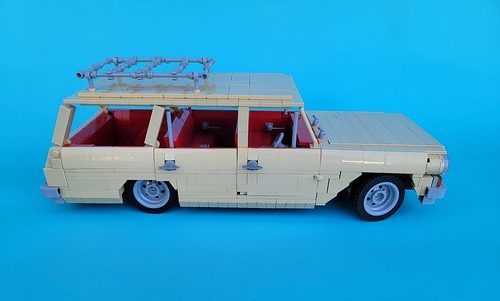
These days a cream station wagon would be a rather interesting vehicular sight, surrounded by a sea of grey SUVs. Back in ’60s America however, and they were the byword for boring.
Even the name of this one was uninspired. American car companies are usually quite good at exciting names, but – whilst this would eventually be called the ‘Nova’ – to begin with it was simply known as the ‘Chevy II’, which is almost Sovietly insipid.
Flickr’s Tim Inman is the builder behind this marvellous Model Team recreation of the Chevrolet Chevy II station wagon – which he’s created for the ongoing Festival of Mundanity competition – complete with a beautifully built interior and exterior, opening doors, raising hood, and a life-like engine. Which appropriately is not the optional V8. That would be too interesting.
It’s a fabulous build – although we’re not sure how many mundane points it will earn seeing as today a Chevrolet Chevy II station wagon would be a rather cool sight – and there are lots more images available to see at Tim’s photostream via the link above.
If you’d like to enter your own boring build there are still several weeks of the contest left to go, and some awesome prizes on offer for the winners, with Tim entering into both the Vehicle and Object categories. His object entry might just be the most default and uninspired item in the history of mankind too. Excellent!
When Austin/Morris launched the Mini in 1959, other car manufacturers couldn’t believe the ingenious packaging of Alex Issigonis’ masterpiece.
They also couldn’t believe how Austin/Morris were building it for a profit, and thus Ford bought one to take apart to see how they had done it.
What they found was definitely ingenious packaging, but also that the Austin/Morris profit was literally unbelievable, in that they, well… weren’t making any.
The British car industry was a weird place.
Austin/Morris corrected this rather crucial issue with a price rise (not that their incompetence would disappear of course, causing the companies to do so themselves eventually), and the Mini became one of the best selling small cars of all time, along with becoming a design icon.
If you fancy taking a classic Mini apart yourself as Ford did you can now give it a go, thanks to Pixeljunkie‘s ‘exploded’ Mini Cooper, instructions for which are available so you can explode your own!
There’s more to see at Pixel’s photostream, take a look via the link above, whilst we rue not titling this post something along these lines…
Unlike Vladimir Putin, Dawid Boczek has a most excellent erection.
This is his spectacular Liebherr LTM 1070 4.2 mobile crane, a 7,000 piece, nine motor masterpiece with a frankly huge boom. Unlike Vladimir Putin.
Those nine motors power everything from the remote control eight-wheel-drive and six-wheel-steering to the boom slewing, elevation, extension, winch and pneumatic outriggers, making it really very clever indeed. Unlike Vladimir Putin.
Dawid’s incredible creation also features a few mechanical functions too, including opening and lockable doors, and live axle suspension, meaning it’s both secure and stable when things get rough. Unlike Vladimir Putin.
There’s lots more of Dawid’s brilliantly-engineered build to see at both the Eurobricks forum and his ‘Liebherr LTM 1070’ album on Flickr – click the links above to get it up!
The Soviet Union, for all the terror, oppression, and poverty meted out on its inhabitants, achieved some amazing things. Uniting almost all of Eastern Europe, it spanned over 22,000 square kilometres and eleven time-zones before its collapse in 1990, heralding a freedom long-awaited by millions.
The two largest countries within the bloc were the Russian SFSR and the Ukrainian SSR, where collaboration on military, vehicle and aircraft manufacturing was particularly close.
Which makes it all the more awful that Russia has decided to invade and bombard its brother, despite a shared history, language, people, accomplishments, and that Kyiv is actually even older than Moscow. It’s a war to revive the Soviet Union, in a time where – thankfully – such oppression is incredibly hard to achieve, and is – we hope – doomed to fail.
Today’s creation captures the shared history of Russia and Ukraine beautifully, being a Russian Lada Niva constructed in Ukrainian colours. Flickr’s PalBenglat is the builder, answering our call to build in blue and yellow, and there’s more to see on Flickr. Good luck Ukraine.