El Camino

Car-based pick-ups have been a strangely transient body style over the years. Currently popular in South America, previously popular but now dead in Australia, and returning once more after a long hiatus to the U.S.

This new crop of car-based pick-ups being marketed in the U.S includes the new Ford Maverick and the decidedly strange-looking Hyundai Santa Cruz, and it could mean there’s room for the famous of them all to make a comeback; the mighty Chevrolet El Camino SS.

Based on the Chevrolet Chevelle, the El Camino swapped the traditional sedan/station-wagon bodywork for a two-door cab with a pick-up bed, and it could be bought with Chevrolet’s most powerful engine of the time, a 13-second 1/4 mile 450bhp V8.

Despite this prodigious power, suspension and steering were still, well… it had them we suppose, and disc brakes were an optional extra. Handling was clearly not an El Camino strong-suite then, but if it could stop and go round corners quickly all your stuff would fly out of the bed, so perhaps Chevrolet were cleverer than we’re giving them credit for. Or it could be that American consumers only cared about big power and racing stripes…

This wonderful recreation of the definitive muscle-car-pick-up comes from Jakub Marcisz, who has replicated the 1970 El Camino SS brilliantly in brick-form. Jakub’s model includes (somewhat superfluous) working steering, the requisite big piston engine connected to the rear wheels, opening doors, hood and tailgate, and – most importantly of all – racing stripes.

There’s lots more to see at Jakub’s ‘Chevrolet El Camino SS’ album, and you can make the jump to ’70s racing-striped muscle-car-based-pick-up wonderfulness via the link above.

Fork This

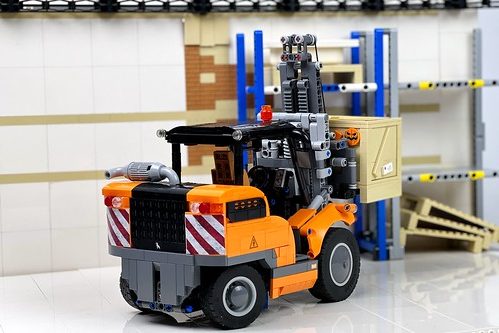
This a motorised forklift truck, it comes from previous bloggee Vladimir Drozd, and it is quite good at squashing Elves.

With a number of our smelly little workers distracted by something shiny, the Elven discoverer of this creation snuck up and dropped a box on them. Because it could.

Doubtless a victim of past smushings, it enjoyed being the perpetrator immensely, and is now happily eating an orange Smartie whilst we patch up the victims.

A pair of Power Functions motors raise and tilt the forklift boom (enabling a brick built box to tip smartly onto those underneath), whilst a further two motors drive and steer the truck itself, and there’s more to see at both Flickr, Eurobricks, and via the video below.

YouTube Video


Retro-Future

The past was very futuristic. This is a CF-104 Starfighter, essentially a Lockheed F-104 Starfighter built under license by Canadair for the Royal Canadian Air Force, and exported to several NATO allies during the 1960s. And it’s very shiny indeed.

The Elves are rather transfixed by it, as – honestly speaking – are we. Perhaps we’re not so different…

There’s more to see of this artfully recreated replica of the ’60s supersonic fighter courtesy of Ryan Harris, and you can join us staring in wonder at his ‘CF-104 Starfighter’ album by clicking here.

Acceptable in the ’80s

And the 2020s it seems, as the once fairly unfashionable Ferrari Testarossa is now a bonafide millionaires’ toy, worth much much more than the entire contents TLCB office car park.

This one comes from Technic-building legend Lachlan Cameron (aka LoxLego), whose Technic recreation of the ’80s supercar includes a full remote control drivetrain, LED lights, custom (and really rather accurate) wheels, working suspension, a flat-12 engine, pop-up headlights, and opening doors, front trunk and engine cover.

There’s much more of the build to see at the Eurobricks discussion forum and on Flickr, plus you can read Lachlan’s interview here at TLCB in the Master MOCers series by clicking here.

*Today’s title song.

Hash Brown

We’re on two wheels today, thanks to Jonathan Elliott and this lovely BMW R80 ‘Cafe Racer’ motorcycle. There’s a brick-built boxer engine, single-shock suspension, and shaft drive constructed from the five-hundred carefully chosen pieces, a good few of which are brown. And brown bikes look ace. Ride to the cafe via the link above.

70cc

…is all you need to move yourself about. And – as anyone that’s familiar with transport methods in many Asian countries will know – not just yourself, but your spouse, children, family dog, and shop. All at once.

The Yamaha 70cc scooter is one of millions and millions that form the backbone of much of the world’s travel, and this 1974 example perfectly captures the simplicity of the real thing.

Built by Marco Gan of Flickr, just a handful of carefully chosen pieces have been used, some of which might be held together by magic.

Climb on board (along with three others, a box of live geese, and shop selling delicious snacks) via the link above, whilst we ready a rather marvellous building competition that celebrates vehicles just like this one…

Wheat Season

It’s wheat season. Not here in TLCB’s home nation, where everything is under a thin layer of ice, but somewhere it probably it is.

Regular bloggee 1saac W. is bringing in the wheat harvest back in the 1950s, with his lovely brick-built Ford 8N tractor and ’49 Chevrolet pick-up.

A neat Technic-pin field of wheat stands behind the classic farm due, and there’s more to see of both the Ford 8N and the Chevy at 1saac’s photostream.

Grab your hay fork and head to 1950s rural America via the link in the text above.

Itsa Me… Anti-Gravity Mario!

People have been lobbing green shells at one another for three decades, and the glorious carnage that is Mario Kart is just as appealing now as ever!

Mario Kart 8 was released in 2014, enabling Mario and his assortment of fellow racers to hover in ‘anti-gravity’ mode for the first time. And you could still lob green shells.

Cue Stephan Froden, who has recreated everyone’s favourite Italian plumber and his anti-gravity go-kart from nearly 23,000 LEGO bricks.

There are LED lights inside as well as motorised movements, and there’s more to see of Stephan’s wonderful homage to Mario Kart 8 at Ryan McNaught’s ‘Brickvention 2022’ album on Flickr, of which Stephan’s model and many other equally stupendous creations are part. Click the link above to lob your green shell!

Life Begins at Forty

Or so say people over the age of forty. For Ferrari, with whom we have a love/hate relationship here at TLCB Towers, Enzo decided to celebrate his brand’s big 4-0 with a spectacular present to itself; a carbon-fibre, twin-turbocharged racing car for the road.

This was back in 1987 too, so the F40 was nothing short of a sensation. 35 years later and Ferrari’s big launch is an SUV…

Still, we suppose it’s not Ferrari’s fault that the best selling Lamborghini (by miles) is an SUV, the best selling Bentley (by miles) is an SUV, and the best selling Porsche (by miles) is an SUV, but the future of cars is looking bleaker by the day.

Which is probably why classic cars like the F40 are worth astronomical sums these days, as people rail against the SUVness of everything new.

Flickr’s LN TEKNIK is the builder giving us license to reminisce about ‘how things were better in the olden days’, with this gorgeous 1:10 scale Technic Ferrari F40.

Equipped with the full suite of Technic Supercar functions, LN’s recreation of the definitive Ferrari includes working steering, suspension, gearbox and engine, plus pop-up headlights, opening doors, and front and rear clam-shells. And some slightly dodgy looking non-LEGO wheels.

Which means in this post we’ve moaned about SUVs, non-standard wheels, and declared that things aren’t as good as they used to be. And the TLCB is only 10 – imagine how grumpy we’ll be in 30 years! Still, life begins then…

Do it Yourself Mr. Bean

Perhaps Mr. Bean’s greatest moment, driving a Mini via string and a mop from a chair mounted on the roof, has featured a here few times in Lego from. None have used this many bricks though!

Certified LEGO Professional Ryan McNaught has used over five thousand pieces to recreate the iconic TV scene, with Bean’s Mini, new armchair, and the man himself all wonderfully captured in brick.

Ryan’s build is part of ‘Brickvention 22’, and a host of other models from the Lego Show – built by a variety of talented creators – join Mr. Bean’s Mini in Ryan’s ‘Brickvention 2022’ album.

Click the link above to take a look at the Mini and the other Brickvention builds, and we’ll be featuring another of our favourites from the show here shortly!

My Other Car’s The Batmobile

Not many people can say that. One really. And we suspect if he knew anyone else was saying it he wouldn’t be happy.

However thanks to TLCB Master MOCer Nico71, you dear readers, can say ‘My Other Car’s the Batmobile’, as this deeply cool hot rod – instructions for which are available – is constructed only from the parts found within the new LEGO Technic 42127 Batmobile set.

There’s working steering, a V8 engine and… er, that’s it. Because to be fair it’s all the 42127 set is equipped with. Plus some unnecessary light-up bricks, but our thoughts on those being a Technic ‘feature’ mirror Batman’s feelings on impersonators.

You can convert your own 42127 Batmobile set into Nico’s hot rod alternate via his excellent website, where building instructions, further imagery and a video are available. Click the link above to take a look.

Commie Combi

This beautiful blue creation is a Lada 1200 Combi / VAZ-2102, one of the defining cars of the communist-era Soviet Union and – in it’s earlier years at least – not actually a bad one.

Produced from 1970 until 1988, the Lada 1200 / VAZ-2102 was based on the Fiat 124, itself still in production and rather good too.

For the licensed version the Soviet engineers raised the Fiat’s ride height, strengthened the chassis, and increased the thickness of the bodywork steel to ensure the car could cope with Russian roads and winters, and replaced the rear disc brakes with aluminium drums, because… er, we don’t know. They were worse.

Anyway, the car was a success, with a million built in the the first three years alone, and exported to many markets where the Fiat version wasn’t already on sale (Fiat didn’t permit Lada/VAZ to compete directly with its own product).

TLCB’s home nation got the Lada 1200 in 1974, when the Fiat 124 was replaced by the newer 131, becoming the first Lada on sale in the market, and likely a brave purchase by consumers during the Cold War.

A thousand Lada jokes would follow, which was a bit unfair as the 1200 was fine, but many were probably as much to do with anti-communist sentiment as they were with automotive quality.

This lovely Model Team recreation of the Lada 1200 Combi / VAZ-2102 comes from Flickr’s Legostalgie, whose wonderful Lego replicas of Communist cars have appeared here numerous times so far. His latest captures the Lada brilliantly, with superbly accurate bodywork, opening doors, hood and tailgate, a life-like interior and engine, and even a trunk on the roof-rack.

There’s lots more to see Legostalgie’s ‘Lada 1200 Combi / VAZ-2102’ album on Flickr, and you can head to the Communist-era Soviet Union (or the United Kingdom) c1974 via the link in the text above.

Don’t Mention the War II

For some reason people don’t seem to like it when Germany and Japan collaborate. What? We’ve already done that joke today? Damn…

Moving on, this is the fifth generation Toyota Supra, a frankly wonderful looking sports car widely hated by the internet for being a partnership between BMW and Toyota. Which means of course that it’s rather excellent.

This spectacular Technic recreation of the internet’s least favourite collaboration is the work of Jeroen Ottens, who was commissioned to replicate the A90 Supra’s wild bodywork in brick form.

Not only has Jeroen done that, he’s included a working 6-cylinder engine linked to the rear wheels, an 8-speed gearbox, independent suspension, and working steering, plus opening doors, tailgate and hood.

It’s a fantastic creation, and – whether you’re a xenophobic internet commenter or can appreciate a good car regardless of badge stamped into the components – one that’s worth a closer look.

Head over to Flickr or Eurobricks for full build details, further imagery, and the potential for “That’s not a Supra”/”Nice BMW” comments.

Don’t Mention the War

This bizarre looking vehicle is a Porsche 356 Carrera GTL Abarth, a lightweight racing car from 1960 resulting from a rare collaboration between Germany and Italy.

Previous partnerships between the two European powers were – thankfully for mankind – disastrous failures, but the Porsche 356 Carrera GTL Abarth was… OK, not great either.

It overheated, the steering couldn’t turn enough, and there were a few ‘differences of opinion’ between Porsche and Abarth when it came to acceptable build quality.

However unlike their 1940s effort, the two nations persevered and re-engineered the 356 Carrera GTL to the point where it became a rather excellent racing car, successfully competing across Europe and taking three consecutive class wins at Le Mans.

This neat Model Team recreation of the German-Italian racer comes from Tim Inman, who has managed to replicate the 356 Carrera GTL’s decidedly odd bodywork in brick form.

Opening doors and a lifting engine cover reveal a detailed interior and rear-mounted engine respectively, and there’s more to see of Tim’s Porsche 356 Carrera GTL Abarth at his photostream.

Click the link above to join the Axis Powers’ 1960 campaign, which was a lot better than their 1940 effort…

Sharknado

Sharks are definitely not cut out for life on land. No-one told the makers of Sharknado though, who managed to extract such cinematic brilliance from the premise that a further five films have followed. If they keep going surely eventually one’s going to win an Oscar.

Anyway, enough on the tragic state of film-making – here’s another fictional land-based shark – but unlike the aforementioned cinematic disgraces, this one is most excellent.

Previous bloggee Martin Vala is the builder behind this ‘Shark’ Dakar concept, and fictional though it may be it looks so real we had to look it up to check it didn’t actually exist. Like a Sharknado Oscar though, it definitely doesn’t, which makes it all the more impressive that the design originated from the inside of Martin’s head.

There’s much more of the build to see at Martin’s ‘Shark T1+’ album on Flickr, and you can swim over via the link in the text above.