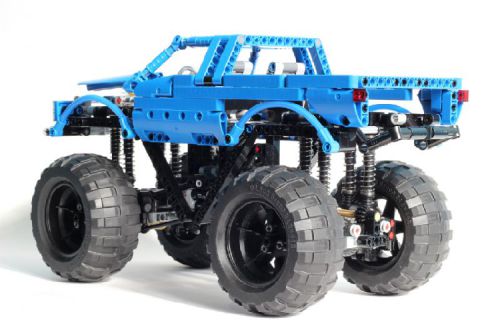
Never has a vehicle found by one of Elves been more… Elven. Well, maybe if paave‘s Technic Bigfoot monster truck was remote controlled, but weary of past smushings we’re rather thankful that it isn’t.
Based on a 1974 Ford F-250 pick-up truck, the original ‘Bigfoot’ was, like all the best inventions, built by a man in his shed. After a motorsports promotor saw a video of the truck crushing some old cars in a field he asked Bigfoot’s creator, Bob Chandler, if he wouldn’t mind repeating the stunt in front of a paying audience. Bob tentatively agreed and the rest is history, with Ford even sponsoring the truck from the early ’80s.
Paave’s Technic recreation of Bob’s F-250 probably won’t be crushing any cars, but it is just as technically capable, with accurate four-wheel steering, four-wheel drive, and four-link axles with enormous suspension travel. Head over to MOCpages with a warm beer and a footlong hot-dog to see more of paave’s creation.
From the sophisticated beauty of yesterday’s post to… well, a big red truck. But what Damian Plesniak (aka damianple)’s Technic truck lacks in fancy Model Team detailing it more than makes up for with its superbly engineered working functions.
Underneath the blocky Renault Magnum-esque exterior lies a range of mechanical features, including a tilting cabin with suspended seats, a V6 piston engine, all-wheel suspension and a locking trailer hitch.
Damian’s creation also includes the obligatory remote control drive and steering courtesy of a brace of Power Functions motors, with a further two motors powering the lifting third axel and a clutch to disengage the drive to it when it’s raised.
There are lots more images of Damian’s remote control Technic truck to view at Brickshelf and Flickr, plus you can read more about the build and watch a video of the truck in action at the Eurobricks discussion forum here.
This astonishing creation comes from one of our very favourite builders, TLCB Master MOCer and published author Dennis Glaasker aka BricksonWheels. It’s a 1935 Duesenberg SJ Dual Cowl Phaeton, one of the most expensive and luxurious cars ever made.
With a supercharged 6.8litre straight-eight engine producing 320bhp (a huge figure for 1935) the SJ Phaeton cost around thirtytimes that of a regular car, and today commands a price well into the millions. Driven by movie stars and the social elite, just 36 Duesenberg SJs were made before the Great Depression and the Second World War put an end to the production of super-luxurious vehicles.
Dennis Glaasker’s incredible Lego recreation of the 1935 SJ Duel Cowl Phaeton is a near-prefect replica of the original car, and contains over 5,000 pieces, many of which have been professionally chromed, and 5,200 pieces in both open and closed roof configurations.
The pig-nosed driver of this Ferrari 312 isn’t taking any prisoners with that move. Under Bernie Ecclestone’s helm Formula 1 would see said combatant confined to the pits for ‘causing a collision’, but this is 1967, and rules were for sissies.
The car the Ferrari has swiped has appeared here at TLCB before, a Brabham BT24, and it’s now pictured alongside the latest build by Flickr’s Pixel Junkie in this wonderfully nostalgic Formula 1 scene.
It’s Brabham that went on to win the 1967 Formula 1 World Championship, despite having a slower car than the Lotus of the time, whilst Ferrari finished a lowly fifth. Ferrari may have lost the battle in ’67, but it is they who won the war, with Brabham fading into history whilst the prancing horse has gone on to win almost twice as many titles as any other team.
Being British we prefer the outcome in ’67 though, so we’ll leave this post with a picture of the Brabham BT24 rightfully back in front of the Ferrari 312, and you can us find at Pixel Junkie’s photostream feeling patriotic.
One of the most common comments we receive here at The Lego Car Blog, along with ‘Can I have instructions?’ and ‘Send nudes’, is ‘why don’t you feature more digital creations?’.
Well in answer, we’re a blog about Lego models, and a digital creation is not a Lego model. It’s a picture of one. However, every so often a digital creation comes along that is worth flexing our rules for… this is one such time.
This wonderful Speed Champions style 1970 Ferrari 512S Longtail was discovered on Flickr and it comes from TLCB newcomer Alan Guerzoni. Alan has faithfully replicated Ferrari’s glorious Le Mans racer beautifully in digital bricks, and he’s gone a step further by designing and adding period-correct decals to the render – something he’d have been unable to do if the model was build from real pieces.
We’d still rather Alan’s Ferrari 512S was constructed using actual LEGO though, and fortunately it can be – awesome decals included – thanks to the LEGO Ideas platform, where the Ferrari is currently available to support in Alan’s quest to see it become an official LEGO set.
With LEGO already partnered with Ferrari and the 512S Longtail slotting neatly in the Speed Champions line-up we think it stands a very good chance of making the cut. There are more images to see at Alan’s Flickr photostream via the link above, and you like what you see you can cast your vote on LEGO Ideas by clicking here.
This glorious vintage roadster by Flickr’s Galaktek was discovered by one of our Elves today, and we’re pretty sure it is absolutely not their cup of tea. Smooth, restrained, classy… literally none of the qualities that our Elven workforce would choose in a vehicle. But the discovering Elf knows its masters rather well, because it is absolutely our cup of tea. TLCB Staff are a civilised bunch you see.
Unusually coloured in cream and tea hues, Galaktek’s roadster looks the perfect car in which to take a jaunt to the country club for a, well… cream tea. The closest this TLCB writer is going to get to that vision is drinking a can of Red Bull alone in the stationary cupboard, so whilst he partakes in a slightly tragic but harmless fantasy you can check out more of Galaktek’s model at his photostream via the link above.
Tammo S.‘s colourful sci-fi hovercraft has run into some problems in the snow. Indeed snowflakes from the crash-landing still spatter its windscreen. Fortunately the pilot has found a nicely-shaped chunk of Lego ice floe to land on. He’s come prepared with a cooking stove and tools to fix the fault too. If he really gets stuck, he can always shelter in the well appointed cockpit that has been provided with lots to read and unusually, a potted plant.
Click here to see more details. Alternatively, as it’s sci-fi on The Lego Car Blog, click here for today’s tenuous link to British pop music.
After a productive day here in TLCB Towers – with several Elves successful and fed – this rumbled into the office. Powered by two Power Functions XL motors, with eight wheel drive, four wheel steering, a straight six engine, a two speed gearbox, and some of the tricksiest suspension we’ve ever seen, pipasseyoyo‘s 8×8 military truck had the potential to undo the peace in a big way.
Fortunately for us, both of the truck’s two speeds are slow, meaning a mass Elven smushing was never on the cards. However the model’s enormous load bed and high torque makes it the perfect vehicle for transporting a collection of whooping Elves around the office. Whilst we do that (we are nice sometimes) you can see more of pipasseyoy’s hugely impressive creation on Brickshelf via the link above, and you can watch it in action with some suitably hardcore music courtesy of the video below.
The Gloster Meteor is one of this writer’s very favourite aircraft. And that’s probably the nerdiest line ever said in human history. Anyway, it is. Because look at it.
The Meteor was the Allies first jet-powered aircraft, and the only one to enter service during the Second World War. Powered by two Rolls-Royce Welland turbojet engines designed by the engineering genius Sir Frank Whittle, the meteor became the fastest aircraft of the time, breaking numerous speed and climbing records.
The Meteor was flying on the very edge what what was achievable in the 1940s, and thus hundreds of the aircraft (and the pilots that flew them) were lost to accidents, mechanical failures and fuel starvation (the Meteor could only fly for an hour at most). However, the Meteor was also fast enough to catch and destroy the V1 flying bomb in flight, and destroyed 46 German aircraft on the ground by the end of the war. The Meteor wasn’t permitted to fly over land in German occupation though, so great was the fear of the aircraft being captured and its secrets being learned.
After the war the incredible rate of jet aircraft development meant the Meteor quickly become obsolete, ending its days as a target tug, but without the Meteor’s pioneering technology it could have been many more years before jetting off on holiday became a realistic possibility for millions of people.
This beautiful recreation of a the Gloster Meteor in Royal Danish Airforce livery comes from previous bloggee Henrik Jensen, and it captures the iconic shape of the real aircraft brilliantly. There’s more to see of Henrik’s build at MOCpages and Flickr where Henrik has made the internal secrets of his model available to view. Even if you’re German.
LEGO’s official 10248 Ferrari F40 set received an excellent review here at The Lego Car Blog. However, it is a set that may be out of reach for many due to its fairly hefty pricing. Well fear not, because Amaman may have the answer.
LEGO’s 31070 Turbo Track Racer set is around half the price of its Ferrari counterpart, but contains all the pieces you need (plus a few you don’t) to build a wonderful Ferrari F40 replica. Amaman’s excellent F40 recreation is accurate enough it could be passed off as an official set in its own right, and when you’re bored with it 31070 provides a wealth of parts to build countless other vehicular creations.
You can check out Amaman’s 31070 Alternative Ferrari F40 on both MOCpages and Flickr, and you can see two alternate 31070 alternates by clicking here and here. Then go and buy the set and see what you can create!
It’s been a while since we featured a vehicle from Mad Max – Fury Road, but thanks to a reader we’re back in the apocalyptic wastelands of George Miller’s 2015 epic. The Elves – despite not finding this creation themselves – are watching a screening of the movie in their cage room, so we can probably expect extreme violence from them tomorrow. In the meantime let’s take a closer look at today’s build.
Based on an AM General M814 military truck with a Mercedes-Benz W123 limousine body mounted atop it, this is the ‘People Eater’s Limousine’. Like all the vehicles from the movie the truck/limo hybrid was built for real, using two salvaged Mercedes-Benz limousines due to be scrapped by a wedding car company.
In the film the truck is used by the Mayor of Gastown as his own personal transportation and can also refine oil on the move, allowing his business to continue earning revenue even while he traverses the desert between Gastown and the Citadel. A smart man then, but he also wears nipple-clamps at all times, so that probably cancels out.
Nipple-clamp wearing businessman aside, this Lego recreation of the People Eater’s Limousine is about an accurate a replica of a Mad Max – Fury Road vehicle as we’ve seen yet, and includes a highly detailed engine, a perfectly replicated interior, and the two oil-refining trailers in tow.
It’s the work of Scott of Flickr and there’s a huge gallery of images available to view at his photostream, which also includes some of the other vehicles from the Mad Max – Fury Road film. Click on the link above to make the jump to Scott’s photostream, and if you want to see what happened to the real vehicle (clue: fire and explosions!) then click here!
This glorious 1980s Porsche 911 Targa comes from very probably the most talented vehicle-building pairing anywhere on the ‘net. The Avro Brothers have been constructing some of the world’s best Lego vehicles for some time, with this particular model debuting almost a decade ago. The brothers’ classic Porsche 911 Targa is surely one of the most perfectly realistic Lego replicas ever built, and now you can build it too.
For once the most frequently asked question of them all here at The Lego Car Blog (‘Can I have instructions?’) can be answered with a resounding Yes, as The Avro Brothers have produced detailed step-by-step building plans which are due to be made available via their new website. In just over 150 pages and just under 900 pieces you could build your own stunning 1980s Porsche 911 Targa. Get started by visiting The Avro Brothers’ Porsche 911 Flickr album via the link above, click on one of the images, and follow the links.
Yes it’s no use saying that you don’t know nothing
It’s still gonna get you if you don’t do something
Sitting on a fence that’s a dangerous course
Oh, you could even catch a bullet from the peace-keeping force
Even the hero gets a bullet in the chest
Oh yeah, once upon a time in the west
Our obscure British music theme continues here at The Lego Car Blog. If that’s not your thing (and if it isn’t, take a long look at yourself), perhaps try this alternative. Oh, the model! This superb Western train robbery scene comes from Flickr’s markus19840420 (there must be a lot of Markuses on Flickr) and there’s more to see by clicking here.
Normally a mixture of Elves and remote control vehicles heralds chaos and destruction across The Lego Car Blog’s offices. Fortunately this excellent model from Arran Hearn lacks the Power Functions that our workforce require for “fun”. It’s left to us to enjoy the look of the build and neat connections that make its shock absorbers. As well as the control unit in the background of the photo, Arran has built a full-sized radio control unit in Lego. Click on the link in the text to see Arran’s work or click here for today’s British pop song in the title.
If you were surprised that yesterday’s find resulted in no Elven carnage, so were we. Fast, nimble and easily controllable from a bluetooth device, Anto’s remote control Citroen World Rally Car would have been the perfect tool to – if not drive over Elves – at least splat them against the corridor walls. But fear not readers, the Elves are back on form today.
This brutal-looking Jeep Wrangler Expedition is neither fast nor nimble, but it is a hugely capable machine. Powered by an on-board LiPo battery, two XL motors drive all four wheels whilst two L motors power the steering and a front-mounted winch. Working lights and monster suspension complete the list of functions, equipping the Jeep for the tough off-road competition for which it was built.
We don’t know how the Jeep fared in the aforementioned event, but if the carnage here at TLCB Towers is anything to go buy, we suspect it did quite well.
Knowing it isn’t the fastest creation, the discoverer Elf waited until nightfall to unleash the Jeep on its unsuspecting colleagues. Many of TLCB Elves sleep in their cages. A sign of their oppression they may be, but a cage-based Elf is usually a safe Elf. However, some of the Elves had taken their chances, simply falling asleep in various poses on the cage room floor. These Elves were not safe. Not safe at all.
Unable to wake and run fast enough, the Jeep made easy work of the snoozing Elves. By the time we reached the cage room at least a dozen had been flattened and one was still desperately clinging the the bumper in a bid to avoid the Jeep’s balloon tyres before Mr. Airhorn put an end to the rampage.
Delighted with its success the lucky Elf at the controls bounded off into the night, leaving us to tidy up the mess. We have Horcik Designs to thank for our troubles, and you can see further images and details of his remote control Jeep Wrangler Expedition at both the Eurobricks forum and Horcik’s Flickr album.
Click the links above to take a look, and you can watch the Jeep in action off-road via the video below.